
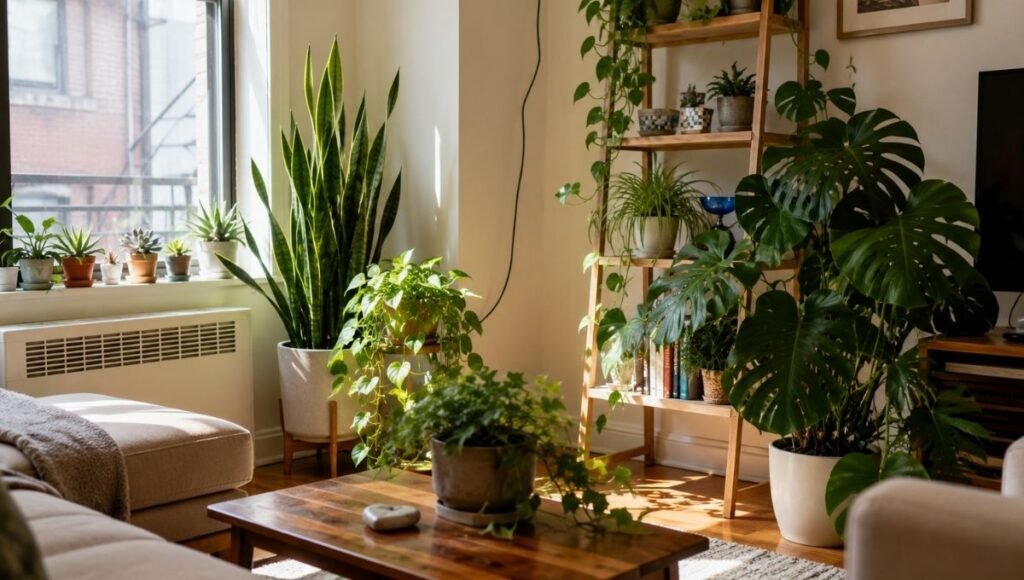
Here’s the thing about indoor plants that nobody tells you upfront: there is no universal care routine. The schedule that keeps your snake plant thriving will slowly drown your calathea. The bright window that makes your basil flourish will bleach your pothos. The watering frequency that works in July is wrong for December.
Most beginners fail not because they don’t care enough — they often care too much — but because they’re applying generic rules to plants that have very specific, very different needs. A snake plant sitting in soggy soil because its owner “watered it twice a week like the tag said” is one of the most common, most preventable plant tragedies in existence.
This is the guide that fixes that. It covers the foundational principles of indoor plant care that apply to every plant you’ll ever own — light, water, soil, humidity, feeding, and troubleshooting — plus links to the specific care guides for the most popular houseplants. Think of it as the operating manual you didn’t get when you bought your first plant.
Key Takeaways
- Overwatering kills more houseplants than every other cause combined — more than pests, bad light, or poor soil
- Light is the most important variable in indoor plant care, and the one most commonly misread — a room that feels bright to human eyes may provide less usable light than a plant needs
- Every plant has a “native environment” that explains its care needs — understanding where a plant comes from makes its requirements make sense rather than feeling arbitrary
- A 2022 scoping review in Environmental Research confirmed that indoor plants in living spaces are consistently associated with reduced stress, improved mood, and stronger sense of wellbeing — your plants are doing something real for you
- The single most effective care habit: check soil moisture with your finger before every watering, without exception
Why Most Houseplant Advice Fails Beginners
Most indoor plant care guides are written as if all plants are basically the same. Water once a week. Give bright light. Feed monthly. Done.
But a snake plant and a calathea are about as similar in their needs as a cactus and a fern. One evolved in dry, rocky African hillsides; the other on the floor of a South American rainforest. Applying the same care to both will make one of them deeply unhappy, and probably kill it.
The more useful approach is to understand the principles behind plant care — why light matters, what overwatering actually does to roots, why different plants need different humidity levels — and then apply those principles to whatever specific plant you have. This guide gives you those principles. The specific care guides at the bottom give you the plant-by-plant details.
The Foundation: Where Your Plant Comes From Explains Everything
Before we talk about watering schedules or fertilizer types, here’s the single most useful thing you can know about any houseplant: its native environment.
- A snake plant from the dry rocky hillsides of West Africa needs infrequent watering and tolerates low light because those are the conditions it evolved in.
- A monstera from the shaded rainforests of Central America needs warm temperatures, humidity, and filtered light — not direct sun — because that’s what the forest canopy provides.
- A cactus from a Mexican desert wants bright sun, bone-dry soil, and almost no water — because that’s survival in an arid climate.
- A pothos from the Solomon Islands grows in the dim, humid understory of tropical forests — which is why it thrives in exactly the kind of indirect light that fills most apartments.
When a care requirement seems strange or inconvenient — “why does this plant need misting every day?” — the answer is almost always in the plant’s origin. Understanding this doesn’t just help you memorize rules; it helps you predict what a plant needs in situations its care guide didn’t anticipate.
Indoor Plant Care: Light
Light is the engine of plant growth. Without adequate light, a plant cannot photosynthesize, cannot produce energy, cannot grow — and eventually cannot maintain itself. Light is the one resource you cannot substitute or work around.
How Much Light Does Your Plant Actually Get?
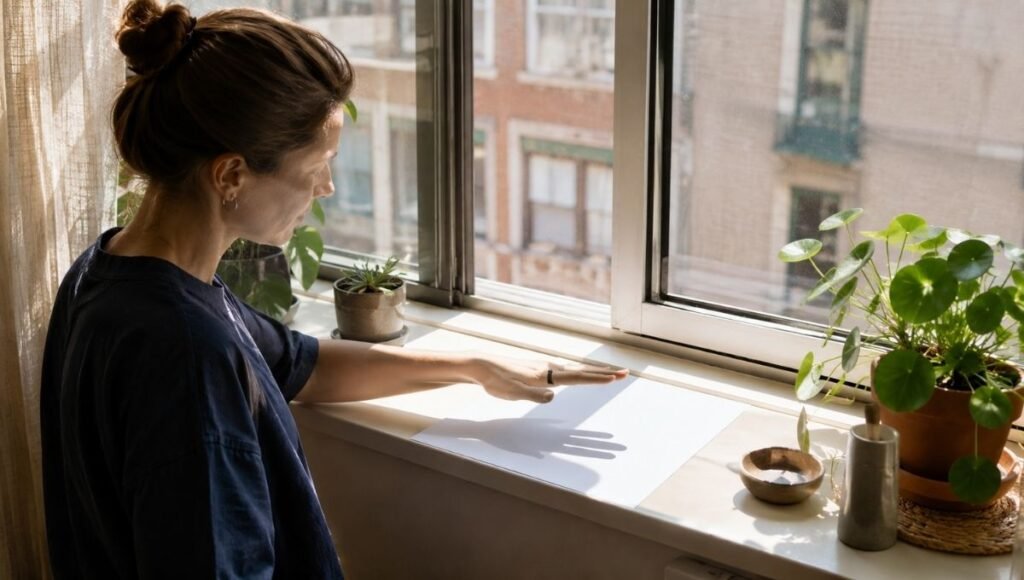
This is where most beginners go wrong. A room that feels bright and pleasant to human eyes may be providing significantly less usable light than a plant needs. Our eyes adapt to light levels in ways that make dim rooms feel brighter than they are. Plants don’t adapt — they either get enough light to function, or they don’t.
The practical test: hold your hand about a foot above a white piece of paper in your growing spot around noon. A sharp, clear shadow means adequate light for most plants. A faint shadow means medium light. No visible shadow means low light — and the range of plants that will thrive there is narrow.
By window direction:
South-facing windows receive the most direct sun throughout the day — the premium position for sun-loving plants like succulents, cacti, herbs, and many flowering plants.
East-facing windows get bright morning sun and softer afternoon conditions — excellent for most tropical houseplants including pothos, monstera, peace lily, and most herbs.
West-facing windows receive afternoon sun, which can be intense in summer — good for most plants, but watch for leaf scorch on sensitive species in peak summer months.
North-facing windows receive the least light — no direct sun. The range of plants that genuinely thrive here is limited: ZZ plants, snake plants, pothos, and low-light ferns manage best.
Light Terms Explained Simply
Direct sun: sunlight hitting the leaves directly, no obstruction. Bright indirect light: near a window, can see the sky, but sun rays don’t hit leaves directly. Medium light: a few feet from a window, enough to read comfortably. Low light: no direct sun, away from windows, artificial light only.
Grow Lights: The Solution for Dark Spaces
If your space doesn’t provide adequate natural light, a full-spectrum LED grow light changes what’s possible. Modern LED grow lights are efficient, affordable (often $15–$40), and effective. Position 4–8 inches above the plant and run for 12–14 hours per day. This is the practical solution for north-facing apartments, basement spaces, or any room where natural light is genuinely insufficient.
Indoor Plant Care: Watering
Overwatering is the leading cause of houseplant death. Not pests. Not insufficient light. Not bad soil. Watering too frequently — or watering on a fixed schedule without checking whether the plant actually needs it — kills more plants than everything else combined.
Why Overwatering Is So Destructive
Plant roots need two things to function: water and oxygen. Healthy soil contains tiny air pockets between particles that allow roots to breathe. When soil stays consistently wet, those air pockets fill with water. Roots lose access to oxygen, weaken, and become vulnerable to fungal infection — this is root rot. By the time yellow leaves or mushy stems appear above ground, the root system is often already significantly damaged.
The cruelest irony: overwatered plants show the same symptoms as underwatered plants — wilting, yellowing, drooping. This leads many beginners to water more when the plant is actually drowning. Always check the soil before adding water.
The Universal Watering Rule
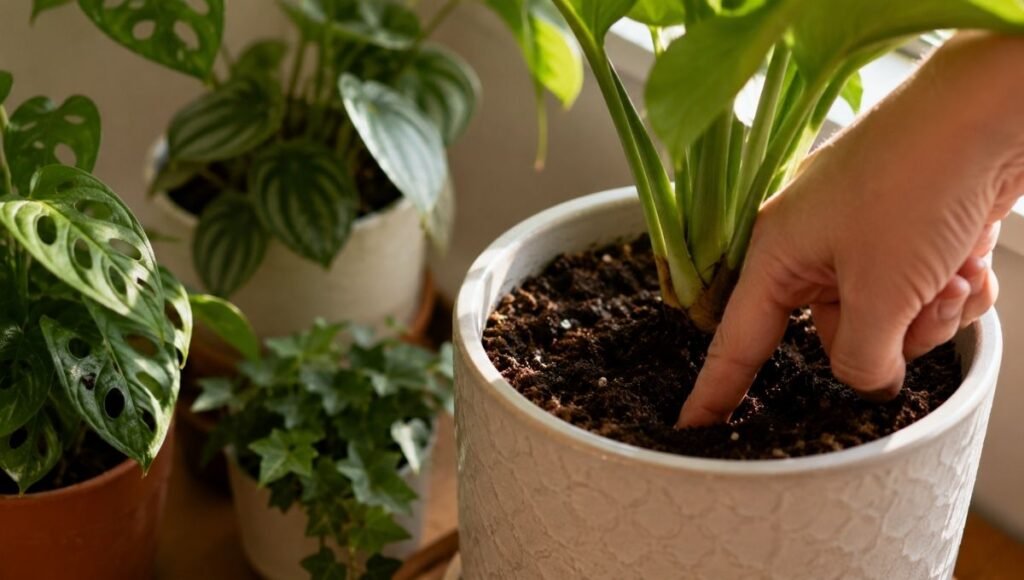
Press your finger 1–2 inches into the soil. If it feels moist at all, don’t water. If it’s dry, water thoroughly until it drains from the bottom.
That single habit — checking before watering — prevents the majority of all houseplant deaths. It takes five seconds. It is worth more than any fertilizer, any grow light, or any expensive potting mix you can buy.
How Often to Water: A General Framework
This varies enormously by plant type, pot size, season, and your home’s conditions. But as a starting framework:
Water more frequently: tropical plants with large leaves (monstera, peace lily, calathea), plants in terracotta pots (which dry faster), plants in summer heat or near sunny windows, plants in active growth.
Water less frequently: succulents and cacti, snake plants, ZZ plants, plants in plastic or glazed pots, plants in winter dormancy, plants in low-light conditions.
Seasonal adjustment: most houseplants need significantly less water in autumn and winter, when growth slows and light decreases. A plant that needed watering every 7 days in June may only need watering every 14–21 days in December. The soil test remains your guide — never the calendar.
How to Water Properly
Water slowly and thoroughly — not a quick splash. The goal is to moisten the entire root zone, not just the top inch. Water until it drains freely from the drainage holes at the bottom of the pot, then stop. Empty any saucers after watering — roots sitting in standing water develop rot.
Morning watering is best when possible — it gives foliage time to dry and sets plants up for the day’s growth.
Bottom watering (setting the pot in a tray of water for 20–30 minutes, then draining) ensures even moisture throughout the root ball and is particularly good for plants that dislike wet foliage (african violets) or for pots where soil has dried out and become hydrophobic.
Water Quality
Most houseplants tolerate standard tap water without issues. Sensitive plants — particularly peace lilies, calatheas, spider plants, and pothos — can develop brown leaf tips from fluoride and chlorine in tap water over time. For these, use filtered water or let tap water sit in an open container overnight before use (which allows chlorine to dissipate).
Indoor Plant Care: Soil
The soil you put a plant in determines how well everything else works. The right potting mix drains adequately, holds enough moisture for roots to absorb, and allows air circulation around the roots. The wrong mix — typically something too dense or compacted — creates the waterlogged conditions that lead to root rot regardless of how carefully you water.
Never Use Garden Soil in Pots
This is the most important soil rule. Garden soil, when placed in a container, compacts with every watering, blocks drainage, and suffocates roots. It also frequently brings in pests and soilborne diseases. Always use potting mix specifically formulated for container plants.
Choosing the Right Mix
Standard all-purpose potting mix works for most tropical houseplants: pothos, monstera, peace lily, philodendron, rubber plant, money tree.
Cactus and succulent mix (or standard mix with 30–50% added perlite) works for drought-tolerant plants: snake plant, ZZ plant, aloe vera, jade plant, succulents and cacti.
Moisture-retentive mix with added coconut coir works for humidity-loving plants: calathea, ferns, Boston fern.
The Role of Perlite
Perlite — those small white particles in potting mix — is not a fertilizer. It’s a type of volcanic glass that improves drainage and aeration. Adding more perlite to any potting mix makes it drain faster and dry out sooner, which suits plants that prefer drier conditions. This is the easiest DIY soil improvement available.
Indoor Plant Care: Pots and Drainage
Drainage holes are not optional. A plant in a pot without drainage holes will eventually develop root rot, no matter how carefully you water — there’s simply nowhere for excess water to go.
If you love a decorative pot without drainage holes, use it as a sleeve: keep the plant in a plain nursery pot inside the decorative one. Remove the nursery pot to water over a sink, drain fully, then return. This gives you the aesthetics without sacrificing drainage.
Pot Materials and What They Mean for Watering
Terracotta (unglazed ceramic): porous walls allow moisture to evaporate through the sides, helping soil dry faster. Better for plants that prefer drier conditions (succulents, snake plants, jade). Requires more frequent watering because it dries faster.
Plastic: retains moisture well, lightweight, affordable. Better for plants that prefer consistent moisture (calathea, ferns, peace lily). Dries more slowly — reduce watering frequency compared to terracotta.
Glazed ceramic: retains moisture like plastic, heavier, often more attractive. Good for most houseplants. Similar watering needs to plastic.
Fabric grow bags: excellent drainage and air pruning of roots. Dries quickly — good for plants that need excellent drainage. Primarily used for edible plants and container vegetables.
When to Repot
Repot when:
- Roots are visibly growing from drainage holes
- Soil dries out unusually fast after watering
- The plant looks visibly too large for its pot
- Growth has stopped despite good light and consistent watering
Go up one pot size only — 1–2 inches larger in diameter. Too-large pots hold excess wet soil around roots, which invites root rot. Repot in spring when plants are entering active growth. After repotting, hold off on fertilizing for 4–6 weeks — fresh potting mix already contains nutrients.
Indoor Plant Care: Humidity and Temperature
Humidity
Many popular houseplants — particularly tropical species — evolved in high-humidity environments and prefer more moisture in the air than most homes provide, especially in winter when heating systems run.
Signs of insufficient humidity: brown, crispy leaf tips and edges; leaves curling inward despite adequate soil moisture; plants that look stressed in winter but recover in summer.
How to increase humidity:
- Place pots on a pebble tray filled with water (water level below the pot bottom — you’re creating evaporation, not root contact with water)
- Group plants together — they create a shared microclimate of higher humidity through transpiration
- Use a small humidifier near your plant collection
- Place humidity-loving plants in naturally humid rooms (bathrooms with good light, kitchens)
Plants that specifically need higher humidity: calathea, ferns, peace lily, monstera, pothos. Plants that prefer lower humidity: succulents, cacti, snake plant, ZZ plant, aloe vera.
Temperature
Most houseplants thrive in temperatures between 60–80°F (15–27°C) — standard indoor room temperature. What they dislike is fluctuation:
Avoid: cold drafts from open windows or exterior doors in winter; direct airflow from air conditioning or heating vents; temperatures below 50°F (10°C) for most tropical plants; hot glass in direct afternoon summer sun.
The placement principle: if a spot feels uncomfortable to you — too cold, too hot, too drafty — it’s probably uncomfortable for your plant too.
Indoor Plant Care: Feeding
Plants need nutrients to grow, and container plants lose those nutrients with every watering — leached out through the drainage holes. Regular feeding during active growth replaces what’s lost and supports healthy development.
When to Feed
Feed: spring through early autumn, when plants are actively growing. Stop feeding: late autumn through winter, when most houseplants slow or stop growing. Fertilizer applied to a resting plant accumulates as mineral salts in the soil, which causes root damage and brown leaf tips.
What to Feed
A balanced liquid fertilizer (look for roughly equal N-P-K numbers, like 10-10-10 or 20-20-20) works for most houseplants. Apply every 4–6 weeks during the growing season at the recommended strength.
For flowering or fruiting plants (orchids, tomatoes, strawberries), switch to a higher-potassium formula during flowering to support bud and fruit development.
Less is more: over-fertilizing causes root damage from salt accumulation, visible as brown leaf tips. When in doubt, feed less frequently or at half strength rather than more.
Reading Your Plant: What Leaves Are Telling You
Plants communicate through their leaves. Learning to read the signals correctly is the difference between solving a problem early and discovering root rot only when it’s severe.
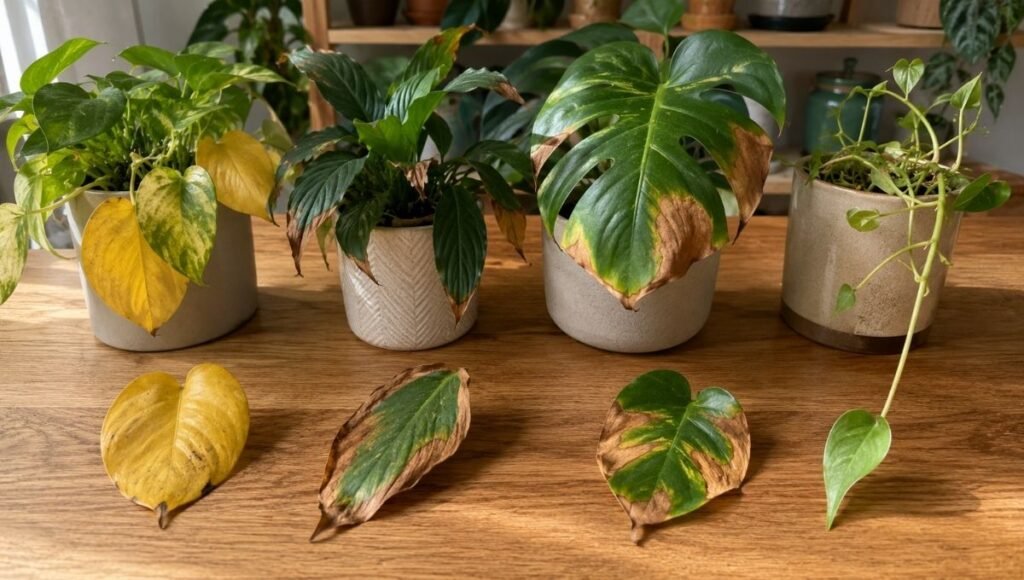
Yellow Leaves
The most common signal — and the one most often misread.
Yellow leaves almost always mean overwatering or root rot. Roots are failing to deliver nutrients to the leaves because they’re damaged by excess moisture. Stop watering, check drainage, and inspect roots if yellowing is rapid or widespread.
Less commonly: insufficient light (gradual yellowing of lower leaves), nitrogen deficiency (if watering is correct and soil is appropriate), or natural aging of the oldest leaves (occasional, not concerning).
Brown Leaf Tips and Edges
Crispy, dry brown tips: usually low humidity, fluoride/chlorine in tap water, or accumulated fertilizer salts. Switch to filtered water, increase humidity, and flush the soil periodically.
Brown edges with soft, yellowing adjacent tissue: often overwatering or root damage.
Scorched brown patches on sun-facing leaves: too much direct harsh sunlight.
Drooping or Wilting
Soil is dry → underwatering. Water thoroughly; most plants recover within hours.
Soil is wet → overwatering or root rot. Stop watering. Inspect roots. The plant is drooping because damaged roots can’t deliver water to leaves, even though soil is saturated.
Leggy, Stretched Growth
The plant is reaching for more light. Stems grow long and thin, leaves are spaced far apart, the plant leans toward the nearest window. Solution: move to a brighter position or add a grow light.
Leaf Drop
Leaves detaching and falling (rather than yellowing in place) usually indicates: insufficient light, a sudden environmental change (being moved, a cold draft, new home), or overwatering in the early stages.
Common Indoor Plant Pests: How to Spot and Handle Them
Pests are rarely the primary cause of a plant’s decline — they’re usually opportunistic, moving in when a plant is already weakened. But once established, they can accelerate decline significantly.
Fungus gnats — tiny flies hovering around soil. Their larvae eat fine root hairs. Prevention: let soil dry out more thoroughly between waterings (breaks their breeding cycle). Treatment: yellow sticky traps for adults, reduce soil moisture.
Spider mites — fine webbing on leaves and stems, tiny dots moving on leaf undersides. Prefer dry conditions. Treatment: increase humidity, spray leaves with water, apply insecticidal soap or neem oil every 5–7 days for 3–4 weeks.
Mealybugs — white cottony clusters on stems and leaf joints. Treatment: cotton swab dipped in 70% isopropyl alcohol applied directly to colonies, followed by insecticidal soap spray.
Scale — brown bumps on stems that look like part of the plant. Scrape off with a soft toothbrush, treat with neem oil or insecticidal soap.
The first step with any pest: isolate the affected plant immediately to prevent spread to neighboring plants.
Seasonal Indoor Plant Care: How Needs Change Through the Year
Your indoor plant care routine should change with the seasons — and many plant problems happen specifically because people don’t adjust.
Spring (March–May): growth resumes. Resume regular watering frequency. Start feeding. This is the best time to repot, propagate, and prune. Move plants closer to windows as light intensity increases.
Summer (June–August): peak growing season. Increase watering frequency as temperatures rise and evaporation increases. Feed every 4–6 weeks. Watch for heat stress from direct afternoon sun through glass.
Autumn (September–November): growth slows. Begin reducing watering frequency. Taper off feeding by early October. Bring any plants that summered outdoors back inside before nighttime temperatures drop below 50°F. Check for hitchhiking pests before bringing outdoor plants inside.
Winter (December–February): most plants enter semi-dormancy. Reduce watering significantly — many plants need half as much water as in summer. Stop feeding entirely. Humidity drops due to heating systems — watch for brown leaf tips. Supplement light if natural light levels are very low.
If You Only Have 10 Minutes to Improve Your Plant Care Right Now
Do three things:
1. Check every plant’s soil. Any that are moist — don’t water today. Any that are dry — water thoroughly.
2. Look at where each plant is positioned relative to your windows. Any that are more than 6 feet from a window and not getting 4+ hours of light — move them closer.
3. Check under a few leaves for any webbing, spots, or tiny moving insects. Early detection of pests prevents them from spreading.
That’s it. Ten minutes. Those three checks, done regularly, will prevent the majority of common houseplant problems.
FAQ
What is the most common reason houseplants die? Overwatering. More houseplants die from too much water than from every other cause combined. The mistake isn’t usually giving too much water in one watering — it’s watering too frequently, before the soil has dried out enough. Check soil moisture with your finger before every watering.
How do I know when to water my plants? Check the soil. Press your finger 1–2 inches into the potting mix. If it’s moist at all, wait. If it’s dry, water thoroughly until it drains from the bottom. This simple test is more accurate than any watering schedule, app, or rule of thumb.
Why are my houseplant leaves turning yellow? Almost always overwatering or root rot. Check soil moisture and drainage. Less commonly: insufficient light, nitrogen deficiency, or natural aging of the oldest leaves. See our full guide: [Plant Leaves Turning Yellow? 7 Real Causes and How to Fix Them].
What is the easiest houseplant for a complete beginner? Pothos or snake plant. Both tolerate low light, irregular watering, and beginner mistakes better than almost any other houseplants. Start with one of these, learn its rhythms, then expand your collection.
Do indoor plants need fertilizer? Yes — particularly during spring and summer. Container plants lose nutrients through drainage with every watering. A balanced liquid fertilizer applied every 4–6 weeks during active growth supports healthy development. Stop feeding in autumn and winter.
How do I increase humidity for my plants? Group plants together (they raise humidity through shared transpiration), place pots on pebble trays with water, or use a small humidifier near your plant collection. Misting provides brief benefit but doesn’t significantly raise ambient humidity.
When should I repot a houseplant? When roots are growing from drainage holes, soil dries out unusually fast, or growth has stalled despite good conditions. Repot in spring into a pot 1–2 inches larger in diameter. Never repot into a dramatically oversized container — excess soil holds moisture the roots can’t absorb.
The Specific Plant Guides
Now that you have the principles, here are the individual care guides for the most popular houseplants. Each one applies the same framework to the specific needs of that plant:
Low-Maintenance Houseplants
- 🌿 [Low Maintenance Indoor Plants: 12 Hard-to-Kill Picks] — where to start if you’re new
- 🌑 [Snake Plant Care: The Complete Guide] — the most forgiving plant for beginners
- 🌿 [How to Care for Pothos] — the plant that teaches you everything
- ⚫ [ZZ Plant Care: The Plant That Thrives on Neglect]
- 🌵 [Aloe Vera Care: Complete Guide] — useful and nearly indestructible
- 🌱 [Spider Plant Care: Complete Guide] — pet-safe and self-propagating
Statement Plants
- 🌿 [Monstera Care: Complete Guide] — the iconic split-leaf plant
- 🪴 [Rubber Plant Care: Complete Guide] — bold, architectural, forgiving
- 🌳 [Money Tree Care: Why Leaves Turn Yellow and How to Fix It]
- 🌱 [Jade Plant Care: The Honest Guide] — long-lived and low-maintenance
- 🌸 [Peace Lily Care: Complete Guide] — the plant that tells you when it’s thirsty
- 🐛 [Calathea Care: Complete Guide] — the prayer plant that moves
Diagnosing Problems
- 💛 [Plant Leaves Turning Yellow? 7 Real Causes and Fixes]
- 💀 [Why Do My Plants Keep Dying? 7 Real Reasons]
- 🔄 [How to Repot a Plant: Step-by-Step for Beginners]
A Closing Thought
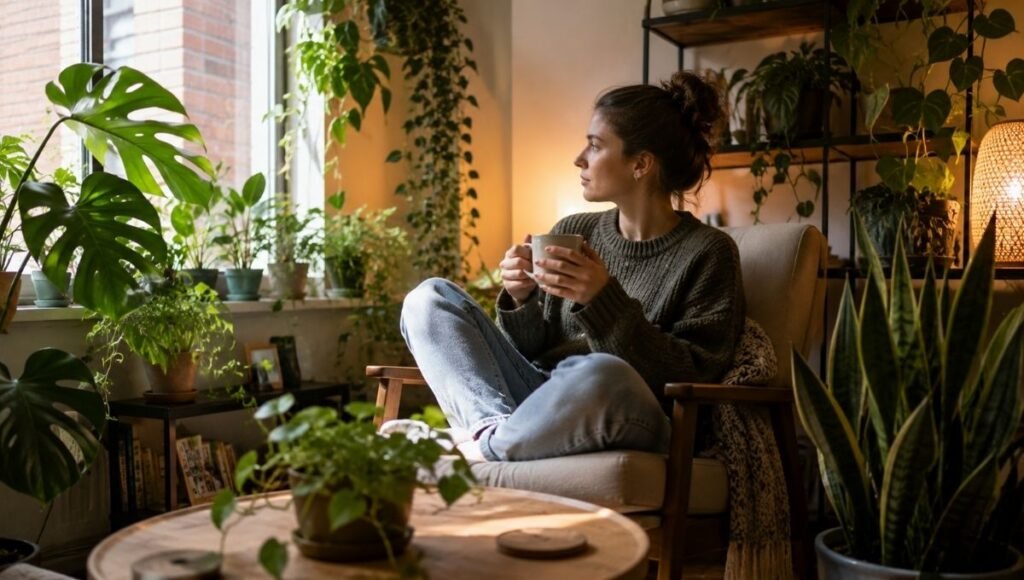
The best indoor plant care routine isn’t the most elaborate one. It’s the one you can sustain — the one that becomes a small, quiet habit woven into daily life. A few minutes in the morning to check the soil. A monthly feed during growing season. A seasonal adjustment when the heat comes on or the light changes.
Research from the University of Exeter found that people who regularly interact with plants — even through simple care tasks — report measurably higher wellbeing and lower stress than those who don’t. Not because they have the perfect collection, or the perfect care routine, but because the act of paying attention to something living is itself restorative.
Start with one plant. Give it what it needs. Notice how it responds. Everything else follows from that.
References: Largo-Wight, E., et al. (2022). When green enters a room: A scoping review of epidemiological studies on indoor plants and mental health. Environmental Research, 214. University of Exeter — Miles Richardson et al. (2022). Connection to nature and wellbeing through everyday activities. People and Nature, 4(2), 339–353. Old Farmer’s Almanac (2026). Houseplant Care Guide. University of Illinois Extension (2023). Caring for Houseplants. Iowa State University Extension — Aaron Steil (2023). Caring for Houseplants.