
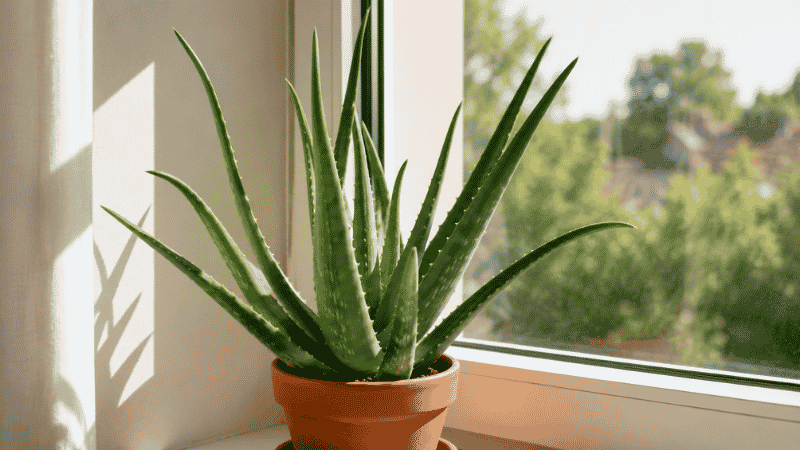
You’ve probably owned an aloe vera at some point. Maybe you bought one specifically because you burned yourself cooking and remembered that aloe gel was supposed to help. You set it in a bright window, watered it occasionally, and it mostly just sat there — occasionally producing a new leaf, mostly doing nothing obvious.
Then one day, weeks or months later, you realized: it was still alive. Completely unbothered by your inconsistent watering schedule, your bright-then-dim window placement, your occasional months of ignoring it entirely.
That’s the aloe vera experience. It’s a plant that quietly rewards the people who worry about it least. But there’s a difference between an aloe that survives and one that actually thrives — fat, upright, producing new offsets, ready to offer you a leaf of cooling gel whenever you need it.
This guide covers everything you need to know about aloe vera care: the one mistake that kills most aloe plants (too much water), why it goes brown or limp, how to harvest and use the gel, and how to keep this ancient, useful plant genuinely healthy for years.
Key Takeaways
- Aloe vera is a succulent that stores water in its leaves — overwatering is the most common cause of death; water only when the top third of the soil is completely dry
- A 2024 systematic review and meta-analysis in the Amrita Journal of Medicine confirmed that aloe vera gel significantly accelerates healing of first- and second-degree burns compared to conventional treatments — the plant on your windowsill is genuinely useful medicine
- Aloe vera needs bright indirect light or some direct sun — it goes leggy and weak in dim conditions
- Aloe vera gel should not be ingested without medical guidance — the clear inner gel is generally safe topically, but the yellow-green latex layer beneath the skin can cause serious digestive problems
- With basic care, aloe vera plants can live for decades and produce numerous “pup” offsets that can be repotted as new plants
What Exactly Is Aloe Vera?
Aloe vera (Aloe barbadensis miller) is a succulent plant native to the Arabian Peninsula, now naturalized throughout the world’s tropical and subtropical regions. It’s one of the oldest documented medicinal plants in human history — ancient Egyptian and Chinese records describe its use for burns, wounds, and skin conditions dating back thousands of years.
Like all succulents, aloe vera stores water in its thick, fleshy leaves. This water storage capacity is what makes it so forgiving — the plant can sustain itself through extended dry periods using its internal reserves, which is why missed waterings rarely cause immediate problems. The challenge, as with all succulents, is that this same capacity means roots sitting in wet soil are rapidly deprived of oxygen and begin to rot.
The medicinal reputation is well-earned. A 2024 systematic review and meta-analysis published in the Amrita Journal of Medicine, analyzing four randomized controlled trials, found that aloe vera gel produced significantly faster healing of first- and second-degree burns compared to 1% silver sulfadiazine cream — the conventional burn treatment. A separate 2024 study in the Journal of Burn Care & Research confirmed these findings in a larger population. The plant’s anti-inflammatory compounds, particularly acemannan (a polysaccharide), appear to accelerate wound closure and reduce pain.
Aloe Vera Care: Light Requirements
Aloe vera is one of the few houseplants that genuinely benefits from some direct sunlight. Unlike tropical plants that evolved under forest canopies and need filtered light, aloe evolved in open, sun-exposed arid environments. It wants light — more than most people give it.
Best placement: a south or west-facing window where it receives several hours of direct or bright indirect sunlight per day. This is where aloe vera grows fastest, stays most compact and upright, and maintains the deepest green color.
East-facing windows: workable — aloe manages on bright indirect light but grows more slowly and the leaves may become slightly elongated and lighter green.
Low light conditions: aloe vera in low light becomes leggy, stretched, and weak. The leaves elongate toward the light source, lose their compact upright form, and the plant becomes significantly more susceptible to overwatering damage because it uses water more slowly. If your aloe is looking pale, floppy, or stretched, it needs more light.
Direct harsh sunlight through glass in summer: this can actually scorch the leaves, causing reddish-brown patches and crispy edges — particularly in very hot climates or during peak afternoon summer heat. If your window receives very intense afternoon sun in summer, position the plant slightly back from the glass or filter with a sheer curtain.
Outdoors in summer: aloe vera loves being outside from late spring through early autumn (May to September in most of North America). It grows noticeably faster outdoors in good sun. Bring it back inside before nighttime temperatures drop below 50°F (10°C).
How to Water Aloe Vera (Less Than You Think)
Aloe vera’s water storage in its leaves makes it one of the most drought-tolerant houseplants available. The practical implication is simple: it needs far less water than you’d instinctively give it.
The rule: allow the top third of the soil to dry out completely before watering. For a plant in 6 inches of soil, that means the top 2 inches should be dry — press your finger in to test. When you water, water deeply until it flows from the drainage holes, then let the soil dry to that depth before watering again.
Frequency: every 2–3 weeks in spring and summer; every 4–6 weeks in autumn; once a month or less in winter. The plant grows very slowly in winter and its water needs drop dramatically.
The most important rule: never let aloe vera sit in standing water. Empty saucers after watering. If the pot sits in accumulated water, the roots will rot within days.
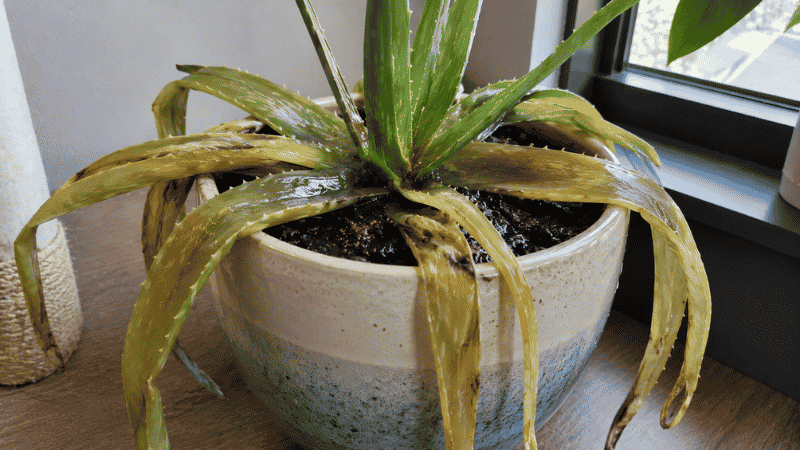
Signs of overwatering: leaves that feel soft, mushy, or translucent rather than firm and plump; leaves that are yellowing, particularly at the base of the plant; a musty smell from the soil; roots that are brown and mushy when inspected.
Signs of underwatering (rare): leaves that feel thin and slightly shriveled rather than plump and firm; leaves that curl inward slightly; the plant leans or droops despite adequate light.
The honest reality: most aloe vera plants die from overwatering, not drought. When in doubt, wait another week before watering.
Soil: The Foundation of Aloe Health
Aloe vera needs the fastest-draining soil you can provide. Standard potting mix holds too much moisture for aloe — its structure, while fine for tropical houseplants, stays too wet between waterings for a succulent that needs rapid drying.
The best soil for aloe vera: a cactus and succulent potting mix, or a standard potting mix combined with coarse sand or perlite at a ratio of roughly 50/50. This creates the fast-draining, gritty texture that aloe vera roots evolved in.
Never use garden soil in pots. It compacts, blocks drainage, and creates the waterlogged conditions that cause root rot.
Pots: terracotta (unglazed ceramic) is ideal for aloe vera because the porous walls allow moisture to evaporate through, helping the soil dry out faster. This natural drainage assistance suits a plant that needs rapid drying between waterings.
Drainage holes are non-negotiable. An aloe in a pot without drainage holes will develop root rot regardless of how carefully you water.
When and How to Repot Aloe Vera
Aloe vera is a slow grower and doesn’t need frequent repotting. Plan to repot every 2–3 years, or when:
- The plant has become noticeably top-heavy and unstable in its pot
- Roots are growing out of drainage holes
- The plant has produced multiple “pups” (offset plants) that are crowding the pot
- The potting mix has broken down and is no longer draining well
When repotting, go up one size — 1–2 inches larger in diameter. Aloe vera prefers a pot that’s only slightly larger than its root ball; too-large pots hold excess wet soil.
One timing note: repot in spring or early summer when the plant is entering active growth. Avoid repotting in winter. After repotting, wait 1–2 weeks before the first watering — letting the roots settle and any small root injuries callus before introducing moisture reduces root rot risk.
Aloe Vera Pups: Free New Plants
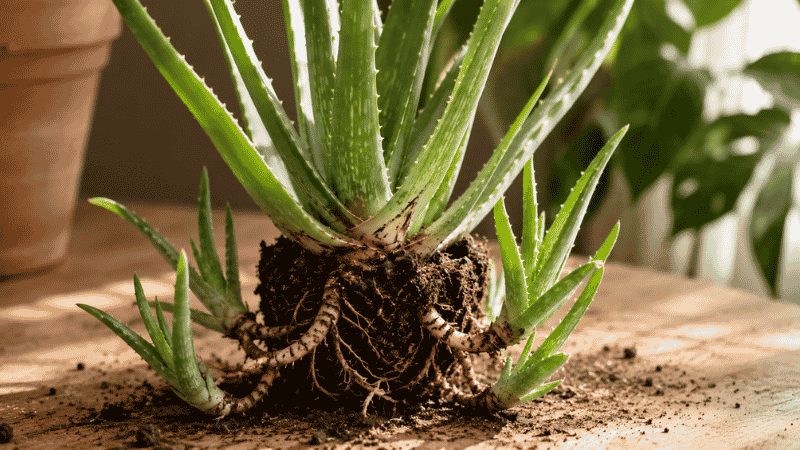
One of the most rewarding aspects of owning a mature aloe vera is the eventual appearance of “pups” — small offset plants that emerge from the base of the mother plant, growing from the root system. A healthy, established aloe will produce these regularly once it reaches maturity.
How to separate pups:
- Wait until the pup is at least 2–3 inches tall and has developed its own small leaves.
- Remove the entire plant from its pot to access the roots.
- Gently separate the pup from the mother plant — it will be attached by a connecting root. Use clean scissors if needed to cut the connection.
- Allow the cut surfaces to air-dry for 1–2 days before potting. This callusing step significantly reduces rot risk.
- Plant the pup in its own small pot of cactus mix and wait 1–2 weeks before watering.
Pups removed before they’ve developed their own roots will need more careful handling — they can still be propagated in dry cactus mix, but they’ll take longer to establish.
How to Harvest and Use Aloe Vera Gel
This is the section most aloe vera owners want — and with good reason. Having a plant that produces freely available, scientifically validated wound care on your windowsill is genuinely useful.
When to harvest: choose a mature, healthy outer leaf — the thick, plump, outermost leaves contain the most gel. The plant replaces harvested leaves from the inside outward.
How to harvest:
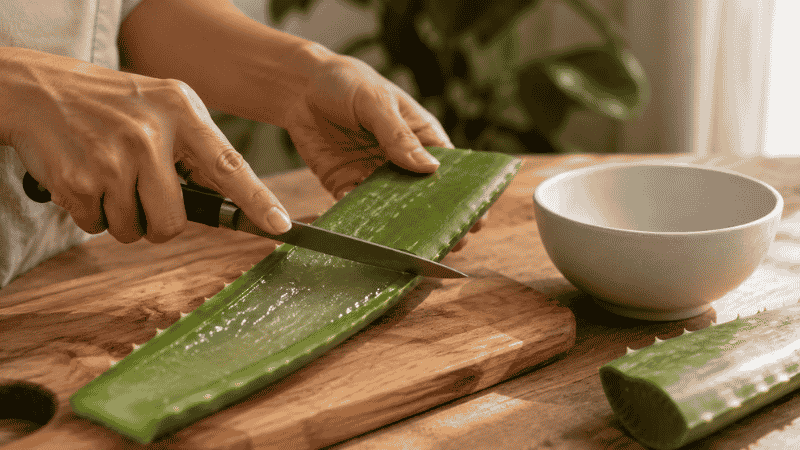
- Cut a mature outer leaf as close to the base as possible with a clean knife.
- Stand the cut end upright in a glass for 10–15 minutes, allowing the yellow-green latex (called aloin) to drain from the cut end. This step is important — aloin is a powerful laxative and skin irritant that you don’t want in your gel.
- Wash the leaf under cold water.
- Slice off the flat top and bottom edges of the leaf, then peel away the outer skin.
- The clear inner gel can be scooped out with a spoon or used directly from the leaf by splitting it open.
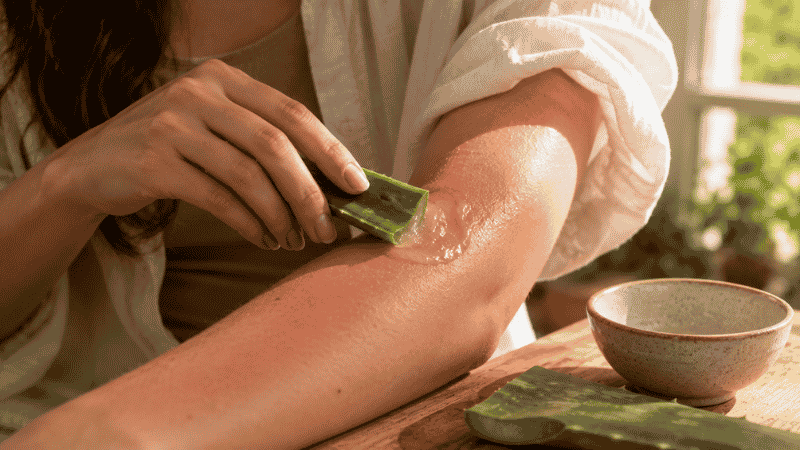
Topical use: fresh aloe vera gel applied to minor burns, sunburn, and skin irritation provides documented soothing and healing effects. Apply a thin layer to the affected area. The gel is naturally cooling on contact.
Storage: fresh gel keeps in the refrigerator for 5–7 days in a sealed container. The cool temperature also enhances the soothing effect on burns and sunburn.
Important safety note: aloe vera gel is for topical use. Do not ingest aloe vera gel without medical guidance. The inner gel in small amounts is generally considered safe, but the aloin latex is a strong stimulant laxative that can cause severe digestive symptoms. Commercial aloe vera products for internal use have been processed to remove aloin — fresh gel from your plant has not been through this process.
Common Aloe Vera Problems
Leaves Turning Brown
Soft, mushy brown leaves at the base: almost always root rot from overwatering. Remove the plant from its pot immediately, cut away all mushy roots and brown leaf tissue with clean scissors, let the plant air-dry for 24–48 hours, and repot in fresh dry cactus mix. Do not water for 2 weeks after repotting.
Brown, crispy leaf tips: usually too much direct harsh sun (sunscorch) or the plant drying out too severely between waterings. Adjust light placement and check watering frequency.
Entire leaves turning brown from tip downward: often cold damage or a dramatic temperature change. Keep aloe away from cold drafts and temperatures below 50°F.
Leaves Turning Yellow
Usually overwatering — the same root cause as brown mushy leaves but at an earlier stage. Check soil moisture and drainage. If the soil is consistently wet, reduce watering frequency immediately and ensure the pot drains freely.
Less commonly, yellow leaves indicate too much direct harsh sun during summer, which bleaches the chlorophyll.
Leaves Going Limp or Floppy
Soft and limp: overwatering or root rot — the roots can no longer deliver water to the leaves, causing them to lose turgor pressure despite being surrounded by moisture. Check roots.
Thin and limp: underwatering — the plant has depleted the water stored in its leaves. Water thoroughly and the leaves will plump up within a few days.
Leggy, Stretched Growth
The plant needs significantly more light. Move it to a sunnier window or outdoors in summer. Existing leggy growth won’t reverse, but new growth in better light will be compact and upright.
⚠️ A Note on Pets and Aloe Vera
Aloe vera is mildly toxic to cats and dogs if ingested. The aloin compounds in aloe can cause vomiting, diarrhea, and lethargy in pets. The ASPCA lists aloe vera as toxic to both cats and dogs.
Keep aloe vera out of reach of pets that chew on plants. If your pet ingests aloe vera, contact your veterinarian.
If You Only Have 5 Minutes Right Now
Check whether the soil is completely dry in the top third. If it is, water thoroughly and let it drain completely. If the leaves look soft or mushy, stop watering entirely and check the roots. If the plant looks pale and leggy, it needs more light.
Aloe vera care is genuinely simple once you internalize the core rule: dry before watering, good drainage always, bright light whenever possible.
FAQ
How often should I water aloe vera? Every 2–3 weeks in spring and summer; every 4–6 weeks in autumn; once a month or less in winter. Always check the soil — water only when the top third of the soil is completely dry. When in doubt, wait another week.
Why are my aloe vera leaves soft and mushy? This indicates overwatering and root rot. Remove the plant from its pot, cut away all mushy roots and brown leaf tissue, let it air-dry for 24–48 hours, and repot in fresh dry cactus mix. Hold off on watering for 2 weeks.
Can aloe vera survive in low light? Technically yes, but it becomes leggy, weak, and much more vulnerable to overwatering damage in dim conditions. Aloe vera genuinely needs bright indirect light or some direct sun to stay healthy. If your space is consistently dim, a grow light positioned 6–12 inches above the plant helps.
Is aloe vera gel safe to use on skin? Yes — topically applied aloe vera gel is well-documented to soothe burns, sunburn, and minor skin irritation. Harvest a mature outer leaf, drain and wash it, and apply the clear inner gel. Avoid ingesting aloe gel from your plant without medical guidance.
How do I know when to separate the pups? When offset plants are at least 2–3 inches tall with their own developed leaves. Separate during repotting in spring for the best results.
Why is my aloe vera turning red or pink? Reddish discoloration is usually a stress response — often from too much direct intense sun, temperature fluctuations, or being root-bound. It’s typically not dangerous, but identify and correct the stressor. Move to slightly less intense light or repot if root-bound.
Do aloe vera plants flower? Yes — mature, well-established aloe vera plants (typically 4+ years old) can produce tall flower stalks with tubular orange, yellow, or red flowers. This usually happens in late winter or spring and indicates the plant is very healthy. Flowering is more common when the plant is kept outdoors in summer.
The Plant That Earns Its Space
There’s something particularly satisfying about owning a plant that’s genuinely useful. The monstera looks beautiful. The snake plant purifies air. The pothos trails perfectly from a shelf. But aloe vera can soothe a burn on a Thursday evening in your kitchen — a functional, immediate utility that no other common houseplant offers.
It’s also one of the most historically significant plants in human cultivation. People have been growing aloe vera specifically for its medicinal gel for at least 6,000 years. The plant on your windowsill is part of a long, continuous thread of human relationship with this remarkable succulent.
Give it a sunny window, resist the urge to water it too often, and it will repay you with decades of quiet, useful presence.
Keep Growing
- 🌵 [Low Maintenance Indoor Plants: 12 Hard-to-Kill Picks] — more plants that thrive on minimal attention
- 🌿 [Best Plants for Beginners: 15 Picks That Are Actually Hard to Kill] — your next plant awaits
- 💛 [Plant Leaves Turning Yellow? 7 Real Causes and Fixes] — the full guide to diagnosing any struggling plant
- 🌱 [Gardening for Beginners: Grow Your First Garden] — ready to expand beyond houseplants?
References: Malhotra, P., Kataria, N., Mandal, A., Kalyani, V.C., & Kumari, K. (2024). Efficacy of Aloe Vera Gel vs. 1% Silver Sulfadiazine in First- and Second-Degree Burn Wound Healing: A Systematic Review and Meta-Analysis. Amrita Journal of Medicine, 20(3), 94–102. Huang, Y.N., Chen, K.C., Wang, J.H., & Lin, Y.K. (2024). Effects of Aloe vera on Burn Injuries: A Systematic Review and Meta-Analysis. Journal of Burn Care & Research, 45(6), 1536–1545. ASPCA Animal Poison Control Center. Toxic and Non-Toxic Plant List — Aloe Vera. National Center for Complementary and Integrative Health (NCCIH), NIH (2020). Aloe Vera: What You Need to Know. Old Farmer’s Almanac (2025). Aloe Vera Plant Care Guide.