
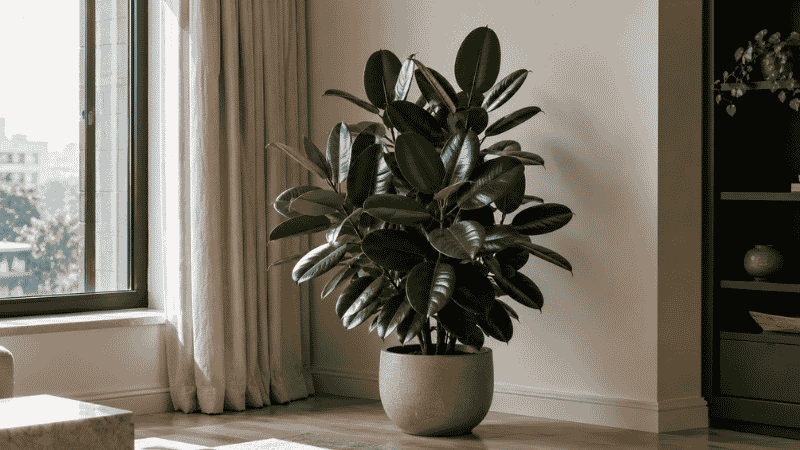
You walked past it in the plant shop and stopped. Not because it was delicate or intricate, but because it was impressive. Those large, glossy leaves — deep green, or burgundy, or cream-streaked depending on the variety — catching the light like they’d been polished. A rubber plant in good health is one of the most effortlessly striking houseplants you can own, and it has the architectural presence to fill a corner in a way that smaller plants simply can’t.
Here’s the good news: rubber plant care is significantly more forgiving than the plant’s dramatic appearance suggests. It communicates its needs clearly — drooping leaves mean thirst, leaf drop means stress, stretched growth means it wants more light. Once you learn to read those signals, keeping a rubber plant happy becomes genuinely manageable, even for a complete beginner.
This guide covers everything: the right light, how to water without causing root rot, why the leaves drop when you move it, how to clean those glossy leaves, and how to propagate new plants from the one you already have.
Key Takeaways
- Rubber plants (Ficus elastica) prefer bright indirect light but tolerate lower light — variegated varieties need more light to maintain their coloring
- Water when the top 1–2 inches of soil feel dry — overwatering causes root rot; rubber plants always prefer too dry over too wet
- Rubber plants dislike being moved — leaf drop after relocating is normal and temporary; give the plant 2–4 weeks to adjust before worrying
- The milky latex sap is an irritant — wear gloves when pruning or propagating; rubber plants are toxic to cats and dogs if ingested
- With good light and consistent care, rubber plants can grow 12–24 inches per year indoors and eventually reach ceiling height
What Makes Rubber Plants Special
Ficus elastica is native to the tropical rainforests of South and Southeast Asia — particularly India, Nepal, and Malaysia — where it grows as a large canopy tree reaching 100 feet or more. Its name comes from the milky latex sap it produces, which was historically harvested and used to make rubber before the Para rubber tree (Hevea brasiliensis) became the commercial standard.
Indoors, rubber plants become manageable architectural statement pieces — typically reaching 3–6 feet in a home setting, occasionally taller in ideal conditions. Their large, leathery leaves are their defining feature: naturally glossy and firm, they make the plant look carefully cultivated even when it’s barely been touched.
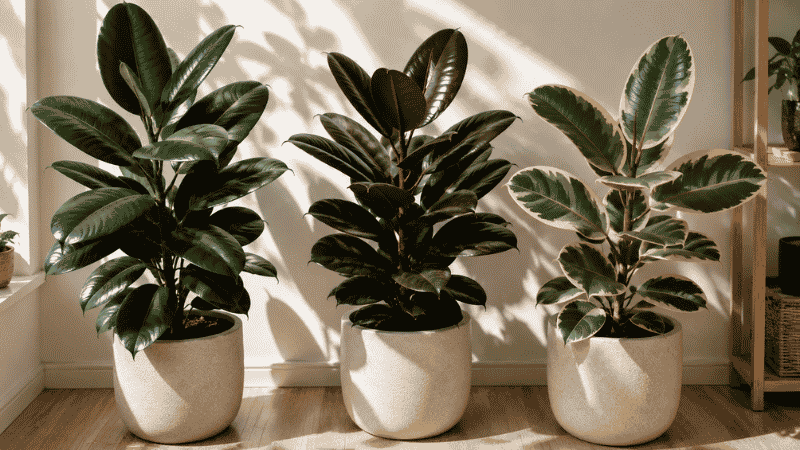
Popular varieties and their differences:
- Ficus elastica ‘Robusta’ — the classic deep green, the most widely available and most tolerant of lower light
- Ficus elastica ‘Burgundy’ — deep burgundy-black leaves, dramatic and beautiful; needs bright light to maintain rich color
- Ficus elastica ‘Tineke’ — cream and green variegation with pink edges on new growth; requires the most light of all varieties
- Ficus elastica ‘Ruby’ — pink, cream, and green variegation; striking and slightly slower growing
- Ficus elastica ‘Congesta’ — compact variety with smaller leaves; ideal for smaller spaces
The care requirements are essentially the same across varieties, with one important note: variegated varieties (Tineke, Ruby) have less chlorophyll in their leaves and need significantly more light than the solid-green varieties to maintain their coloring and grow at a reasonable pace.
Rubber Plant Care: Light Requirements
Rubber plants are adaptable to a range of light conditions, which contributes significantly to their popularity. But like all plants, they have a preference — and understanding the spectrum helps you get the most from them.
Bright indirect light is the sweet spot. Near an east or south-facing window, or a few feet back from a west-facing window, a rubber plant grows steadily, maintains rich leaf color, and stays compact and well-shaped. This is where they look their best.
Medium indirect light — farther from a window, or in a north-facing room with decent ambient light — is workable. Growth slows noticeably and solid-green varieties manage better than variegated ones. Burgundy varieties may shift toward greener tones as the burgundy pigmentation requires more light to express.
Low light — dim corners, rooms with small windows — is tolerated short-term but not indefinitely. The plant grows very slowly, produces smaller leaves, and begins to lean or reach toward the nearest light source. Variegated varieties will lose their patterning.
Direct harsh sunlight — particularly through south or west-facing glass in summer — scorches the leaves, producing brown patches and bleached areas that won’t reverse. Bright indirect light or filtered sun through a sheer curtain is the maximum.
One particularly useful rubber plant trait: unlike some Ficus species (looking at you, fiddle leaf fig), rubber plants tolerate variable light conditions without immediately dropping all their leaves. They adapt, though the adaptation shows in growth rate and leaf quality.
How to Water a Rubber Plant
The watering rule for rubber plants is simple and consistent: water when the top 1–2 inches of soil feel dry. Press your finger into the soil — if it’s moist at that depth, wait. If it’s dry, water thoroughly until it drains from the bottom of the pot.
During the growing season (spring and summer), this typically means watering every 7–10 days. In winter, reduce watering to every 2–3 weeks as the plant’s growth slows. But always check the soil rather than following a fixed calendar — the actual frequency varies with temperature, pot size, light level, and season.
Between the two watering extremes, rubber plants always prefer too dry over too wet. Underwatering is far less dangerous — the plant simply droops and lower leaves may curl inward. Water thoroughly and it recovers within a day. Overwatering, by contrast, leads to root rot that’s invisible until it’s already serious.
Signs of overwatering: yellowing leaves (particularly lower leaves), soft or mushy stems near the soil, brown spots on leaves, mold on the soil surface, or a foul smell from the pot. If you see these signs, stop watering immediately, check the roots, and consider repotting in fresh dry soil.
Signs of underwatering: drooping or wilting leaves, dry crispy leaf edges, leaves curling inward, and lower leaves yellowing and dropping. Water thoroughly and the plant recovers quickly.
On water quality: water quality isn’t a major concern for rubber plants the way it is for calatheas or peace lilies. Standard tap water is fine for most varieties, though if your water is heavily chlorinated, leaving it out overnight before use is a reasonable precaution.
The Leaf Drop Mystery: Why Rubber Plants Drop Leaves When You Move Them
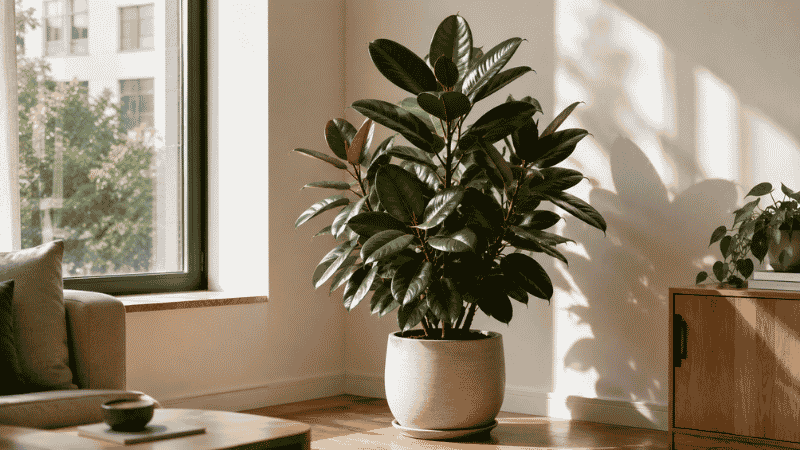
This is the most alarming thing rubber plants do, and the one that most beginners panic about. You bring your rubber plant home from the shop, or move it to a new room, and within a week the leaves start dropping. One by one, then several at once.
Moving a rubber plant to a new spot in the house, bringing it home from the garden centre, or any significant environmental change triggers a stress response. The plant drops leaves to reduce the water it needs to sustain while it adjusts to new light levels, humidity, and temperature.
This is normal and temporary. Give the plant 2–4 weeks in its new position without moving it again. The leaf drop will stop as the plant acclimates. New leaves will emerge in the weeks that follow.
To minimize leaf drop when moving:
- Water the plant 24 hours before moving it
- Choose a final position carefully before committing — every subsequent move restarts the adjustment period
- Don’t dramatically change light levels in one step if possible; intermediate positions help
- Keep temperature and humidity stable in the new location
The worst thing to do after leaf drop begins is to move the plant again, trying to find a “better” spot. Stability is what the plant needs most.
Soil and Pots
Good drainage is the single most important factor in rubber plant soil. Dense, water-retentive potting mixes that work for moisture-loving plants are a recipe for root rot with Ficus elastica.
Use a standard all-purpose potting mix improved with perlite — about 20–30% perlite by volume improves drainage significantly without sacrificing the structure the roots need. Alternatively, a cactus and succulent mix blended 50/50 with standard potting mix works well.
Pot requirements: drainage holes are non-negotiable. A rubber plant in a pot without drainage will develop root rot regardless of careful watering.
Pot material: for larger specimens, heavy terra-cotta pots or adding stones to the bottom help prevent tipping — rubber trees can get top-heavy fast. Terracotta also breathes, helping soil dry out faster between waterings, which suits rubber plants well.
Repotting: rubber plants are relatively slow to become root-bound and don’t need frequent repotting. Repot when they get too big for their current pot and roots are coming out the bottom. Spring is the best time to repot, as the plant is actively growing. Choose a pot that is one or two sizes larger than the current one, ensuring it has drainage holes.
Temperature and Humidity
Rubber plants prefer temperatures between 60–80°F (16–27°C) — standard indoor room temperature. They dislike cold: keep them away from drafty windows in winter, exterior doors, and air conditioning vents. Avoid exposing them to extreme temperature fluctuations or cold drafts. Sustained temperatures below 55°F (13°C) can cause leaf damage.
Humidity is appreciated but not demanding. Rubber plants prefer moderate to high humidity but tolerate average household conditions without significant stress. In very dry environments — particularly in winter with heating running — occasional misting or a pebble tray with water helps. Brown crispy leaf edges in winter are often a humidity signal rather than a watering problem.
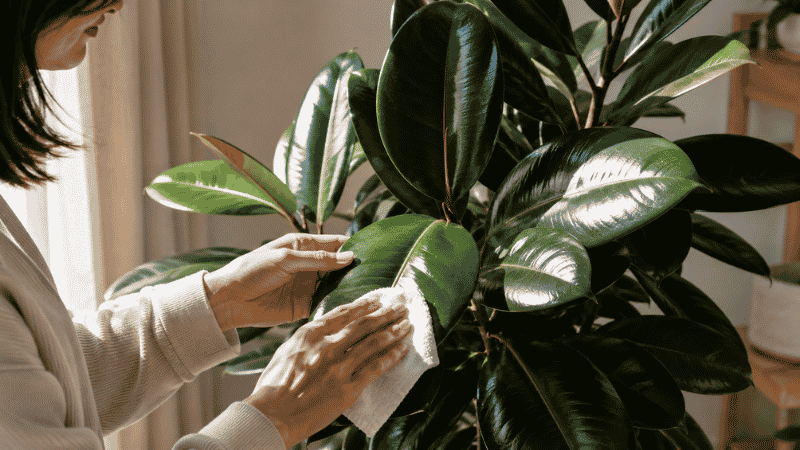
One care habit worth developing: wipe the large leaves with a damp cloth every few weeks. Dust accumulates on rubber plant leaves faster than on most houseplants (the large glossy surface is a natural dust collector), and a dusty leaf absorbs light less efficiently. A clean leaf looks better and photosynthesizes better — two good reasons for the same simple task.
Feeding Your Rubber Plant
Rubber plants are moderate feeders during active growth. A balanced liquid fertilizer applied every 4–6 weeks during spring and summer keeps them growing steadily. Use a fertilizer at the recommended strength — rubber plants don’t need half-strength feeding the way more sensitive plants do.
Stop feeding entirely in autumn and don’t feed through winter. The plant’s growth slows significantly and fertilizer it can’t use accumulates as mineral salts in the soil. If you notice white crusty deposits on the soil surface or pot rim, flush the soil thoroughly with water to remove accumulated salts.
Pruning: Shaping Your Rubber Plant
Rubber plants benefit from occasional pruning — both to control their size and to encourage a bushier, more branching growth habit rather than a single tall trunk.
When to prune: spring or early summer, when the plant is entering active growth and recovers most quickly from pruning stress.
How to prune: cut just above a leaf node (the small bump where a leaf attaches to the stem) using clean, sharp scissors or pruning shears. The plant will branch from the cut point, producing two or more new stems rather than continuing as a single trunk.
Important: Ficus elastica produces a milky latex sap when cut, which can irritate skin — wear gloves and wipe away any dripping sap promptly to prevent damage to other leaves or surfaces. The sap dries white and is difficult to remove once set. Keep a damp cloth nearby when pruning.
Avoid removing more than one-third of the plant’s foliage at a time to minimize stress, and always remove any yellow, damaged, or diseased leaves as needed.
How to Propagate a Rubber Plant
Propagating rubber plants is rewarding and not particularly difficult. Stem cutting propagation is the most common method.
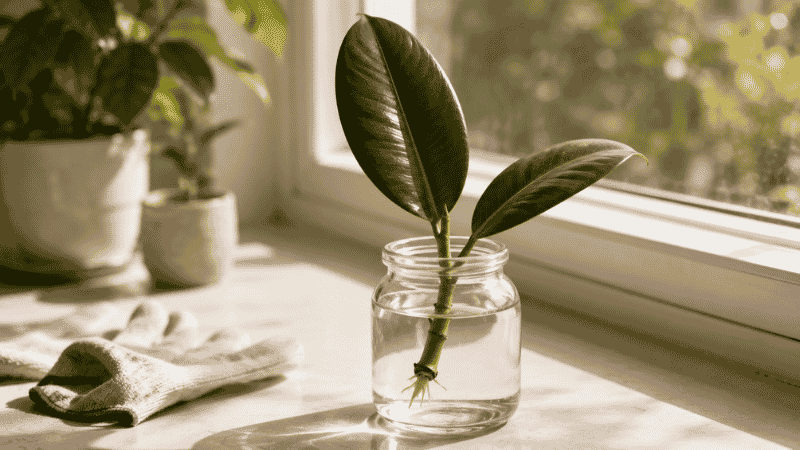
Stem cutting in water:
- Choose a healthy stem with at least 2–3 leaves and a visible node.
- Cut just below a node using clean scissors. The cutting should be 4–6 inches long.
- Allow the cut end to sit in open air for 30–60 minutes — this lets the latex sap seal, which reduces rot risk.
- Place the cut end in a jar of room-temperature water, with the node submerged and leaves above the waterline.
- Set in bright indirect light and change the water every few days.
- Roots should develop in 4–6 weeks. Once roots are 1–2 inches long, pot up in standard potting mix.
Stem cutting in soil: After allowing the cut end to seal, plant directly into moist potting mix. Keep the soil slightly moist (not wet) and cover loosely with a clear plastic bag to maintain humidity. Roots develop in 4–8 weeks.
Always wear gloves when propagating — the latex sap irritates skin and eyes.
Common Rubber Plant Problems
Leaves Turning Yellow
Yellowing leaves are usually caused by overwatering or poor soil drainage. Check that your pot has proper drainage holes and avoid watering until the top inch of soil feels dry. Reduce watering frequency immediately. If yellowing is rapid or widespread, check roots for rot.
Less commonly: too little light causes gradual yellowing, particularly in lower leaves. Sudden cold can also cause yellowing and leaf drop.
Leaves Dropping
If the leaves of the rubber plant are drooping, it is almost always a watering issue. Check soil moisture first. If the soil is dry, water thoroughly — the plant recovers quickly from underwatering. If the soil is wet and leaves are dropping, reduce watering and check the roots.
Sudden leaf drop (multiple leaves at once) after a move or environmental change is a stress response — normal and temporary. Stop moving the plant and give it time to adjust.
Brown Spots on Leaves
Brown spots with a bleached or faded appearance indicate sunscorch from direct harsh light. Move the plant away from the window or filter the light. Brown spots with a darker border may indicate fungal issues from overwatering — improve drainage and reduce watering.
Leggy, Stretched Growth
The plant needs more light. Move it to a brighter position. Leggy growth can be pruned back to encourage branching in the new, better-lit location.
Loss of Variegation
Variegated varieties losing their cream, pink, or burgundy coloring need more light. Move to a brighter spot. The existing faded leaves won’t regain their color, but new leaves grown in better light will be more vibrant.
⚠️ Toxicity: Rubber Plants and Pets
The rubber plant (Ficus elastica) is considered toxic to cats and dogs. If ingested, your pet will get mouth irritation, vomiting, or diarrhea. The ASPCA confirms rubber plants are toxic to both cats and dogs.
Keep rubber plants out of reach of pets that chew on plants. The latex sap is also an irritant to human skin — wear gloves when pruning or propagating and wash hands thoroughly after handling.
If your pet ingests rubber plant leaves or sap, contact your veterinarian or the ASPCA Animal Poison Control Center (888-426-4435) promptly.
If You Only Have 5 Minutes Right Now
Check the soil. If the top 1–2 inches are dry, water thoroughly. If the plant has recently been moved and is dropping leaves, stop moving it and give it 2–4 weeks of stability. If the leaves look dusty, wipe them with a damp cloth.
Those three habits — consistent watering, stable placement, clean leaves — cover the vast majority of rubber plant care.
FAQ
How often should I water a rubber plant? Every 7–10 days in spring and summer; every 2–3 weeks in autumn and winter. Always check the top 1–2 inches of soil first — water only when they feel dry. Rubber plants recover from underwatering quickly; they’re much more sensitive to overwatering.
Why is my rubber plant dropping leaves? The two most common causes are a recent move (stress response — normal and temporary, give it 2–4 weeks) or inconsistent watering (swinging between too wet and too dry). Check soil moisture and stabilize the plant’s position.
Why are my rubber plant leaves turning yellow? Usually overwatering. Check that your pot has drainage holes and let the soil dry to 1–2 inches depth before watering. If yellowing is widespread and rapid, check roots for rot — mushy, dark roots need to be trimmed and the plant repotted in fresh dry soil.
Are rubber plants safe for cats and dogs? No — rubber plants are toxic to cats and dogs if ingested. They cause mouth irritation, vomiting, and diarrhea. Keep them out of reach of pets. Contact your vet if ingestion occurs.
How do I make my rubber plant grow faster? Provide bright indirect light (the single biggest growth factor), feed with a balanced liquid fertilizer every 4–6 weeks in spring and summer, and ensure the pot is appropriately sized — not too large. Rubber plants also grow noticeably faster outdoors in summer in a sheltered spot with bright indirect light.
Why is my rubber plant losing its burgundy or pink coloring? Insufficient light. Variegated and colored varieties need more light than solid-green varieties to maintain their distinctive coloring. Move to a brighter position — near a window with good indirect light. Existing faded leaves won’t recolor, but new growth in better light will be more vibrant.
Can I put my rubber plant outside in summer? Yes — rubber plants enjoy being outdoors in summer in warm weather (above 60°F). Place in a spot with bright indirect light or dappled shade — direct outdoor sun can scorch the leaves. Bring back indoors before nighttime temperatures drop below 55°F.
The Presence of a Rubber Plant
There’s a reason rubber plants have been a staple of interior design for decades. A well-grown rubber plant in a clean pot doesn’t just add greenery to a room — it changes the room. The large, glossy leaves bring a quality of aliveness that smaller, more delicate plants can’t replicate at the same scale.
Research consistently shows that large indoor plants — and the rubber plant is one of the most impactful — measurably improve the perceived quality of a space, reduce stress responses, and create the kind of biophilic environment that humans are wired to find calming. Your rubber plant isn’t just décor. It’s doing something real.
Give it a bright corner, a little water when the soil says it’s ready, and some patience when it adjusts to its new home. It will reward you for years.
Keep Growing
- 🌿 [Low Maintenance Indoor Plants: 12 Hard-to-Kill Picks] — more plants that thrive with minimal attention
- 🌑 [Snake Plant Care: The Complete Beginner’s Guide] — another architectural plant that loves a bright corner
- 💛 [Plant Leaves Turning Yellow? 7 Real Causes and Fixes] — the full diagnostic guide for any struggling plant
- 🔄 [How to Repot a Plant: Step-by-Step for Beginners] — when your rubber plant outgrows its pot
References: Largo-Wight, E., et al. (2022). When green enters a room: A scoping review of epidemiological studies on indoor plants and mental health. Environmental Research, 214. ASPCA Animal Poison Control Center. Toxic and Non-Toxic Plant List — Rubber Plant (Ficus elastica). Blooming Expert (2026). Ficus elastica Care Guide: 8 Varieties, Light, Pruning and Propagation. Almanac.com (2025). Rubber Tree Plant Care — Ficus elastica. Deep Green Permaculture (2025). The Comprehensive Guide to Caring for Rubber Plant.