
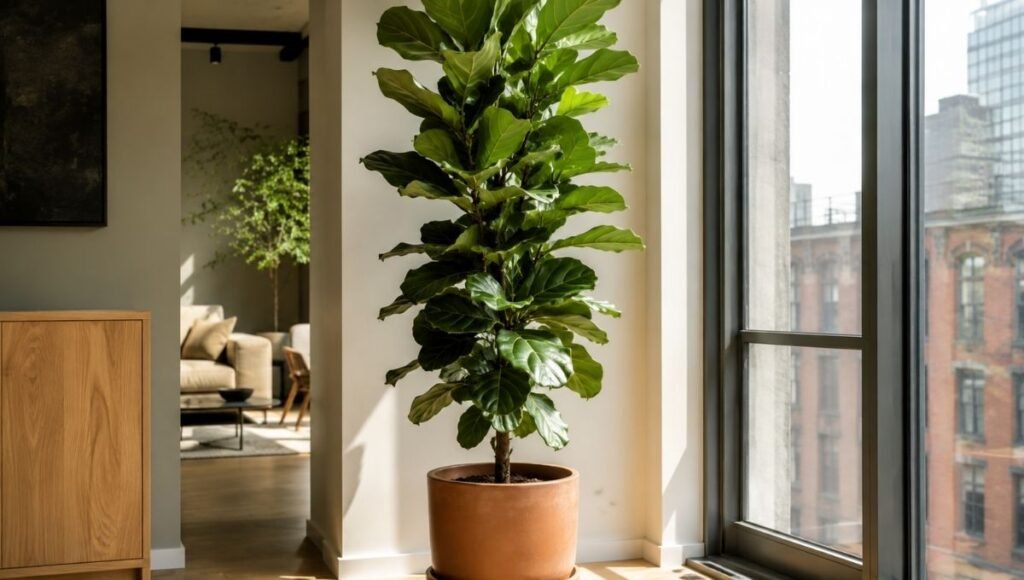
Let’s start with some honesty: the fiddle leaf fig has the worst reputation of any popular houseplant. People buy them because they look incredible in interiors — that tall, architectural silhouette, those large violin-shaped leaves — and then spend the next six months watching them drop leaves, develop brown spots, and dramatically decline in ways that feel deeply personal.
It’s not personal. But it does mean the fiddle leaf fig is not the plant for everyone, and certainly not the plant for someone who wants a forgiving, low-maintenance companion. It is, however, absolutely manageable once you understand the specific things it cares about deeply — and the things that, once you stop doing, will transform your relationship with it entirely.
I’ve had mine for two years. It dropped eleven leaves in the first month. It’s now over five feet tall and producing new growth consistently. The turnaround wasn’t magic — it was understanding three things: where to put it, how rarely to water it, and how much it hates being moved. Everything else is secondary.
This is the fiddle leaf fig care guide for the rest of us.
Key Takeaways
- Fiddle leaf figs are sensitive to movement — every time you relocate one, expect a period of leaf drop as it adjusts; find the right spot once and commit
- Overwatering is the most common cause of fiddle leaf fig decline — water only when the top 2 inches of soil are completely dry, roughly every 7–10 days in summer
- Bright indirect light near a window is essential — insufficient light is the second most common reason fiddle leafs decline slowly and mysteriously
- Brown spots on leaves have different causes that require different fixes — dark brown from the edges means underwatering; dark spots from the center means overwatering or root rot
- Fiddle leaf figs are toxic to cats and dogs — ingestion causes digestive irritation; keep out of reach of pets
The One Thing Nobody Warns You About
Before anything else, this: fiddle leaf figs hate being moved.
This is the piece of advice that would have saved my first plant and probably yours too. Every time you relocate a fiddle leaf fig — from the shop to your car, from your car to your home, from one room to another, from indoors to outdoors and back — it enters a stress response and may drop leaves. Multiple leaves. Sometimes a lot of them.
This is not your plant dying. It’s your plant adjusting. And it will stabilize — usually within 2–4 weeks in a new position — and then resume normal life. The mistake most people make is interpreting the leaf drop as a sign that the spot is wrong, moving the plant again, and triggering another stress response. This cycle is how a fiddle leaf fig ends up going from healthy to genuinely struggling within two months of coming home.
The rule: choose your spot carefully, put the plant there, and do not move it again unless you absolutely have to. Every move costs you leaves and weeks of recovery time.
Fiddle Leaf Fig Care: Light Requirements
Fiddle leaf figs want bright indirect light — and quite a lot of it. Not the dim ambient light of a room that feels pleasant; actual significant light from a nearby window.
The ideal position: within 3–6 feet of a large south or east-facing window. The plant should be able to see sky from where it sits — not just a wall reflecting light, but actual outdoor light coming through glass. East-facing windows give lovely morning light without the intensity of afternoon sun. South-facing windows are excellent for most of the year. West-facing windows work, but monitor for leaf scorch from intense afternoon summer sun.
What insufficient light looks like: the plant produces smaller and smaller new leaves over time; existing leaves look slightly dull; the plant leans heavily toward the nearest light source and becomes top-heavy and unbalanced; growth effectively stops during the growing season.
What too much direct sun looks like: bleached, pale patches on the sun-facing side of leaves; leaves that feel papery in affected areas. Move slightly away from the glass or filter with a sheer curtain.
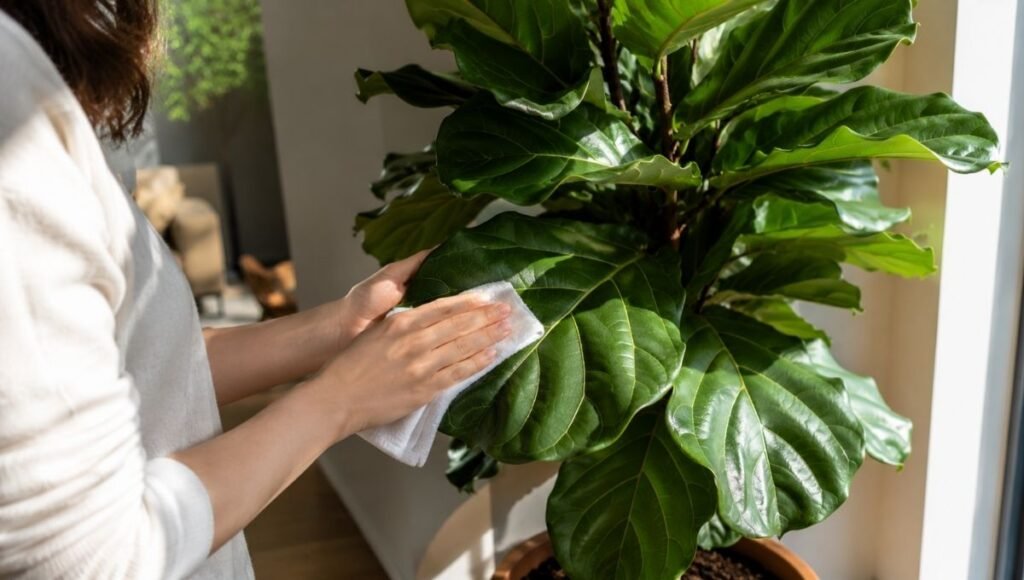
The leaf-cleaning habit: fiddle leaf fig leaves are large and smooth, which means they collect dust efficiently. Dusty leaves can’t photosynthesize as effectively — they’re literally filtering out available light. Wiping leaves with a damp cloth every 2–3 weeks is genuinely functional, not just aesthetic. Use a soft cloth and clean water. This is one of the most quietly effective care habits for this plant.
Rotation: because fiddle leafs grow toward light, they’ll lean noticeably toward the window over weeks if you don’t adjust them. A quarter turn every month or every second watering keeps growth even and prevents the plant from becoming lopsided.
How to Water a Fiddle Leaf Fig (The Most Important Skill)
The watering sweet spot for a fiddle leaf fig is narrower than most plants. Too much water causes root rot and those dark brown spots that spread from the center of leaves. Too little causes dry, crispy brown edges and eventually leaf drop. But between those two extremes is a relatively forgiving zone — and the key to staying in it is simple.
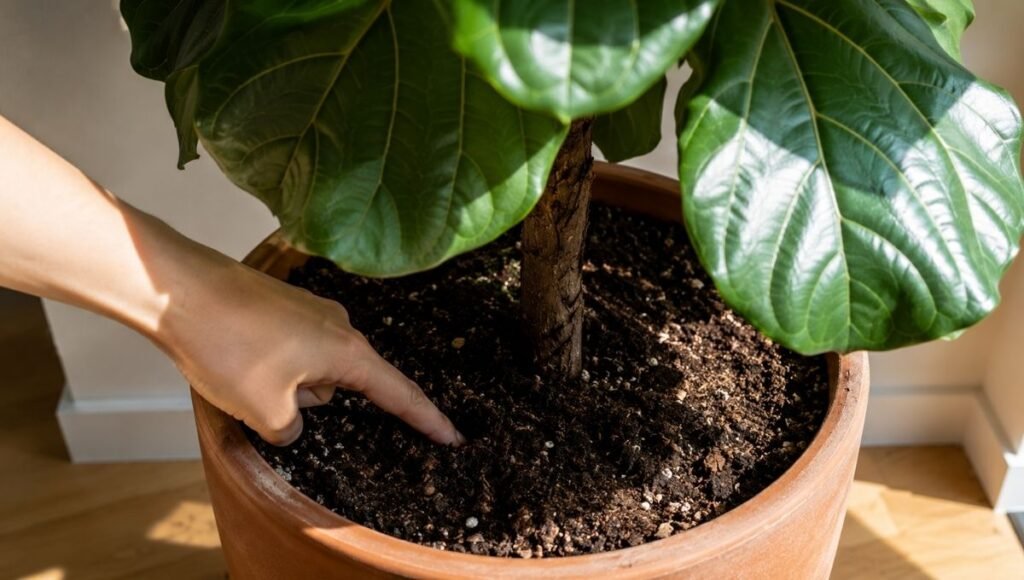
The rule: allow the top 2 inches of soil to dry out completely before watering. Press your finger into the soil. Still moist? Wait. Completely dry to that depth? Water now — thoroughly, until it drains from the bottom of the pot.
Frequency as a rough guide: every 7–10 days in spring and summer; every 10–14 days in autumn; every 2–3 weeks in winter. But the soil test overrides everything. The actual frequency depends on your pot size, your home’s temperature, the light level, and the season — it will be different in July and January.
The underwatering vs. overwatering distinction is worth learning because the fixes are opposite:
Overwatering (most common): dark brown spots that start in the middle or center of leaves, soft or mushy areas on the leaf, spots spreading outward. Soil stays wet for more than 10 days. The spots feel wet or slightly translucent. Reduce watering immediately. Check for root rot if widespread.
Underwatering: brown spots or edges that start at the outer edge of leaves and work inward. Dry and crispy texture. Soil is bone dry. The leaf tips and margins crisp up rather than developing soft patches. Water more frequently and thoroughly.
One of the most common mistakes: seeing brown spots, panicking, watering more, making root rot worse. Check the soil first. Always.
Water quality: fiddle leaf figs are sensitive to fluoride and chlorine in tap water. If you can, use filtered water or let tap water sit overnight before using. Brown tips specifically (as opposed to larger brown patches) are often a water quality issue.
Soil, Pots, and Repotting
Soil: fiddle leaf figs want well-draining, aerated soil. The cactus/palm mix recommended by A Beautiful Mess’s plant contributor works well — the added sand keeps the mix loose and prevents compaction and waterlogging. Standard potting mix with 20–30% added perlite is equally effective. The goal is soil that drains freely and dries out at a reasonable rate — not within a day (too fast) and not staying wet for weeks (too slow).
Never use garden soil in containers. It compacts and creates the soggy, dense conditions that fiddle leaf figs can’t tolerate.
Pots: terracotta is an excellent choice. Its porous walls allow moisture to evaporate through the sides, which helps the soil dry at a pace that suits fiddle leaf figs. It also adds weight — useful for a tall plant that can become top-heavy.
The pot should be only modestly larger than the plant’s current root ball. Fiddle leaf figs like to feel somewhat snug. A pot that’s significantly larger than necessary holds excess wet soil around roots, which increases root rot risk.
Drainage holes are non-negotiable. This cannot be said enough. A fiddle leaf fig in a pot without drainage will develop root rot. No exceptions.
Repotting: once every 1–2 years, ideally in spring. Signs it’s time: roots growing from drainage holes, soil drying out unusually fast after watering, growth noticeably stalling despite good conditions. When repotting, move up only one pot size. Spring is ideal because the plant is entering active growth and recovers faster.
After repotting: expect a period of adjustment. Hold off on fertilizing for 6 weeks and keep the plant in its usual position — resist the urge to also change its location at the same time.
Humidity and Temperature
Fiddle leaf figs are native to the tropical rainforests of West Africa — warm, humid, and consistently warm year-round. Indoors, the main threats are cold drafts, dry air, and temperature fluctuations.
Temperature: keep between 60–80°F (16–27°C). Below 55°F (13°C) causes leaf damage and drop. Avoid positioning near exterior doors, drafty windows, air conditioning vents, or heating vents — all create the temperature instability that stresses this plant.
Humidity: moderate to high humidity is preferred. In dry winter conditions with heating running, leaf edges may crisp and brown. A pebble tray with water, grouping with other tropical plants, or a small humidifier nearby all help. The fiddle leaf fig won’t die from average household humidity, but it will look noticeably better in more humid conditions.
Feeding
A balanced liquid fertilizer applied monthly during spring and summer gives the plant the nutrients it needs to sustain its large leaves and support new growth. Use a fertilizer specifically formulated for houseplants or for fiddle leaf figs (these are widely available and slightly higher in nitrogen to support leaf development).
Stop feeding in autumn. Don’t feed through winter — the plant’s growth slows to minimal and accumulated fertilizer salts cause leaf tip damage.
Over-fertilizing is a real risk: too much nitrogen produces soft, lush growth that’s more susceptible to disease, and salt buildup in the soil damages roots. Monthly at full strength during growing season; nothing in winter. That’s the entire feeding plan.
Pruning and Shaping
Most fiddle leaf figs sold in shops have a single main trunk with leaves clustered near the top. With pruning, you can encourage branching — a broader, bushier shape that looks more like a tree and less like a stick with leaves.
How to encourage branching: cut the top of the main trunk just above a leaf node — the small bump where a leaf attaches to the stem. The plant will branch from the cut point, producing 2–3 new stems rather than continuing as a single trunk. Do this in spring for fastest recovery.
Wear gloves: fiddle leaf figs produce milky latex sap when cut, which irritates skin and can stain surfaces. Wipe the cut with a damp cloth and let it dry naturally. Don’t panic at the sap — it seals the wound naturally.
Removing dead leaves: pull or cut any leaves that are more than 50% brown or yellowed. They won’t recover, and leaving them uses energy the plant could direct toward healthy new growth. Always remove at the base of the leaf stem.
Propagating a Fiddle Leaf Fig
Propagating fiddle leaf figs is possible but slower than most houseplants. Stem cuttings are the standard method.
How to propagate:
- Cut a stem section with at least 2–3 leaves and a visible node, just below the node.
- Allow the cut end to dry for 30–60 minutes — this lets the latex sap seal.
- Place the cutting in a jar of room-temperature water with the node submerged.
- Set in bright indirect light and change water every few days.
- Roots develop in 4–8 weeks — slower than pothos or spider plant, but reliable.
- Once roots are 1–2 inches long, pot up in fresh potting mix.
Alternatively, air layering produces a more established new plant: wound the stem, wrap in moist sphagnum moss, cover in plastic, and wait for roots to develop before cutting. More involved but produces faster results once the new plant is separated.
Common Fiddle Leaf Fig Problems: A Practical Guide
Brown Spots on Leaves
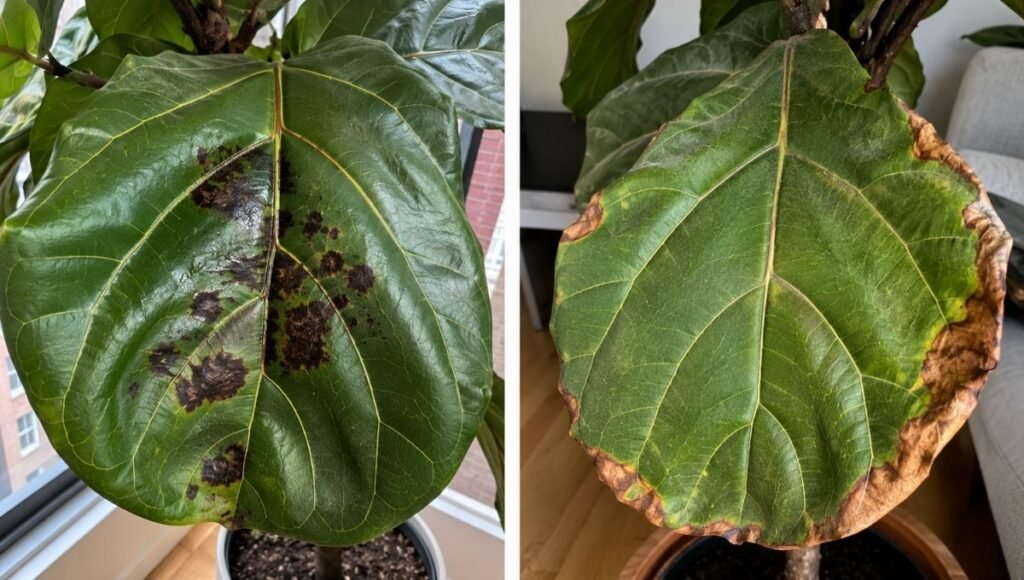
The most common concern — and the most diagnostic, because the location and texture of the spots tell you exactly what’s wrong.
Dark brown spots spreading from the center, soft texture: overwatering or root rot. Stop watering. Check drainage. Inspect roots if widespread. Reduce watering frequency.
Brown spots or edges starting from the leaf margin, dry and crispy: underwatering or low humidity. Increase watering frequency and check humidity levels.
Small round spots with a yellow halo: possibly a fungal or bacterial infection, often triggered by wet leaves or poor air circulation. Remove affected leaves, improve air circulation, water at the base rather than over foliage.
Leaf Drop
Losing a few leaves after moving the plant: normal stress response. Give it 2–4 weeks of stable conditions.
Significant ongoing leaf drop without a recent move: usually root rot (check soil moisture and roots) or insufficient light. Address whichever applies.
No New Growth
If the plant has produced no new leaves during spring or summer despite good conditions: light is the most likely limiting factor. Move to a brighter position. Also check whether the plant is severely rootbound — very rootbound plants slow growth dramatically.
If You Only Have 10 Minutes Right Now
Don’t water it. Check the soil first. Then look at where it’s positioned — is it within 5 feet of a decent window? If it’s in a dim corner, that’s your first problem to solve.
Those two things — resisting the urge to over-water and getting the light right — will do more for your fiddle leaf than any fertilizer, any misting routine, or any plant food on the market.
⚠️ Toxicity: Fiddle Leaf Figs and Pets
Fiddle leaf figs (Ficus lyrata) are toxic to cats and dogs. The latex sap and leaves cause irritation to the mouth, vomiting, and digestive upset if ingested. The ASPCA confirms Ficus species are toxic to both cats and dogs.
Keep fiddle leaf figs out of reach of pets that chew on plants. Contact your veterinarian if ingestion occurs.
FAQ
Why are my fiddle leaf fig leaves dropping? The most common cause is a recent move — stress from environmental change triggers leaf drop that usually stabilizes in 2–4 weeks. If the plant hasn’t been moved recently, insufficient light or root rot from overwatering are the next most likely causes. Check soil moisture and light conditions.
How often should I water a fiddle leaf fig? When the top 2 inches of soil feel completely dry — typically every 7–10 days in summer, every 10–14 days in autumn, and every 2–3 weeks in winter. Never water on a fixed schedule without checking the soil first.
Why does my fiddle leaf fig have brown spots? The location of the spots tells you the cause: dark brown spots starting in the center of the leaf indicate overwatering or root rot; dry crispy brown edges and tips indicate underwatering or low humidity. Treat accordingly.
Can fiddle leaf figs grow in low light? No — not successfully. Fiddle leaf figs need bright indirect light near a window to maintain leaf health and produce new growth. In genuinely low light, they slowly decline. If your space is dark, choose a snake plant or ZZ plant instead — they’re better suited.
Are fiddle leaf figs safe for cats and dogs? No — fiddle leaf figs are toxic to cats and dogs. Ingestion causes oral irritation, vomiting, and digestive upset. Keep out of reach. Contact your vet if ingestion occurs.
How do I stop my fiddle leaf fig from leaning? Rotate the plant a quarter turn every month or every second watering. This prevents the plant from growing asymmetrically toward the light source and keeps the shape balanced and upright.
A Note on the Reputation
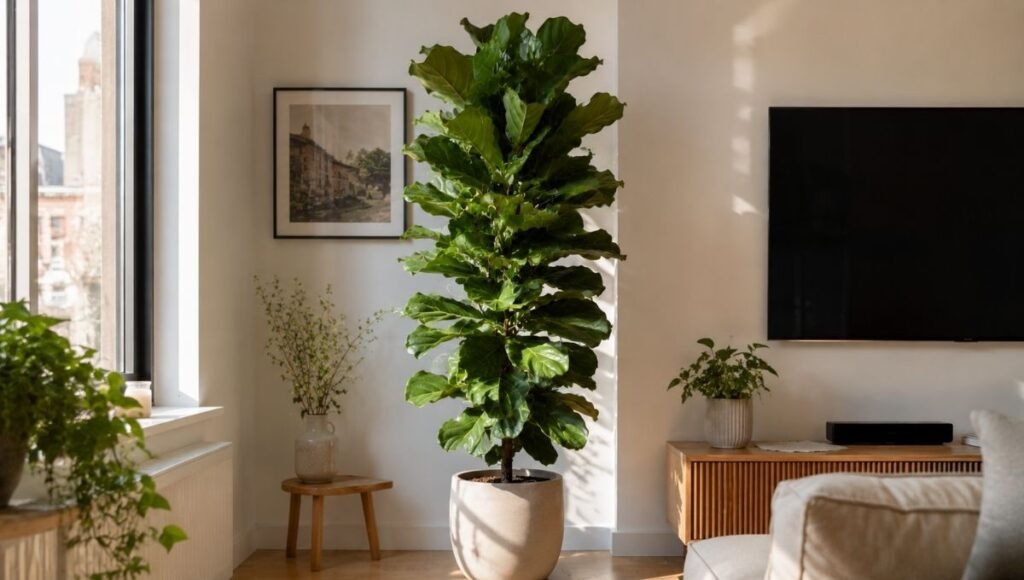
The fiddle leaf fig’s reputation for being “difficult” is not entirely unfair — it’s definitely more sensitive than a pothos or a snake plant, and it will absolutely punish you for overwatering or moving it around too much. But “difficult” and “impossible” are very different things.
The honest assessment is this: if you can find it the right spot (bright indirect light, stable temperature, no drafts), commit to watering only when the soil is dry, and leave it alone — the fiddle leaf fig is a stunning plant that will grow steadily and dramatically for years. The problems almost always come from doing too much, not too little.
Research from the Royal Horticultural Society consistently shows that attention and observation are the most important skills in successful plant care — not products, not complicated routines, but genuinely paying attention to what the plant is telling you. The fiddle leaf is demanding in the sense that it’s communicative. It shows you when something’s wrong. Learn to read it, and the rest follows.
Keep Growing
- 🌿 [Indoor Plant Care: The Complete Beginner’s Guide] — the principles behind every plant you’ll ever own
- 🌑 [Rubber Plant Care: Complete Guide] — a similarly architectural statement plant, but significantly more forgiving
- 💛 [Plant Leaves Turning Yellow? 7 Real Causes and Fixes] — diagnose any struggling plant fast
- 🔄 [How to Repot a Plant: Step-by-Step for Beginners] — when your fiddle leaf outgrows its pot
References: ASPCA Animal Poison Control Center. Toxic and Non-Toxic Plant List — Fiddle Leaf Fig (Ficus lyrata). Royal Horticultural Society (2025). Growing Ficus lyrata indoors. Houseplant411 (2024). Fiddle Leaf Fig Plant Care Guide. Missouri Botanical Garden Plant Finder (2024). Ficus lyrata — Fiddle Leaf Fig. Bloomscape Plant Care Team (2024). Fiddle Leaf Fig Care. Soga, M., Gaston, K.J., & Yamaura, Y. (2017). Gardening is beneficial for health: A meta-analysis. Preventive Medicine Reports, 5, 92–99.