
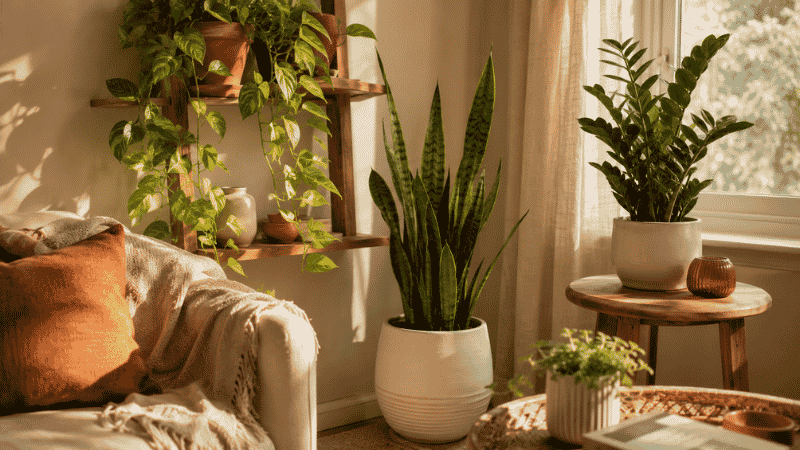
You walked past a plant shop last spring. Something green caught your eye — a glossy pothos in a terracotta pot, trailing its vines like it had all the time in the world. You bought it. You brought it home, found it the perfect sunny corner, watered it religiously every three days, talked to it occasionally.
And then, about six weeks later, it quietly died.
Here’s the thing nobody tells you: that pothos almost certainly didn’t die from neglect. It probably died from too much care — overwatering, a location that was sunnier than it looked, or soil that never had a chance to dry out. The problem wasn’t you. The problem was that nobody matched you with the right plant for your actual home and your actual lifestyle.
That’s what this guide does. Whether you have a dark apartment, a sun-drenched balcony, a forgetful watering schedule, or a curious cat, we’ve matched the best low maintenance indoor plants to the real situations people actually live in — not the idealized plant-parent life on Instagram.
Key Takeaways
- The leading cause of houseplant death is overwatering, not neglect — so “low maintenance” often means less watering, not more attention
- Research published in the Journal of Physiological Anthropology found that interacting with indoor plants reduces psychological and physiological stress — your green corner is genuinely good for you
- Most low maintenance indoor plants can survive 2–4 weeks without water, making them perfect for busy people and frequent travelers
- Light is the single most important factor in choosing the right plant — matching a plant to your actual light levels matters more than any other care consideration
- You don’t need a yard, a green thumb, or expensive equipment — just the right plant in the right spot
What Actually Makes a Plant “Low Maintenance”?
Before we dive into recommendations, it’s worth getting clear on what “low maintenance” really means — because a lot of plant lists get this wrong.
A truly low maintenance indoor plant has at least three of these four qualities: it tolerates irregular watering (can go 2+ weeks without a drink), it adapts to a range of light conditions, it bounces back from beginner mistakes without sulking, and it doesn’t demand high humidity, special fertilizers, or frequent repotting.
What it does not mean is “requires zero care.” Every living thing needs some attention. The difference is that low maintenance plants are forgiving — they give you a wide margin for error, and they recover when you slip up.
The single biggest mistake people make when choosing a plant is picking based on looks without checking light requirements. A beautiful fiddle leaf fig in your north-facing living room is a recipe for heartbreak. A pothos in that same spot will thrive for years.
Best Low Maintenance Indoor Plants for Low Light Rooms
If your home has small windows, north-facing rooms, or corners that never see direct sun — this section is for you. These plants have evolved to survive in the dappled shade of tropical forest floors, which means your dim apartment is practically paradise to them.
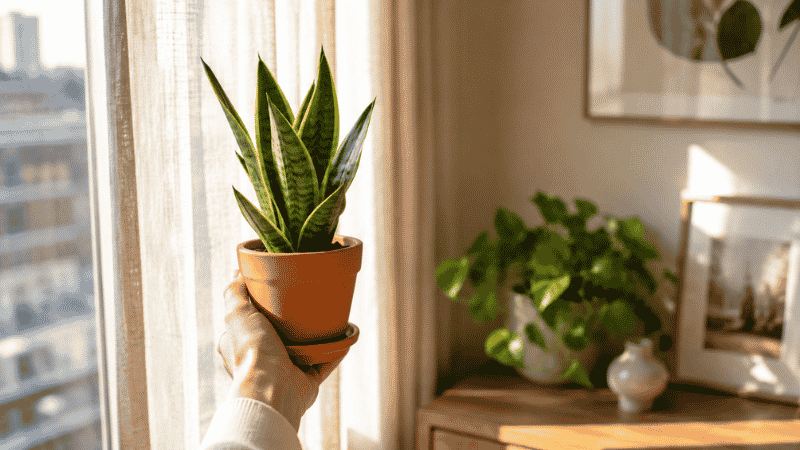
Snake Plant (Dracaena trifasciata)
Light: Low to bright indirect | Water: Every 2–6 weeks | Pet safe: No
The snake plant is the most commonly recommended beginner plant in the world, and for good reason: it is genuinely almost impossible to kill. It tolerates low light better than virtually any other plant, stores water in its thick leaves, and can survive weeks of being completely ignored.
Its upright, architectural shape adds structure to any room, and it comes in dozens of varieties — from compact tabletop sizes to dramatic four-foot floor plants.
Most common way to kill it: Overwatering. Snake plants rot quickly in soggy soil. Water only when the soil is completely dry all the way through, and make sure the pot has drainage holes.
Pothos (Epipremnum aureum)
Light: Low to bright indirect | Water: Every 1–2 weeks | Pet safe: No
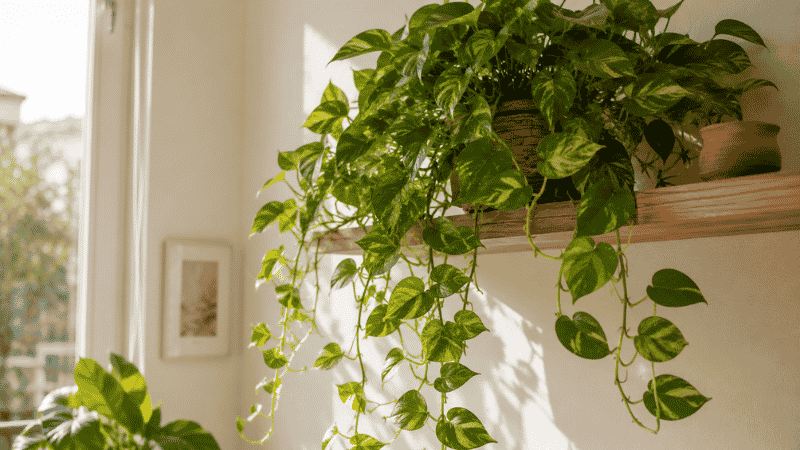
If you only own one plant, let it be a pothos. It grows in water, in soil, in almost any lighting condition, and it will trail beautifully from a shelf or climb enthusiastically up a moss pole. It’s been called “the houseplant that cannot die,” which is only a slight exaggeration.
Golden pothos, marble queen, neon, and satin pothos all have slightly different looks but share the same easygoing personality. Start with golden pothos — it’s the most widely available and the most forgiving of the bunch.
Most common way to kill it: Overwatering in a pot without drainage. Pothos wants to almost dry out between waterings. In low light, it needs even less water than you think.
ZZ Plant (Zamioculcas zamiifolia)
Light: Low to medium indirect | Water: Every 2–4 weeks | Pet safe: No
The ZZ plant looks like it was designed by an interior decorator — glossy, deep green, perfectly symmetrical. It also happens to survive in conditions that would finish off most other plants. Its thick rhizomes (underground storage organs) hold water for weeks, making it the ideal choice for travelers and the chronically forgetful.
You’ll often see ZZ plants in hotel lobbies and airport lounges — places that require attractive plants with near-zero maintenance. That’s your endorsement right there.
Most common way to kill it: Root rot from overwatering. This plant would genuinely rather be underwatered. If in doubt, wait another week.
Peace Lily (Spathiphyllum)
Light: Low to medium indirect | Water: Weekly | Pet safe: No ⚠️ (toxic to cats and dogs)
The peace lily is the rare low-light plant that also flowers, producing elegant white blooms several times a year. It’s one of NASA’s top-rated air-purifying plants, and it has the most useful feature of any houseplant: it dramatically droops when it’s thirsty, then perks back up within hours of being watered. It’s essentially self-signaling.
This makes it the perfect plant for beginners who aren’t sure when to water — the plant tells you itself.
Most common way to kill it: Direct sunlight, which scorches the leaves. Keep it away from south-facing windows, and it will reward you handsomely.
Chinese Evergreen (Aglaonema)
Light: Low to medium indirect | Water: Every 1–2 weeks | Pet safe: No
Chinese evergreen might be the most underrated plant on this list. It comes in stunning varieties — deep green, silver-streaked, pink-tipped, red-flushed — and it tolerates conditions that would devastate most other plants: low light, dry air, inconsistent watering. It’s commonly used in shopping malls and office buildings for exactly this reason.
If you want something with more visual personality than a plain green plant but still need near-zero maintenance, aglaonema is your answer.
Most common way to kill it: Cold drafts. Keep it away from air conditioning vents and cold windows in winter.
Best Low Maintenance Indoor Plants for Sunny Spots and Balconies
If you have south or west-facing windows, a bright balcony, or a sunroom, you have a different problem: most low-maintenance plants actually prefer indirect light, so bright spots can be limiting. These plants love the sun and still ask very little of you.
Aloe Vera
Light: Bright direct or indirect | Water: Every 2–4 weeks | Pet safe: No
Aloe vera is both a plant and a first-aid kit. Its gel soothes sunburns, minor cuts, and skin irritation — which means the more sunburned you get tending your balcony, the more useful your aloe becomes.
As a succulent, it stores water in its fleshy leaves and genuinely thrives on neglect. Give it a sunny windowsill or a spot on the balcony, water it infrequently, and it will quietly double in size over the coming months.
Most common way to kill it: Overwatering, especially in winter. Aloe needs very little water when temperatures drop. Reduce watering to once a month between October and February.
Spider Plant (Chlorophytum comosum)
Light: Medium to bright indirect | Water: Every 1–2 weeks | Pet safe: ✅ Yes
The spider plant is one of the few truly pet-safe options on this list, which makes it particularly valuable for households with cats or dogs. It’s also one of the most enthusiastic plants you can own — it produces cascading “spiderettes” (baby plants on long stems) that you can snip off and propagate in a glass of water for free new plants.
It looks gorgeous in a hanging basket, where the babies can drape down like a living curtain.
Most common way to kill it: Root-bound neglect. Spider plants grow fast and need repotting every year or two. If growth slows dramatically, check whether roots are circling the bottom of the pot.
Rubber Plant (Ficus elastica)
Light: Medium to bright indirect | Water: Every 1–2 weeks | Pet safe: No
The rubber plant brings drama to a room in a way few other low-maintenance plants can. Its large, glossy leaves — which come in deep green, burgundy, or variegated cream and pink — create an instant statement. It grows steadily into an impressive floor plant over time, and it asks very little in return.
Give it a bright spot away from direct afternoon sun, let the top inch of soil dry before watering, and wipe its leaves with a damp cloth occasionally to keep them glossy and dust-free.
Most common way to kill it: Sudden environmental changes. Rubber plants are sensitive to being moved — once they settle in a spot they like, leave them there.
Low Maintenance Indoor Plants That Are Safe for Pets
This is one of the most-searched and least-answered questions in the houseplant world: which plants won’t hurt my cat or dog? Many of the most popular low-maintenance plants — including pothos, snake plant, ZZ plant, and peace lily — are toxic to pets if ingested.
If you share your home with animals, these are your safest choices:
Spider Plant — Non-toxic to cats and dogs. Mildly hallucinogenic to cats (they love chewing it), but not harmful.
Boston Fern (Nephrolepis exaltata) — Non-toxic, loves humidity, looks lush. Needs a bit more watering than most on this list but is very forgiving.
Areca Palm (Dypsis lutescens) — Non-toxic, brings a tropical vibe to a room, tolerates low to medium light.
Calathea / Prayer Plant (Calathea spp.) — Non-toxic, stunning patterned leaves, folds its leaves at night like hands in prayer.
Parlor Palm (Chamaedorea elegans) — Non-toxic, elegant, grows slowly in low to medium light, and is one of NASA’s air-purifying picks.
One important caveat: “non-toxic” means the plant won’t cause serious harm if chewed — it doesn’t mean zero reaction. Any plant can cause mild stomach upset in pets if eaten in large quantities. If your pet has a strong habit of chewing plants, even non-toxic varieties are best kept out of reach.
The One Plant Every Beginner Should Start With
If you’ve read this far and still can’t decide, let me make it simple: start with a pothos.
Not because it’s the most beautiful (though it is lovely). Not because it’s the trendiest (though it’s always in style). Because it will teach you, better than any guide, what a healthy plant looks like versus a struggling one. Its leaves tell you everything — yellow means too much water, brown tips mean too dry, trailing stems reaching toward the light means it wants a brighter spot.
Pothos is the best teacher in the plant world. Spend one season with a pothos, and you’ll understand watering, light, and soil better than any article can explain. After that, you’re ready for anything.
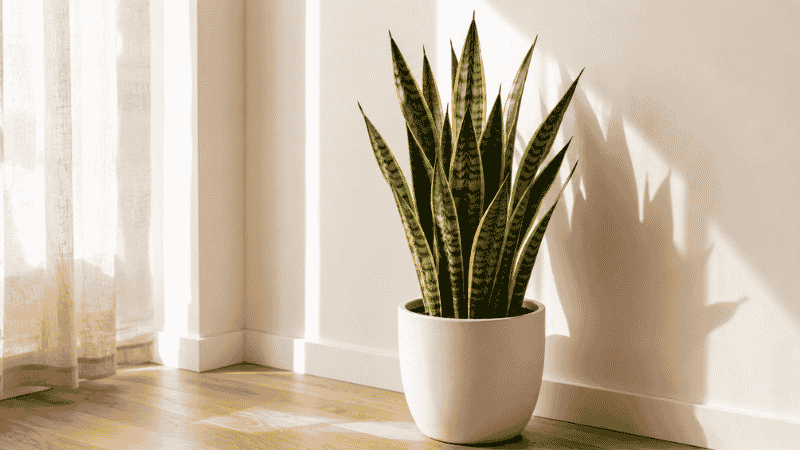
The #1 Mistake That Kills “Easy” Plants (It’s Not What You Think)
It’s not forgetting to water. It’s not the wrong pot. It’s not even bad soil.
The number one killer of low maintenance houseplants is watering on a schedule instead of checking the soil.
People set a calendar reminder — “water plants every Sunday” — and follow it faithfully regardless of what the plant actually needs. In winter, when growth slows and light drops, that weekly watering schedule can be twice as frequent as the plant requires. The soil stays wet, roots sit in moisture, and rot sets in gradually and invisibly.
The fix is simple: before you water anything, stick your finger an inch into the soil. If it’s still moist, put the watering can down and walk away. If it’s dry, water thoroughly until it drains from the bottom.
That one habit change will save more plants than any fertilizer, any grow light, or any expensive potting mix.
Simple Care Habits That Make Any Low Maintenance Plant Thrive
You don’t need a complicated routine. These four habits, done occasionally, will keep almost any low maintenance plant healthy and happy for years.
Check the soil before every watering. We cannot say this enough. Your finger is the most accurate soil moisture meter available, and it’s free.
Wipe the leaves once a month. Dust blocks light absorption. A damp cloth run over the leaves once every few weeks keeps plants cleaner, healthier, and more attractive.
Rotate the pot quarterly. Plants grow toward light, which means one side gets lush and the other stays sparse. Rotating 90 degrees every few months keeps growth even.
Repot when roots start escaping. Most low maintenance plants need repotting every 1–2 years. Signs it’s time: roots growing from drainage holes, soil drying out much faster than usual, or noticeably slowed growth. Go up one pot size — not dramatically larger.
When Your “Easy” Plant Is Struggling: Warning Signs to Watch
Even the hardiest plants occasionally signal distress. Here’s how to read the warning signs before things get serious:
Yellow leaves: Usually overwatering or poor drainage. Let the soil dry out completely before the next watering. Check that the pot has drainage holes.
Brown, crispy leaf tips: Usually underwatering or low humidity. Water more thoroughly (until it drains from the bottom), or mist the leaves if the air is very dry.
Leggy, pale, reaching stems: Not enough light. Move the plant closer to a window or to a brighter room.
Mushy stems at soil level: Root rot — the most serious condition. Remove the plant from its pot, cut away any brown or mushy roots, let the roots air-dry for an hour, and repot in fresh dry soil. Reduce watering dramatically going forward.
White crusty deposits on soil surface: Mineral buildup from tap water. Flush the soil thoroughly with water every few months, or switch to filtered water.
If you’ve tried all of the above and the plant continues to decline rapidly, it may be worth consulting your local nursery or garden center — some plants carry hidden pest infestations (particularly root mealy bugs) that are very hard to diagnose at home.
Frequently Asked Questions
What is the easiest indoor plant to keep alive? The pothos (Epipremnum aureum) is widely considered the most beginner-friendly houseplant in the world. It tolerates low light, survives irregular watering, grows in water or soil, and is available at almost every garden center and grocery store for under $10.
What low maintenance indoor plants are safe for cats and dogs? Spider plants, Boston ferns, areca palms, parlor palms, and calatheas are among the most popular pet-safe low maintenance options. Always verify toxicity at the ASPCA Animal Poison Control website (aspca.org) before bringing a new plant home.
What indoor plants don’t need sunlight? No plant can survive in complete darkness — all plants need at least some light source. However, ZZ plants, snake plants, pothos, Chinese evergreen, and cast iron plants can thrive in very low light conditions, including rooms with only a single north-facing window or indirect light from a hallway.
How often should I water low maintenance indoor plants? Most low maintenance plants need watering every 1–3 weeks, depending on the plant, pot size, soil type, and season. Rather than following a rigid schedule, check the soil before every watering: if the top inch is dry, water thoroughly; if it’s still moist, wait. In winter, most plants need significantly less frequent watering.
Can I keep low maintenance plants on a balcony? Many low maintenance plants do very well on balconies, especially in summer. Aloe vera, spider plants, rubber plants, and snake plants handle balcony conditions well. The key is knowing your balcony’s light level — south-facing balconies with direct sun suit succulents and aloe; east or north-facing balconies with indirect light are better for pothos, peace lily, and ferns. Bring sensitive plants indoors when temperatures drop below 50°F (10°C).
What is the best low maintenance plant for a dark apartment? ZZ plant and cast iron plant (Aspidistra elatior) are the strongest performers in genuinely dark conditions. Both tolerate minimal light better than virtually any other houseplant. For a dark apartment, also consider a snake plant in a variety with lighter-colored leaves, which tends to handle low light slightly better than deep-green varieties.
Do low maintenance indoor plants really clean the air? NASA’s landmark Clean Air Study identified several houseplants — including peace lily, snake plant, and pothos — as effective at removing common indoor air pollutants like formaldehyde and benzene. More recent research suggests the effect in real homes is modest (you’d need many plants for significant impact), but studies consistently show that the presence of indoor plants reduces psychological stress and improves mood, regardless of their air-filtering capacity.
The Bigger Picture: Why Having Any Plant Matters
A 2021 study published in the Journal of Physiological Anthropology found that interacting with indoor plants — touching, smelling, tending — actively reduces sympathetic nervous system activity, which is the biological marker of stress. Participants reported feeling more comfortable and calm after just a few minutes of plant interaction, compared to computer task control groups.
You don’t need a perfectly curated plant corner or a collection of rare specimens. One pothos on a shelf. One snake plant in a corner. A peace lily on your desk. These small additions to a home consistently show up in research as meaningful contributors to wellbeing — particularly in urban apartments where daily access to nature is limited.
Start with one plant. Learn how it breathes. And see where it takes you.
Ready to Keep Growing?
You’ve found your plant. Now take the next step:
- 🌱 [Gardening for Beginners: Grow Your First Garden (No Yard Needed)] — ready to take things outside? Start here
References
- Miyazaki, Y., & Kawana, S. (2021). Physiological effects of interaction with plants. Journal of Physiological Anthropology, 40(1), 1–9.
- Wolverton, B.C., Johnson, A., & Bounds, K. (1989). Interior Landscape Plants for Indoor Air Pollution Abatement. NASA/ALCA Final Report. NASA.
- Soga, M., Gaston, K.J., & Yamaura, Y. (2017). Gardening is beneficial for health: A meta-analysis. Preventive Medicine Reports, 5, 92–99.
- American Society for the Prevention of Cruelty to Animals (ASPCA). Toxic and Non-Toxic Plant List — Cats and Dogs. aspca.org/pet-care/animal-poison-control/toxic-and-non-toxic-plants.
- Iowa State University Extension and Outreach. (2023). Caring for Houseplants. Aaron Steil, Consumer Horticulture Extension Specialist.