
If you’ve ever killed a succulent, a cactus, or a plant that was literally advertised as “impossible to die,” you might have started to believe that plants and you simply don’t mix. That the gardening gene skipped you. That some people are plant people and some just aren’t.
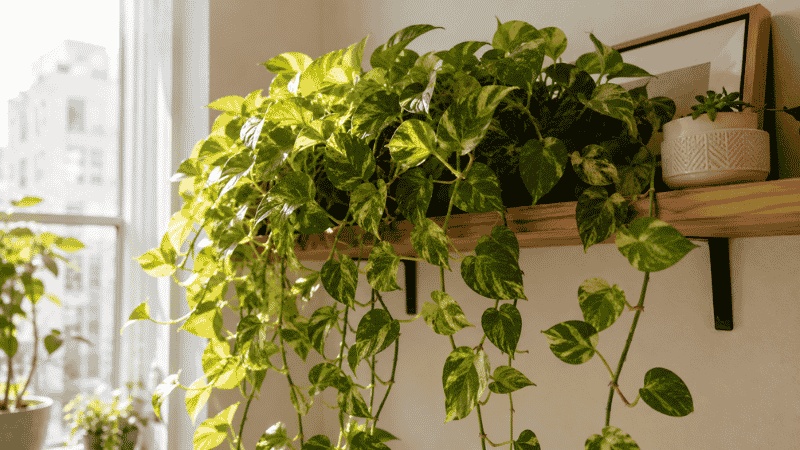
Here’s what I want you to know before we get into anything else: pothos care is different. Not just “easier” — genuinely different. This plant was practically designed to succeed with beginners. It communicates clearly when it needs something. It recovers from mistakes. It grows in water, in soil, in dim corners, and on sunny windowsills. It trails beautifully from a shelf, climbs enthusiastically up a moss pole, or sits cheerfully in a hanging basket doing nothing but looking lush.
Pothos is the plant that teaches you how to be a plant person — not because it demands anything, but because it shows you so clearly what a healthy, happy plant looks and feels like. Once you know what you’re looking for, every plant you own after this one will be easier.
This is your complete guide to how to care for pothos: everything from light and water to propagation, troubleshooting, and the varieties worth choosing.
Key Takeaways
- Pothos (Epipremnum aureum) is widely considered the most beginner-friendly houseplant in the world — it adapts to low light, forgives irregular watering, and grows in water or soil
- A 2022 scoping review in Environmental Research found that access to indoor plants like pothos consistently reduces emotional stress, anxiety, and negative mood — your plant is doing something real for you
- Overwatering is the most common cause of pothos decline — water only when the top 1–2 inches of soil feel dry
- Pothos is mildly toxic to cats, dogs, and children if ingested — keep it out of reach of curious pets and small children
- One pothos plant can produce trailing vines several feet long, and propagating cuttings in water is one of the easiest ways to multiply your plant collection for free
What Makes Pothos So Special?
Before we get into the care details, it’s worth understanding why pothos is so universally recommended — because it’s not just marketing.
Pothos (Epipremnum aureum) is native to the Solomon Islands in the South Pacific, where it grows as a vigorous climber in tropical forest understories. This origin explains its indoor character precisely: it evolved under a dense forest canopy, where light is filtered and inconsistent, where periods of rain alternate with drier spells, and where it needs to be tough enough to survive without constant conditions. In your home, that evolutionary toughness translates into flexibility — it genuinely adapts to your life rather than demanding you adapt to it.
It’s also one of the NASA Clean Air Study’s top-performing plants, identified as effective at removing indoor pollutants including benzene and formaldehyde from the air. And a 2022 scoping review published in Environmental Research found that having indoor plants — even simply looking at them — is consistently associated with reduced stress and improved emotional wellbeing. Your pothos isn’t just decoration. It’s working.
Pothos Care: Light Requirements
Pothos is famous for tolerating low light — and it genuinely does. But “tolerates” and “thrives” are very different things, and understanding the difference will make a noticeable difference in how your plant looks.
In low light (north-facing rooms, dim corners, spaces far from windows): pothos survives. It stays alive, grows slowly, and holds its leaves. But variegated varieties — those with yellow, white, or silver markings — will gradually lose their pattern and revert toward plain green, since the variegated cells have less chlorophyll and can’t photosynthesize as efficiently in low light. Growth will also slow noticeably.
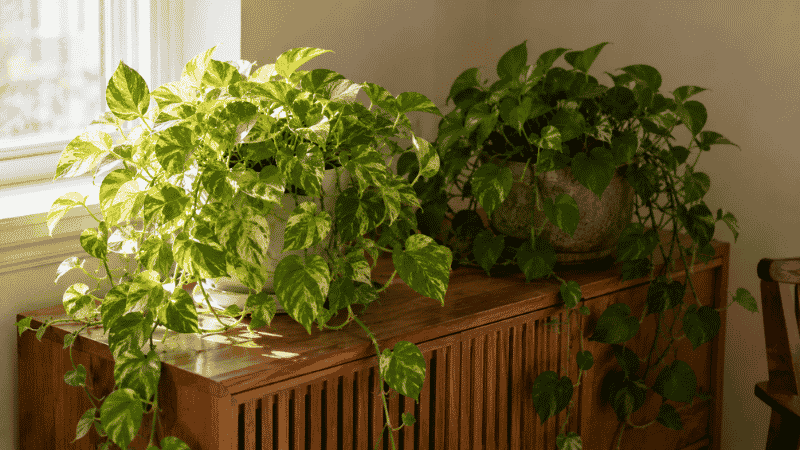
In medium to bright indirect light (east or west-facing windows, a few feet back from a south-facing window): pothos thrives. Growth is faster, leaves are larger, and variegated varieties maintain their distinctive patterns more vibrantly.
In direct harsh sun: avoid it. Direct afternoon sunlight scorches pothos leaves, creating bleached or brown patches that won’t reverse. If your sunniest window gets intense direct sun for several hours, move your plant a foot or two back from the glass, or filter the light with a sheer curtain.
Practical guidance: If your pothos is growing slowly, producing small pale leaves, or losing its variegation, more light is almost always the answer. Move it closer to a window and watch what happens over the next 4–6 weeks.
How to Water Pothos (The Most Important Skill)
The single most important thing to understand about watering pothos is this: it is far more tolerant of underwatering than overwatering.
Pothos stores water in its thick stems and leaves. A plant that has gone slightly too long without water will droop visibly — a clear, unmissable signal — and recover within hours of being watered. This is actually useful: the plant tells you when it’s thirsty.
A plant that has been overwatered doesn’t give the same warning. The damage happens underground, at the roots, while the plant may still look relatively fine above the surface. By the time you see yellowing leaves and mushy stems, root rot is already established.
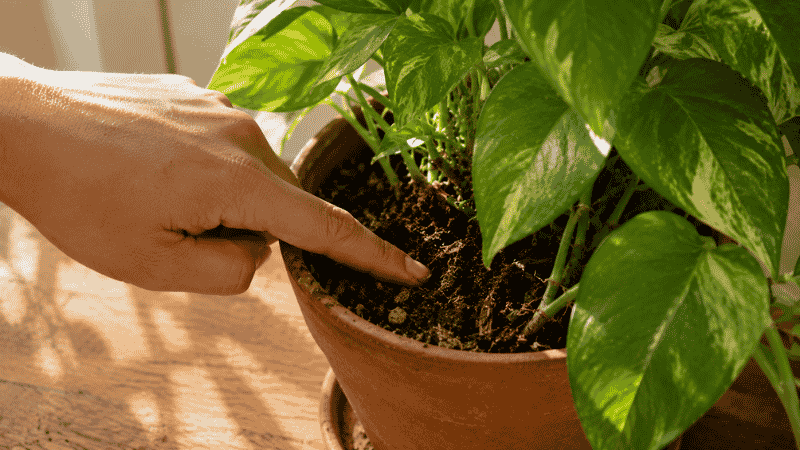
The watering rule for pothos: Press your finger into the soil. If the top 1–2 inches feel dry, water thoroughly — until water drains from the bottom of the pot. If they feel moist at all, wait.
Seasonal adjustment: In spring and summer, your pothos is actively growing and may need watering every 1–2 weeks. In autumn and winter, growth slows and the plant uses significantly less water — every 2–4 weeks is often enough. Don’t follow a rigid calendar schedule; always let the soil be your guide.
The pot matters: Always use a pot with drainage holes. A pothos in a pot without drainage is a pothos headed for root rot — there’s nowhere for excess water to go, so it pools at the bottom and saturates the roots. If you love a decorative pot without holes, use it as a sleeve: keep your pothos in a plastic nursery pot inside the decorative one, and remove it to water over a sink.
Soil: Keep It Simple
Pothos isn’t particular about soil, but it does need good drainage. A standard all-purpose potting mix works perfectly well. If you want to improve drainage slightly — which is helpful if you tend to water on the generous side — mix in a small amount of perlite (about 20–30% of the total volume).
Never use garden soil in a container. It compacts with repeated watering, blocks drainage, and can introduce pests and diseases.
On repotting: Pothos doesn’t need frequent repotting. Check every year or two — if roots are growing out of the drainage holes or the plant is drying out within a day of watering, it’s time to move up one pot size. Go up only one size (1–2 inches larger in diameter); too large a pot holds excess wet soil that the roots can’t absorb, increasing root rot risk.
Temperature and Humidity
Pothos does well in the conditions most people keep their homes — roughly 65–85°F (18–29°C). It’s a tropical plant, so it dislikes cold: temperatures below 50°F (10°C) can stress or damage it, and frost will kill it. Keep it away from cold drafts near windows in winter and away from air conditioning vents in summer.
Humidity-wise, pothos is easygoing. It grows perfectly well in standard household humidity without any misting or humidifier required. In very dry environments (particularly in winter with heating running), you might notice brown leaf tips — this is a sign of low humidity rather than a watering problem. Grouping plants together or placing a small tray of pebbles and water near the plant can help in dry conditions.
Fertilizing: Less Than You Think
Pothos doesn’t need heavy feeding. A balanced liquid houseplant fertilizer, applied once a month during spring and summer at half the recommended strength, is more than enough to keep a pothos growing well.
Stop fertilizing in autumn and don’t feed at all in winter — the plant’s growth slows significantly, and fertilizer it can’t absorb builds up as mineral salts in the soil, which can burn roots and cause brown leaf tips.
Signs of over-fertilizing: white crusty deposits on the soil surface or inside the pot rim, brown leaf tips despite appropriate watering, or leaves that look stressed despite seemingly correct care. If this happens, flush the soil thoroughly by watering heavily several times in a row to wash out accumulated salts.
Pothos Varieties: Which One Should You Choose?
All pothos varieties share the same easygoing care requirements — the differences are primarily visual. Here are the most commonly available:
Golden Pothos — the classic. Heart-shaped leaves in mid-green with irregular golden-yellow streaks. The most widely available, most forgiving, and most tolerant of low light. The best starting choice.
Marble Queen — white and green marbled leaves. Requires slightly more light than Golden to maintain its variegation, but still very easy. One of the most beautiful varieties.
Neon Pothos — solid chartreuse-yellow leaves, no variegation. Surprisingly striking in a room. Very low light tolerant — one of the best choices for dimmer spaces.
Satin Pothos (Scindapsus pictus) — technically a different genus but treated identically in care. Silver-spotted dark green leaves with a matte, velvety surface. Slightly slower growing but distinctly beautiful.
Pearls and Jade — small green and white variegated leaves with a more compact growth habit. Slightly slower than Golden but gorgeous.
For beginners: start with Golden Pothos. It’s the most forgiving, the easiest to find, and teaches you the core habits that apply to every variety.
How to Make Your Pothos Fuller and Longer
Two questions most people have after a few months with their pothos:
“Why does my pothos only grow from the tips and look sparse in the middle?” Pothos naturally puts most of its energy into extending existing vines rather than producing side branches. To encourage bushier growth, trim the long trailing vines — cut just above a leaf node (the small bump where a leaf joins the stem). The plant will branch from that cut point, producing multiple new stems instead of one long one. Those cut pieces can be propagated (see below).
“How do I get bigger leaves?” Pothos leaves grow larger when the plant is allowed to climb rather than trail. In the wild, pothos climbs trees and its leaves can reach 60cm across. Indoors, giving your pothos a moss pole or wooden support to climb — rather than letting it trail from a shelf — will gradually produce noticeably larger leaves. It won’t happen overnight, but over a season you’ll see a clear difference.
How to Propagate Pothos in Water (Free New Plants)
Propagating pothos is one of the most satisfying and easiest plant skills you can learn. One plant can become dozens, entirely for free.
What you need: clean scissors, a glass of water, a sunny spot.
How to do it:
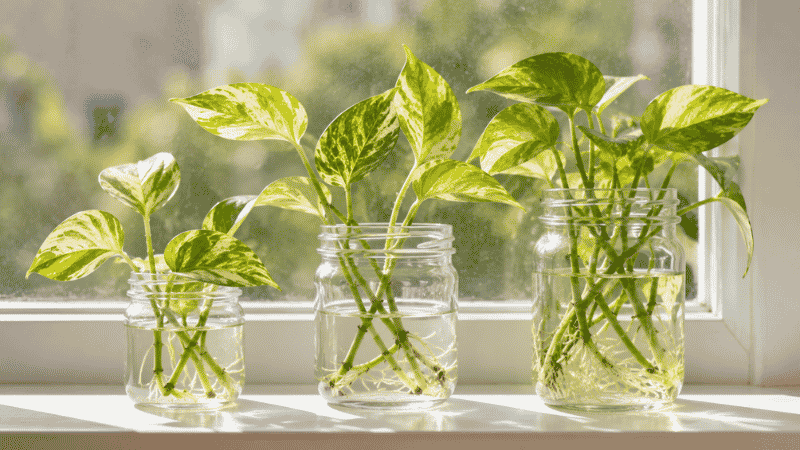
- Find a healthy vine and identify a node — the small bump or aerial root nub on the stem where a leaf attaches.
- Cut the vine just below a node, creating a cutting 4–6 inches long with 2–4 leaves.
- Remove any leaves from the bottom 2 inches of the cutting (leaves submerged in water will rot).
- Place the cut end in a glass of clean water, with the nodes submerged and the remaining leaves above the waterline.
- Set in a spot with bright indirect light. Change the water every few days to keep it clean.
- Roots appear in 1–3 weeks. Once roots are 1–2 inches long, the cutting can be potted in soil — or left growing in water indefinitely (pothos grows happily in water long-term).
Propagated cuttings make wonderful gifts, extra plants for other rooms, or additions to the mother pot to make it fuller and more lush.
Common Pothos Problems and What to Do
Why Are My Pothos Leaves Turning Yellow?
Yellow leaves on pothos are almost always caused by overwatering. When roots sit in consistently wet soil, they can’t absorb oxygen, begin to rot, and stop delivering nutrients to the leaves — which turn yellow.
Fix: Let the soil dry out completely before watering again. Check that your pot has drainage holes and that you’re not watering on a fixed schedule. If yellowing is rapid and widespread, slide the plant out of its pot to inspect the roots — healthy roots are white and firm; rotted roots are brown or black and mushy.
Natural leaf aging (the very oldest, lowest leaves occasionally turning yellow) is normal and not a problem. It’s only concerning if yellow leaves are appearing throughout the plant or progressing rapidly upward.
Why Is My Pothos Drooping?
Drooping leaves almost always mean the plant is thirsty. Check the soil — if it’s dry, water thoroughly and the leaves will perk up within a few hours.
If the soil is wet and the plant is drooping, it’s a more serious signal — potentially root rot, where the root system has been damaged by overwatering and can no longer support the plant structurally. In that case, check the roots as described above.
Why Does My Pothos Have Brown Tips?
Brown, crispy leaf tips are usually caused by low humidity, fluoride sensitivity (tap water), or fertilizer salt buildup. Try switching to filtered water, or let tap water sit out overnight before using. Flush the soil thoroughly every few months to remove accumulated minerals.
Brown tips don’t reverse once they’ve formed — trim the affected tips with clean scissors, cutting at a slight angle to maintain the leaf’s natural shape.
Why Is My Pothos Growing Slowly?
The most common cause is insufficient light. Move it closer to a window. If light is already good, consider whether it’s been a long time since it was fertilized (spring and summer feeding) or whether the pot is too small and the plant is rootbound.
If You Only Have 5 Minutes Right Now
Check the soil. If it’s dry, water thoroughly. If it’s moist, walk away. That’s the entire foundation of pothos care — everything else is refinement.

A Note on Pothos and Pets
Pothos is mildly toxic to cats, dogs, and children if chewed or ingested. It contains calcium oxalate crystals that cause irritation to the mouth, throat, and digestive system — symptoms include drooling, vomiting, and difficulty swallowing. The toxicity is considered mild rather than life-threatening, but it’s worth keeping pothos out of reach of animals and small children that habitually chew on things.
Verify current toxicity information at aspca.org before bringing any new plant home if you have pets.
FAQ
How often should I water pothos? Every 1–2 weeks in spring and summer; every 2–4 weeks in autumn and winter. But frequency matters less than the soil test: water only when the top 1–2 inches of soil feel dry. The plant’s drooping leaves are also a reliable signal that it’s time to water.
Can pothos grow in low light? Yes — better than almost any other houseplant. In low light, pothos survives well and stays green, though growth slows and variegated varieties may lose some of their markings. For the best growth and leaf color, medium to bright indirect light is ideal.
Can pothos live in water permanently? Yes. Pothos grows happily in a jar of water indefinitely — no soil required. Change the water every 1–2 weeks to keep it clean and add a small amount of liquid houseplant fertilizer at very diluted strength every few weeks to provide nutrients. It won’t grow as vigorously as in soil, but it’s a genuinely attractive and low-maintenance option.
Is pothos safe for cats and dogs? No — pothos is mildly toxic to cats and dogs if ingested. Keep it out of reach of pets that chew on plants. For pet-safe alternatives, spider plants, Boston ferns, and areca palms are excellent low-maintenance choices.
How do I make my pothos trail longer? Give it a high shelf, a hanging basket, or train it along a wall with small hooks. Pothos grows toward light — positioning the pot near a window with the vines trailing away from it encourages long, even growth. Trim any bare or sparse sections and propagate the cuttings back into the pot for a fuller effect.
How long can pothos live? With proper care, pothos plants can live for many years — decades in some cases. They’re perennial plants that don’t have a natural lifespan limit under good conditions. Some gardeners have pothos that have been in the family for 20+ years, passed down as cuttings from generation to generation.
The Thing About Pothos
There’s a reason pothos shows up in offices, hospital waiting rooms, hotel lobbies, and every apartment you’ve ever been in that felt like it belonged to someone who had their life together. It’s not high-maintenance aesthetic — it’s the opposite. It’s the plant that works with your actual life, not the idealized version of it.
A 2015 study published in the Journal of Physiological Anthropology found that interacting with indoor plants — transplanting, touching, caring for — actively reduces heart rate, blood pressure, and psychological stress compared to computer tasks. The act of checking your pothos, watering it, watching a new leaf unfurl — these are genuinely restorative moments in an otherwise digital day.
Start with one pothos. Let it teach you. Go from there.
Keep Growing
- 🌿 [Low Maintenance Indoor Plants: 12 Hard-to-Kill Picks] — what to grow alongside your pothos
- 🔄 [How to Repot a Plant: Step-by-Step for Beginners] — when your pothos outgrows its pot
- 💧 [Plant Leaves Turning Yellow? 7 Real Causes and How to Fix Them] — the full diagnostic guide
- 🌱 [Best Plants for Beginners: 15 Picks That Are Actually Hard to Kill] — your next plant awaits
References: Lee, M.S., Lee, J., Park, B.J., & Miyazaki, Y. (2015). Interaction with indoor plants may reduce psychological and physiological stress by suppressing autonomic nervous system activity in young adults: a randomized crossover study. Journal of Physiological Anthropology, 34(1), 21. Largo-Wight, E., et al. (2022). When green enters a room: A scoping review of epidemiological studies on indoor plants and mental health. Environmental Research, 214. Wolverton, B.C., Johnson, A., & Bounds, K. (1989). Interior Landscape Plants for Indoor Air Pollution Abatement. NASA/ALCA Final Report. ASPCA Animal Poison Control Center. Toxic and Non-Toxic Plant List — Pothos.