
Someone asked on Reddit: “How easy are birds of paradise to care for? I keep seeing them everywhere and I want one but I don’t know if I can handle it.”
The answers were split almost perfectly in half. Half the replies said something like “it’s basically a set-it-and-forget-it plant, mine’s thriving and I barely look at it.” The other half said “mine’s been sitting there for eight months and hasn’t done anything.” What nobody explained was why both things are simultaneously true — and it comes down to one variable that most care guides mention but don’t emphasize enough.
Light. Not “bright indirect light” in the vague, hand-wavy way most guides describe it. Actual bright light, hours of it, close to a real window. Give a bird of paradise that, and the rest of the care is genuinely manageable. Put it in a corner that feels bright-ish but actually isn’t, and you’ll have a beautiful, expensive plant that sits there doing nothing and confusing you about what you’re doing wrong.
This guide is honest about what bird of paradise care actually requires, what the common frustrations really mean, and what makes it worth it.
Key Takeaways
- Bird of paradise (Strelitzia nicolai or Strelitzia reginae) needs bright light — 4–6 hours of direct or very bright indirect sun — to grow well indoors; this is the single most important care variable
- Leaf splitting is completely normal — it’s an adaptation from the plant’s native South African environment and doesn’t mean anything is wrong
- Expect very slow growth indoors — a new leaf can take months to unfurl; this is normal and does not mean the plant is struggling
- Bird of paradise is toxic to cats and dogs — the ASPCA lists it as toxic; keep out of reach of pets
- Flowering indoors is rare and requires years of growth, excellent light, and patience — most indoor bird of paradise plants are grown for their spectacular foliage, not their flowers
Two Plants That Share a Name: Which One Do You Have?
Before anything else — because this actually matters for care expectations: “bird of paradise” is used for two different plants, and they have meaningfully different scales.
Strelitzia reginae — the orange bird of paradise. The one with those famous orange and blue crane-shaped flowers. Smaller plant, typically reaching 3–4 feet indoors. More likely to flower (though still rare indoors). The classic one you’ve seen in florist shops.
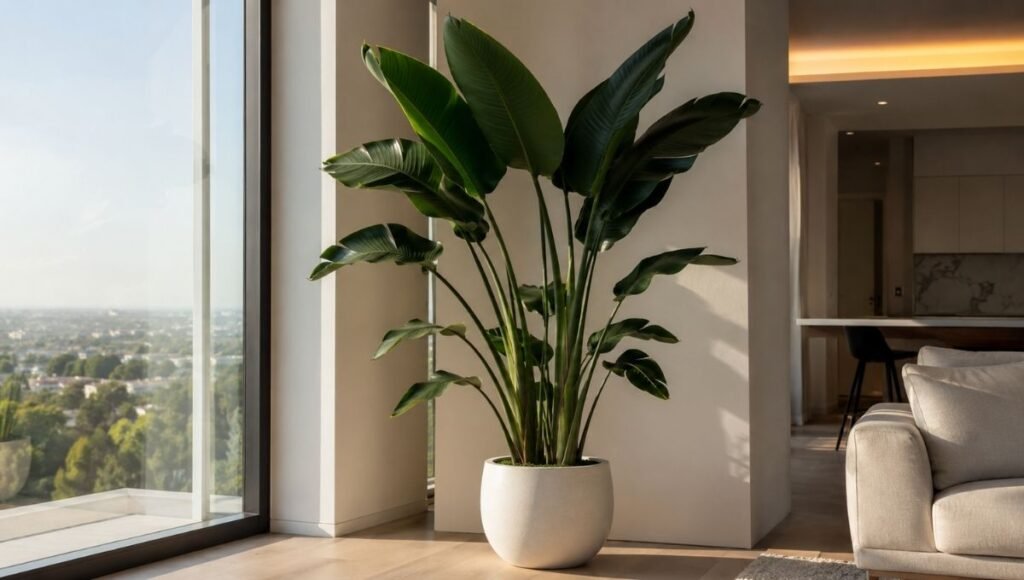
Strelitzia nicolai — the white or giant bird of paradise. Much larger — 6–8 feet indoors is common, and it can go higher. Paddle-shaped leaves that look almost like banana leaves. Rarely flowers indoors. This is the one you’ve seen in every design Instagram account, standing dramatically in a light-filled corner.
Both share the same care requirements, but if you’re buying one for a standard-sized apartment, the nicolai will eventually dominate the room in a way that feels either spectacular or overwhelming depending on how you feel about that kind of presence.
Bird of Paradise Care: The Light Requirement (Where Most People Go Wrong)
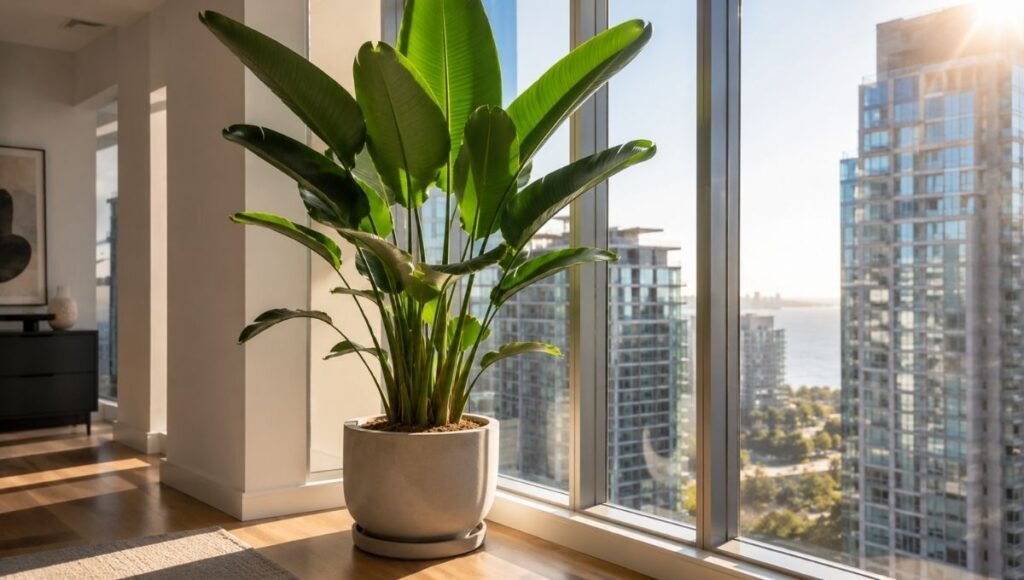
The Reddit thread that inspired this guide got one highly upvoted comment that nailed it: “Mine took off the moment I moved it from ‘near a window’ to ‘actually next to the window with direct sun for a few hours every day.'”
Bird of paradise plants are native to South Africa — open, sunny subtropical regions where they grow in full sun. Indoors, they need more light than most popular tropical houseplants. Significantly more.
What works: a south or west-facing window where the plant receives 4–6 hours of direct sun or very bright indirect light daily. The closer to the glass, the better — unlike shade-loving plants that need to be protected from the window, bird of paradise wants to be as close to that light source as possible (while monitoring for leaf scorch in intense summer heat).
What doesn’t work (despite looking bright): the corner of a room that gets light but no direct sun. A window that faces north. A spot more than 4–5 feet from any window. These positions produce a bird of paradise that stays alive but doesn’t grow, doesn’t produce new leaves, and gradually declines over months in ways that are hard to diagnose.
Signs your bird of paradise needs more light: the plant leans dramatically toward the light source; new leaves are very slow or stopped; stems become floppy rather than upright; existing leaves look pale or slightly dull rather than rich glossy green.
Grow lights: if your space genuinely doesn’t have adequate natural light, a strong LED grow light positioned close to the plant and run for 12–14 hours daily can supplement effectively. This is not a workaround for a completely dark room — bird of paradise needs substantial light — but it extends what’s possible in moderately dim spaces.
One maintenance habit worth building: rotate the plant a quarter turn every few weeks. Like all plants, bird of paradise grows toward light, and consistent one-direction exposure produces a lopsided plant. Rotation keeps growth even and the silhouette balanced.
How to Water a Bird of Paradise (Without Drowning It)
Bird of paradise has fleshy, thick roots — a characteristic of plants that evolved in regions with distinct wet and dry seasons. Those roots store water, which means the plant has genuine drought tolerance and does not want to sit in consistently wet soil.
The watering rule: let the top 2 inches of soil dry out before watering. When you water, water thoroughly — until water drains from the bottom of the pot. Then don’t water again until that top 2 inches is dry again.
Frequency: every 7–10 days in spring and summer when the plant is actively growing; every 14–21 days in autumn and winter when growth slows. But check the soil rather than the calendar — actual frequency depends on your pot size, light level, and home temperature.
Overwatering signs: yellowing leaves, particularly lower leaves yellowing with a yellow line along the browning edge; droopy leaves despite moist soil; a musty smell from the pot; roots that look brown and mushy if you inspect them.
Underwatering signs: dry, crispy leaf tips and edges; leaves curling inward; browning at the edges that feels dry and papery rather than soft; soil that has pulled away from the pot sides.
The distinction matters because the fixes are opposite. If in doubt, check the soil before adjusting anything.
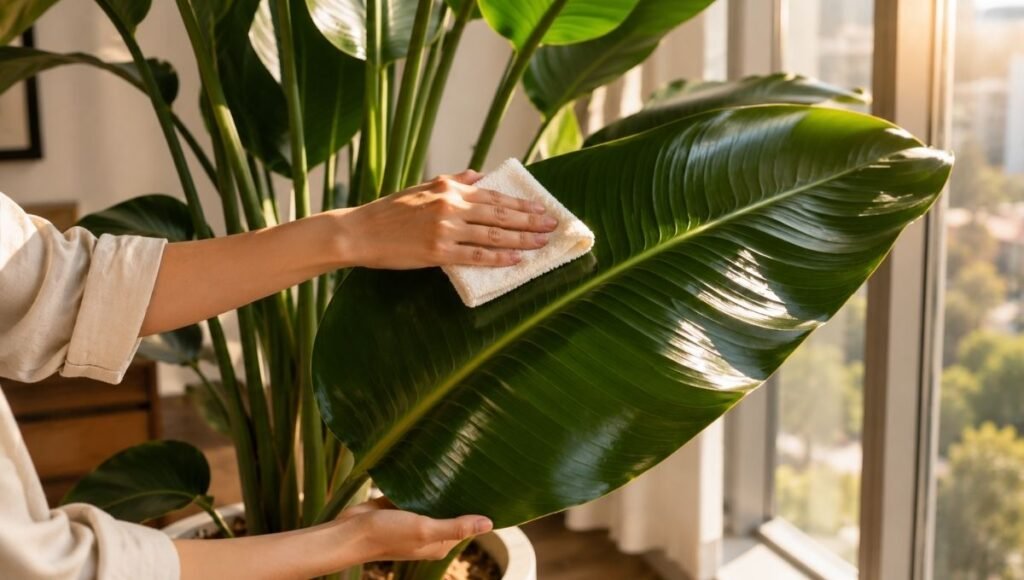
One watering note: bird of paradise leaves accumulate dust faster than most houseplants because of their large, flat surface area. Dusty leaves can’t absorb light as efficiently. Wiping the leaves with a damp cloth every 2–4 weeks is genuinely functional rather than just cosmetic — it directly improves the plant’s ability to use the light you’re providing.
About Those Splits in the Leaves (Not a Problem)
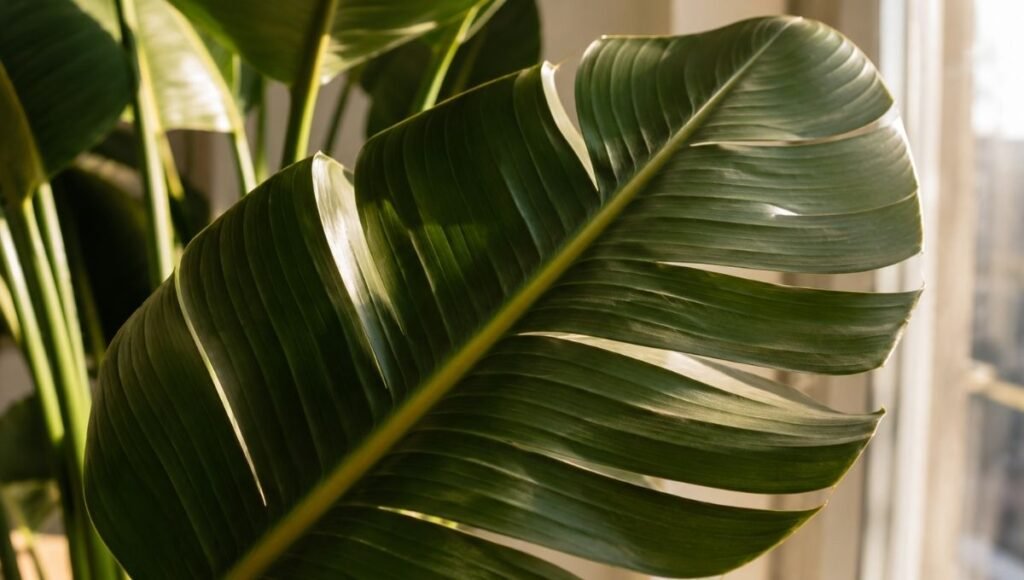
This is probably the most common alarm that new bird of paradise owners experience, and it deserves a clear, unambiguous answer: leaf splitting is completely normal and does not mean anything is wrong.
In the plant’s native South African habitat, the large paddle-shaped leaves split naturally as they mature — an evolutionary adaptation that allows wind to pass through the leaf without tearing it entirely. The splits reduce wind resistance. Indoors, the same splitting happens as leaves age and develop. It can also happen during unfurling, from handling during moving, or from the weight of the leaf itself.
Splits are a feature. They’re part of what gives the bird of paradise its distinctive, slightly wild tropical aesthetic. A split leaf is a mature, lived-in leaf — not a damaged one.
What does indicate a problem: brown, crispy edges progressing from the outside inward (usually underwatering or low humidity); yellow coloring spreading across the leaf (usually overwatering); brown soft patches (usually fungal or overwatering damage).
The Patience Question: How Fast Does It Actually Grow?
Here’s the honest answer that many guides avoid giving: bird of paradise is a slow grower indoors. Noticeably slow, particularly compared to faster tropical plants like pothos or philodendron.
A new leaf can take weeks to emerge and then months to fully unfurl. During winter, growth may stop entirely. In its first year in a new home, a bird of paradise often produces only 1–3 new leaves, even in ideal conditions.
This is normal. It’s not an indication that something is wrong with your care routine. The Reddit thread on bird of paradise care had multiple comments along the lines of “mine didn’t do anything for six months and then just… started growing.” Patience is literally part of the care requirement.
What accelerates growth: bright light (the biggest factor), feeding during spring and summer, and being appropriately — not severely — root-bound.
What slows growth: insufficient light, cold temperatures, being in a pot that’s too large, and winter dormancy.
Soil, Pots, and Repotting
Bird of paradise does well in a well-draining potting mix. Standard all-purpose potting mix with added perlite (20–30%) works well — the goal is soil that drains freely and doesn’t stay soggy after watering. Those fleshy roots that tolerate drought do not tolerate waterlogged conditions.
The rootbound preference: bird of paradise genuinely grows better when slightly root-bound. A pot that’s too large holds excess wet soil that the plant’s roots can’t absorb, increasing root rot risk and slowing growth. Being somewhat snug encourages both growth and — eventually — flowering.
Repot every 2–3 years, or when roots are visibly circling the pot bottom, growing from drainage holes, or the plant is becoming unstable. Go up one pot size — 2 inches larger in diameter. Repot in spring when the plant is entering active growth.
Important: large bird of paradise plants develop root systems substantial enough to crack ceramic pots over time. If you’re growing in ceramic, check the pot annually and move to a stronger container before this becomes a problem.
Pot weight: a large bird of paradise in a 12-inch or larger pot can become very top-heavy. Heavy terracotta or weighted containers help stabilize the plant as it grows. This is practical rather than aesthetic — a 5-foot plant in a lightweight plastic pot will tip over.
Humidity and Temperature
Bird of paradise prefers temperatures between 65–80°F (18–27°C) and humidity above 50%. In practice, most homes meet the temperature requirement easily — but humidity, particularly in winter with heating systems running, often falls short.
Signs of insufficient humidity: curling leaves, brown leaf edges, leaves that look slightly dull. A humidifier nearby, a pebble tray with water, or grouping with other tropical plants all help.
What to keep it away from: cold drafts near exterior windows in winter; direct airflow from air conditioning vents; temperatures below 55°F (13°C), which cause leaf damage.
Summer outdoors: bird of paradise genuinely thrives if moved outside during warm weather (above 60°F consistently). A sheltered spot with bright indirect outdoor light produces noticeably more vigorous growth than any indoor position. Bring it back indoors before nighttime temperatures drop below 55°F in autumn.
Feeding Your Bird of Paradise
A balanced liquid fertilizer applied monthly during spring and summer supports healthy growth and, for mature plants with adequate light, may eventually encourage flowering. Stop feeding in autumn and don’t feed through winter — unused fertilizer accumulates as mineral salts in the soil.
For established plants, a fertilizer slightly higher in phosphorus (the middle N-P-K number) supports root development and, for mature plants, can encourage blooming. Nitrogen-heavy fertilizers produce lush foliage but don’t support flowering.
About Flowering: Let’s Be Realistic
The striking orange-and-blue or white-and-purple flowers are why everyone recognizes the bird of paradise. They’re also why many people buy the plant and then feel vaguely disappointed for years.
Flowering indoors is genuinely rare. Most indoor bird of paradise plants never flower at all — or take 5–7 years of optimal care before producing their first bloom. This is not a care failure. It’s the biology of a plant that evolved to flower in full outdoor sun, as a large, established specimen.
If flowers are your primary goal, understand that you’re committing to years of excellent care in a very bright space, with no guarantee. If spectacular tropical foliage is what you actually love — those enormous, glossy, paddle-shaped leaves — then you’ll be very happy with a bird of paradise, because the foliage alone is genuinely worth it.
The editorial opinion here: most people who own bird of paradise plants stopped caring about the flowers within a year and became completely absorbed by the foliage. The leaves are the plant.
Common Problems and What They Actually Mean
“My bird of paradise hasn’t grown in months.”
Check the light first. Insufficient light is the primary cause of stalled growth. Move it as close to your brightest window as possible. Also check the season — winter dormancy is real, and a plant that’s barely growing in December is often perfectly fine.
“The leaves keep splitting.”
Normal. See above. Not a problem.
“The leaf edges are turning brown and crispy.”
Usually underwatering or low humidity. Check soil moisture — if it’s consistently dry, increase watering frequency and check whether the plant has become severely root-bound (roots circling the pot absorb water poorly). Also check humidity levels in winter.
“The lower leaves are yellowing.”
Usually overwatering. The lowest, oldest leaves also yellow naturally as they age — occasional yellowing at the very base is normal. Widespread or rapid yellowing across the plant indicates overwatering or root rot. Check soil moisture and drainage.
“My bird of paradise is leaning dramatically to one side.”
It’s reaching toward the light. Rotate the pot. If rotation doesn’t eventually correct it, the plant needs more light from a more central direction — its current position is too uneven.
⚠️ Toxicity: Important for Pet Owners
The ASPCA lists bird of paradise as toxic to cats, dogs, and horses. Ingestion can cause vomiting, drowsiness, and mild nausea. Keep it out of reach of pets that chew on plants.
If your pet ingests bird of paradise material and shows symptoms, contact your veterinarian or the ASPCA Animal Poison Control Center (888-426-4435) promptly.
If You Only Have 5 Minutes Right Now
Go look at where your bird of paradise currently is. Is it within 3 feet of a large, south or west-facing window? If not — that’s where to start. Move it as close to your brightest window as the space allows. More than any watering adjustment, any fertilizer, any humidity fix, the light change will have the biggest impact on how this plant performs.
FAQ
How easy is bird of paradise to care for? Moderate. It’s not as forgiving as pothos or snake plant, but it’s not as demanding as calathea or fiddle leaf fig. The main requirement that’s non-negotiable is bright light — 4–6 hours of direct or very bright indirect sun daily. Get the light right and the rest of the care is genuinely manageable.
Why are my bird of paradise leaves splitting? Completely normal — it’s an evolutionary adaptation from the plant’s native South African habitat. Splits allow wind to pass through without tearing the whole leaf. Mature leaves split naturally as they develop. This is a feature, not a problem.
Why isn’t my bird of paradise growing? Almost always insufficient light. Bird of paradise is much more light-hungry than it looks in interior design photos. Move it as close to your brightest window as possible. Also check the season — very slow or stopped growth in winter is normal dormancy.
How often should I water a bird of paradise? When the top 2 inches of soil feel dry — typically every 7–10 days in spring and summer, every 14–21 days in autumn and winter. Always check the soil rather than following a fixed schedule.
Will my bird of paradise flower indoors? Possibly, but don’t count on it. Indoor flowering requires years of optimal care in very bright conditions, and many bird of paradise plants never flower indoors at all. The foliage is spectacular enough to justify growing them regardless.
Is bird of paradise safe for cats and dogs? No — the ASPCA lists it as toxic to cats and dogs. Ingestion causes vomiting, drowsiness, and nausea. Keep out of reach of pets and contact your vet if ingestion occurs.
The Plant That Changes a Room
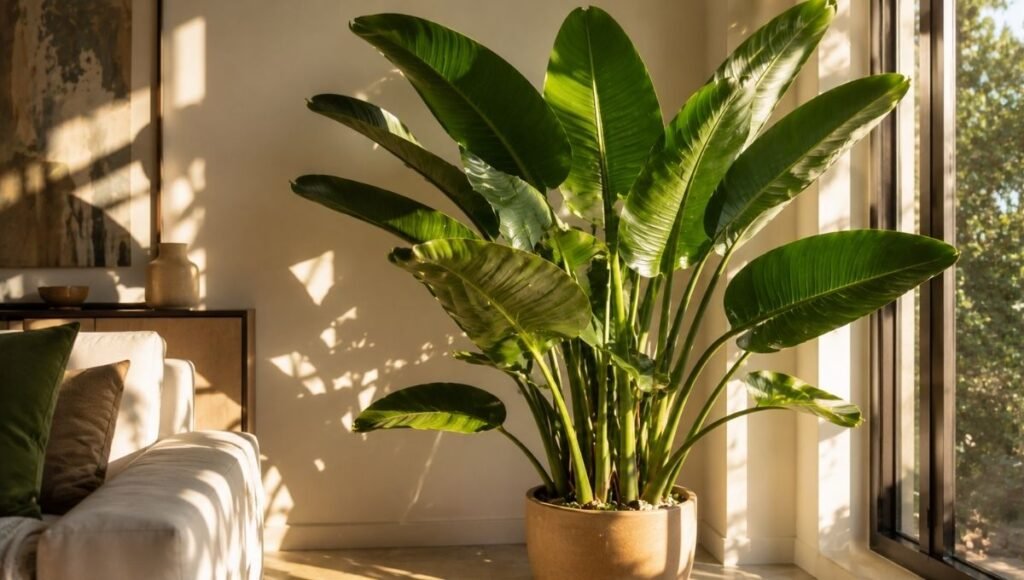
There’s a reason the bird of paradise appears in virtually every aspirational interior design space. A healthy, well-grown specimen — 5 feet tall, with a half-dozen enormous glossy leaves fanning out in all directions — changes the quality of a room in a way that smaller plants simply can’t. It’s not just greenery. It’s presence.
A 2022 review published in Environmental Research found that indoor plants in living spaces consistently reduce psychological stress and improve mood, with larger statement plants having a particularly strong effect on perceived environmental quality. The bird of paradise, grown well, is exactly that kind of plant.
Give it light. Be patient. Don’t worry about the splits. The plant that’s sitting there doing “nothing” for months is building roots, acclimating to your specific home, and preparing to eventually reward your patience in a way that’s very difficult to describe until you see it.
Keep Growing
- 🌿 [Indoor Plant Care: The Complete Beginner’s Guide] — the principles behind every plant you’ll ever own
- 🌿 [Monstera Care: Complete Guide] — another dramatic tropical statement plant
- 🌑 [Low Maintenance Indoor Plants: 12 Hard-to-Kill Picks] — for when you want something more forgiving alongside your bird of paradise
- 💛 [Plant Leaves Turning Yellow? 7 Real Causes and Fixes] — diagnose any struggling plant fast
References: ASPCA Animal Poison Control Center. Toxic and Non-Toxic Plant List — Bird of Paradise (Strelitzia spp.). Largo-Wight, E., et al. (2022). When green enters a room: A scoping review of epidemiological studies on indoor plants and mental health. Environmental Research, 214. NC State Extension Plants — Strelitzia nicolai (2024). Giant Bird of Paradise. The Sill Plant Care Team (2024). How to Care for Bird of Paradise. Gardeners’ World (2024). How to Grow Bird of Paradise Plant. ASPCA Animal Poison Control (2025). Bird of Paradise — Toxicity.