
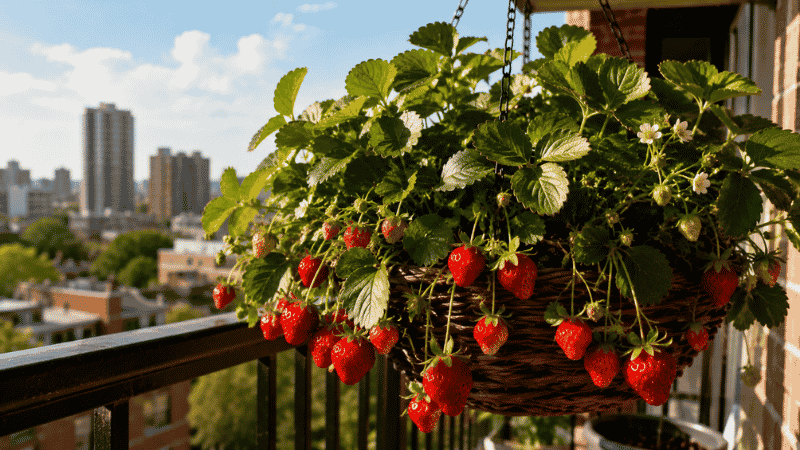
There’s something about a homegrown strawberry that no grocery store can replicate. Not the size — yours will probably be smaller. Not the appearance — they won’t be perfectly shaped. But the flavor? That intense, fragrant sweetness that only happens when a strawberry actually ripens on the plant rather than in a shipping truck? That, you cannot buy.
The best part: you don’t need a garden bed to experience it. Learning how to grow strawberries in pots is one of the most rewarding projects a beginner gardener can take on. Strawberries are naturally suited to container life — they have shallow roots, they look gorgeous trailing from a pot or hanging basket, and the right variety in the right setup will produce fruit reliably for multiple seasons.
What trips most people up isn’t the growing itself. It’s choosing the wrong variety, using too small a pot, or getting the watering rhythm slightly wrong. This guide covers all of it — simply, specifically, and with everything you actually need to know to go from zero to your first bowl of homegrown strawberries.
Key Takeaways
- Strawberries are one of the most beginner-friendly fruits to grow in containers — they have shallow root systems (6–12 inches deep) and thrive in pots, hanging baskets, and grow bags
- Everbearing and day-neutral varieties are the best choices for container growing — they produce fruit continuously throughout the season rather than all at once
- Strawberries need a minimum of 6–8 hours of direct sunlight daily — this is the single most important factor for fruit production
- A 12-inch pot can support 2–3 plants; a standard hanging basket holds 3–4; a grow bag can hold 4–6
- Research from the USDA Agricultural Research Service confirms that strawberries grown in containers with proper drainage and consistent nutrition can produce yields comparable to in-ground plants
- Snipping runners (the long trailing stems the plant sends out) is the single most important productivity habit — runners divert energy from fruit production to reproduction
The First Decision: Choosing the Right Strawberry Variety
This is where most container growers go wrong before they even start. There are three types of strawberry plants, and they perform very differently in pots.
June-bearing strawberries produce one large crop in late spring or early summer, then spend the rest of the season sending out runners and building energy for next year. In a garden bed, this concentrated burst of fruit is wonderful. In a pot, it means weeks of nothing, then a brief window of berries, then months of a plant that’s just sitting there. Not the best container experience.
Everbearing strawberries produce two crops — one in spring and one in late summer or early fall. Better, but still with gaps.
Day-neutral strawberries are the container gardener’s best friend. They produce fruit continuously from late spring through the first frost, regardless of day length or season. One plant can give you fresh strawberries for 5–6 months. For a balcony pot or hanging basket, this is almost always the right choice.
Best day-neutral varieties for containers:
- Albion — large, sweet, firm berries; consistent producer; excellent flavor
- Seascape — reliable, disease-resistant, produces abundantly in warm conditions
- Tristar — smaller berries but intensely sweet; compact plant, perfect for hanging baskets
- Evie-2 — everbearing, compact spread, excellent for smaller pots and balconies
- Temptation — specifically bred for container growing, trailing habit looks beautiful
If you can only find June-bearing varieties locally, they’ll still work — you’ll just have a concentrated harvest rather than continuous fruit, and you’ll want to focus on plant health and runner management for the rest of the season.
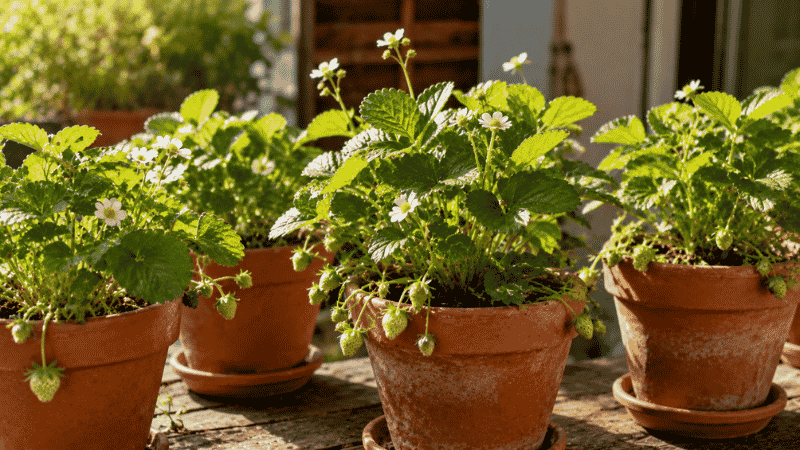
What Size Pot Do You Actually Need?
Strawberry roots are shallower than most fruit plants, but they still need adequate room — both depth and width — to develop properly and anchor the plant against wind and heavy fruit weight.
The minimums:
- Depth: at least 8–10 inches (10–12 inches is ideal)
- Width: at least 12 inches diameter for 2–3 plants
Planting density: No more than 2–3 plants per 12-inch pot. The temptation to squeeze in more is understandable — plants are small and pots feel large. But overcrowded strawberries compete for nutrients and water, producing fewer and smaller fruits. Give them space and they’ll reward you.
Container options beyond standard pots:
Hanging baskets — one of the most beautiful ways to grow strawberries. Trailing varieties (Temptation, Tristar) cascade naturally over the edges and look spectacular on a balcony railing or hook. Use a 12–14 inch basket and plant 3–4 plants. Keep in mind that hanging baskets dry out fastest of all containers — daily watering in summer is not unusual.
Grow bags (fabric pots) — excellent for strawberries. The fabric breathes, which improves root health and prevents the soil from overheating in summer sun. A 5-gallon fabric grow bag holds 4–5 plants comfortably.
Strawberry towers or urns — the classic terracotta urn with pockets on the sides is designed for exactly this purpose. One plant per pocket, plus a couple in the top opening. They look wonderful and use vertical space efficiently on a balcony.
Window boxes — a long rectangular planter along a railing is a practical and attractive option. Space plants 8–10 inches apart.
Whatever container you use: drainage holes are non-negotiable. Waterlogged roots kill strawberry plants faster than almost anything else.
Soil: Don’t Use Garden Soil
Strawberries are particular about their growing medium. They need well-draining, slightly acidic soil — ideally with a pH between 5.5 and 6.5. Garden soil in a pot compacts with watering, drains poorly, and often introduces diseases and pests. It’s one of the most reliable ways to fail at container strawberries.
Use a quality all-purpose potting mix — not garden soil, not topsoil. Look for one that contains perlite or vermiculite (which improve drainage), or add a handful of perlite yourself when filling your containers.
One upgrade worth making: mix a slow-release granular fertilizer or a handful of compost into the potting mix before planting. Strawberries are moderate feeders, and starting with nutrient-rich soil means you won’t need to feed for the first 4–6 weeks.
When filling your container, leave about an inch of space at the top — this makes watering easier without spillover, and leaves room for a thin layer of mulch.
Planting: The Crown Placement Rule
There is one specific technique that makes the difference between a strawberry plant that thrives and one that slowly declines: crown placement.
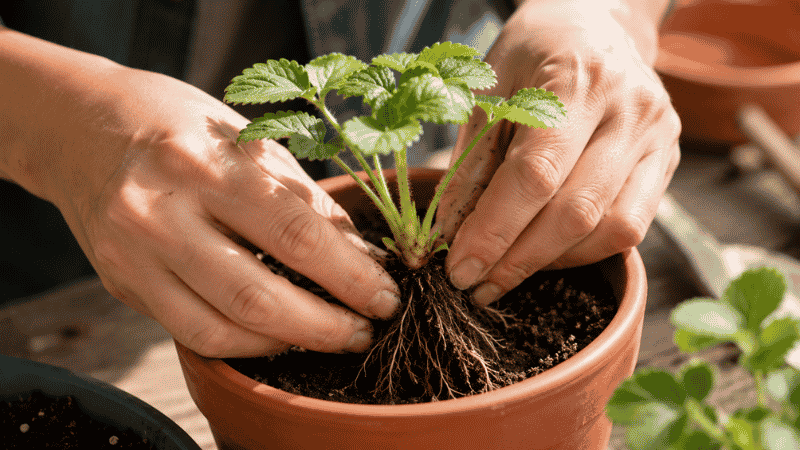
The crown is the central growing point of the plant — the dense, slightly woody junction between the roots below and the leaves above. When planting:
- The crown must sit at soil level — not buried, not elevated
- Buried crowns rot quickly
- Elevated crowns dry out and struggle to establish
Position the plant so the crown is exactly flush with the soil surface. Fan the roots gently outward and downward in the planting hole rather than cramping them in a tight ball. Firm the soil around the roots and water in gently.
Best time to plant: spring, once frost risk has passed and temperatures are consistently above 50°F at night. In mild climates, autumn planting is also possible and gives plants time to establish roots before winter.
Sunlight: The Most Important Factor
Strawberries need more sun than almost any other fruit you can grow in a container — a minimum of 6 hours of direct sunlight daily, and 8 hours is better.
This is the factor that most apartment and balcony growers underestimate. A south-facing balcony that gets 8 hours of sun is ideal. An east-facing balcony with 5–6 hours of morning sun will work for most varieties, though production may be lighter. North-facing balconies and shaded spaces are genuinely not suitable for strawberries — the plants will survive but produce little or no fruit.
Before you buy plants, spend a day observing your balcony or windowsill. Notice exactly where direct sun falls between 9am and 5pm. That observation is worth more than any other preparation you can do.
One practical note: if your space gets strong afternoon sun in summer (west-facing), the soil in containers can overheat significantly. Dark-colored pots absorb heat particularly intensely. In very hot climates, shade the pot itself (not the plant) during the hottest afternoon hours, or use light-colored or fabric containers that reflect or breathe heat away.
Watering Strawberries in Containers
Container strawberries dry out significantly faster than in-ground plants — their soil volume is limited and the sides of the pot radiate heat. In the peak of summer, a hanging basket may need watering every day. A larger pot every 1–2 days.
The watering rule: check the top inch of soil daily. If it feels dry, water thoroughly — until water drains from the bottom. If it still feels moist, wait.
Strawberries want consistent moisture but not waterlogged conditions. The soil should feel like a wrung-out sponge: damp throughout, but never soggy. Both extremes cause problems:
- Too dry: flowers drop before setting fruit; existing fruit is small and tasteless
- Too wet: root rot develops quickly, especially in warm weather
Watering method matters: water at the soil level rather than overhead when possible. Wet leaves and fruit invite fungal problems, including gray mold (botrytis), which is the most common disease of container strawberries. If you must water overhead, do it in the morning so foliage dries before evening.
Feeding Your Container Strawberries
Unlike many ornamental plants, strawberries are actively producing fruit — which requires significant energy. Container plants also lose nutrients through the drainage hole with every watering. Regular feeding is not optional if you want meaningful fruit production.
A simple feeding schedule:
- Before planting: mix slow-release fertilizer into the potting mix
- Once plants are established (2–3 weeks after planting): begin liquid feeding every 2 weeks
- During flowering and fruiting: switch to a fertilizer higher in phosphorus and potassium (the second and third numbers on the label) — these support fruit development rather than leafy growth
- Late summer (everbearing varieties): continue feeding to support the second flush of fruiting
- Autumn: stop feeding and allow plants to prepare for dormancy
A general-purpose balanced liquid fertilizer works for the early season. Once flowers appear, look for a “tomato food” or fruit-specific fertilizer — these are higher in potassium, which is specifically linked to fruit sweetness and size.
The One Habit That Makes the Biggest Difference: Snipping Runners
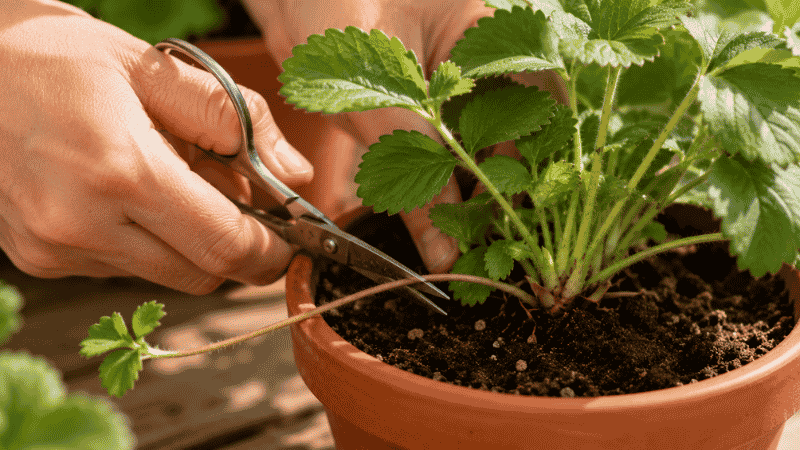
Strawberry plants are reproductive machines. Given the chance, they’ll send out long trailing stems (runners) that root into the ground and create new daughter plants. In a garden bed, this is lovely — free plants spreading across a patch. In a pot, it’s a significant drain on productive energy.
Every runner your plant sends out diverts energy away from flowering and fruiting. A plant that produces five runners produces noticeably fewer and smaller strawberries than the same plant with its runners removed.
The habit: check your plants every week or two. When you see a runner emerging — a long, thin stem growing outward from the crown — snip it off at the base with clean scissors. That’s it. This single habit, done consistently, is the most impactful thing you can do for container strawberry productivity.
The only exception: if a plant is done fruiting for the season and you want to propagate it into new plants, allow one or two runners to root in small pots of soil before cutting them from the parent. Once rooted, they’re independent plants you can overwinter and grow next season.
Common Problems and How to Fix Them
Few or no fruits despite healthy-looking plants: The most common cause is insufficient sunlight — check honestly how many hours of direct sun your container actually receives. The second most common cause is too many runners draining plant energy. The third is planting in the wrong time of year (June-bearing plants purchased late in the season often won’t fruit until the following spring).
Small, bland, or dry fruits: Usually caused by inconsistent watering during fruit development. Once flowers appear, moisture consistency becomes critical. Irregular wet-dry cycles produce small, seedy, tasteless fruit. Stabilize watering and consider increasing feeding.
Gray mold on berries (fuzzy gray coating): Botrytis — the most common strawberry disease in containers. Caused by wet conditions, poor air circulation, and overripe fruit left on the plant. Remove any affected berries immediately. Improve air circulation, water at soil level rather than overhead, and harvest regularly so no fruit stays on the plant past peak ripeness.
Leaves turning yellow: In spring and early summer, some yellowing of older lower leaves is normal. Rapid or widespread yellowing usually indicates overwatering, root rot, or nitrogen deficiency. Check soil moisture and root health first; fertilize if the soil is appropriate.
Slugs or birds eating fruit: Place containers on a raised surface away from slug access. For birds, a simple netting draped over the plants during peak harvest protects the fruit without harming the plant.
When to Harvest (And How to Tell)
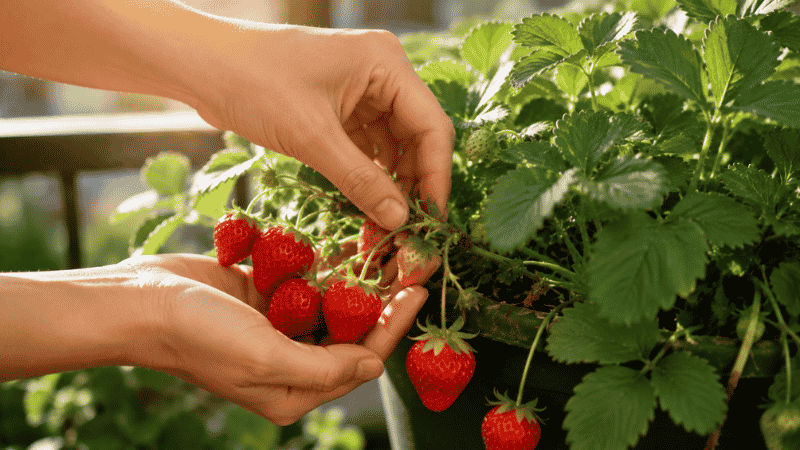
Strawberries do not continue ripening after they’re picked — unlike bananas or tomatoes. A strawberry picked even slightly underripe will never develop its full flavor. Wait for full ripeness.
Signs of full ripeness:
- The berry is completely red (or the characteristic color of your variety) with no white or green at the tip
- The berry separates easily from the plant with a gentle twist — no pulling needed
- The berry feels slightly soft to the touch but not mushy
- The fragrance is noticeable when you lean close
Harvest every 1–2 days during peak production — strawberries don’t keep long on the plant once ripe, and regular harvesting encourages the plant to continue producing. Handle berries gently to avoid bruising, and eat or refrigerate within 1–3 days.
If You Only Have 10 Minutes to Get Started
Buy one everbearing strawberry plant (Albion, Seascape, or whatever your local garden center has of this type), a 12-inch pot with drainage holes, and a bag of all-purpose potting mix. Plant with the crown at soil level in the sunniest spot on your balcony. Water when the top inch is dry. Snip runners as they appear.
That’s the entire setup. Not perfect, but completely functional — and far better than planning indefinitely and planting nothing.
FAQ
Can you grow strawberries in pots year-round? In mild climates (zones 8–10), strawberry plants in containers can stay outdoors year-round with minimal protection. In colder climates, container strawberries need some winter protection — bring them into an unheated but frost-free space (garage, shed) or insulate the pot with bubble wrap or burlap. The plant goes dormant and doesn’t need much care, but the roots can freeze solid in an unprotected pot.
How many strawberry plants do I need per pot? 2–3 plants per 12-inch pot, 1 plant per 6-inch pot, 3–4 plants per standard hanging basket. Don’t be tempted to crowd more in — overcrowding reduces fruit production significantly.
Why are my strawberry plants flowering but not producing fruit? Several possible causes: insufficient light (less than 6 hours direct sun), pollination problems (no insects visiting — try gently brushing flowers with a small paintbrush to transfer pollen), temperatures too high (above 85°F reduces fruit set), or plants that are June-bearing and have finished their single annual crop.
Do strawberries come back every year in pots? Yes — strawberries are perennials. With proper care through the winter, container strawberry plants will come back for 2–4 years before productivity declines. After that, replace with new plants or root runners from your existing plants.
What is the best container for growing strawberries? A 12-inch pot with drainage holes, a hanging basket, or a fabric grow bag are all excellent choices. Strawberry urns (with side pockets) are a classic option that looks beautiful and uses space efficiently. Avoid very small pots (under 8 inches) — they dry out too fast and provide insufficient root room.
Can I grow strawberries on a north-facing balcony? Not productively. Strawberries need 6–8 hours of direct sunlight for meaningful fruit production. A north-facing balcony in the Northern Hemisphere receives very little direct sun. You’d get healthy green plants but very little fruit. Choose leafy greens or herbs for north-facing spaces instead.
That First Berry
The first strawberry you harvest from your own pot will probably be small. It won’t look like the ones at the grocery store. It might be slightly irregular in shape, with a stem that’s a bit too long or a surface that isn’t perfectly glossy.
Eat it immediately, standing at your balcony. It will be sweeter than anything you’ve bought in years.
That’s the moment people become container gardeners for life — not because of efficiency or economics, but because of that specific flavor, that specific experience of having made something delicious from a pot of soil on a balcony.
Start this season. The wait is worth it.
Keep Growing
- 🍅 [Growing Tomatoes in Pots: The Beginner’s Guide] — your next balcony harvest project
- 🌿 [How to Grow Herbs Indoors] — pair your strawberries with a windowsill herb garden
References: USDA Agricultural Research Service (2024). Strawberry Production in Container Systems. University of California Cooperative Extension (2023). Strawberry Production in California: Varieties, Planting, and Care. The Old Farmer’s Almanac (2025). Growing Strawberries in Containers. Epic Gardening — Logan Hailey (2025). 15 Tips for Growing Strawberries in Pots or Containers. Strawberry Plants .org (2022). Growing Strawberries in Containers.