
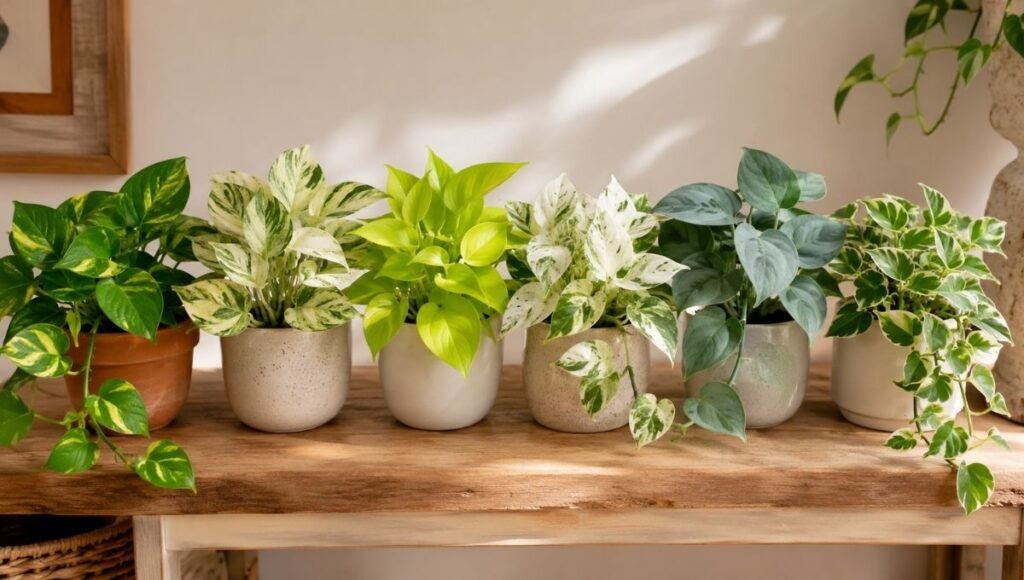
You walked into the plant section and there were six different pothos plants, all labeled slightly differently, all looking somehow both similar and completely unlike each other. The golden one you recognize. But then there’s one that’s almost entirely white. One that’s electric lime green. One with silvery blue leaves that doesn’t even look like it belongs in the same family. And absolutely no guidance on which one you should actually bring home.
This is a real thing that happens, and it’s more confusing than it needs to be. The Reddit community for pothos has an entire pinned thread — called “Master List” — that people post in regularly just to ask which one is this? and which one should I get? The appetite for this information is real and largely unmet by most plant guides, which either list thirty varieties in encyclopedia format or skip the practical question entirely: which pothos variety suits your specific situation?
That’s what this guide actually answers. Not every variety that exists — but the ones you’ll realistically encounter, what makes each one different, and which is best matched to your light, your space, and how you actually live.
Key Takeaways
- All pothos varieties share the same basic care needs — the meaningful differences are in light tolerance, growth speed, and how they look
- The rule that matters most: more white or pale in the leaves = needs more light. Heavily variegated varieties like Snow Queen and Manjula need bright indirect light; solid green varieties like Jade tolerate dim conditions better than almost any other houseplant
- Golden Pothos is still the most beginner-friendly variety and the right starting point for almost everyone
- All pothos varieties contain calcium oxalate crystals and are toxic to cats and dogs — keep out of reach of pets
- “Hawaiian Pothos” and “Satin Pothos” are not separate species — one is just a mature Golden Pothos on a pole, the other isn’t even a true pothos (it’s Scindapsus)
Before the List: The One Rule That Changes Everything
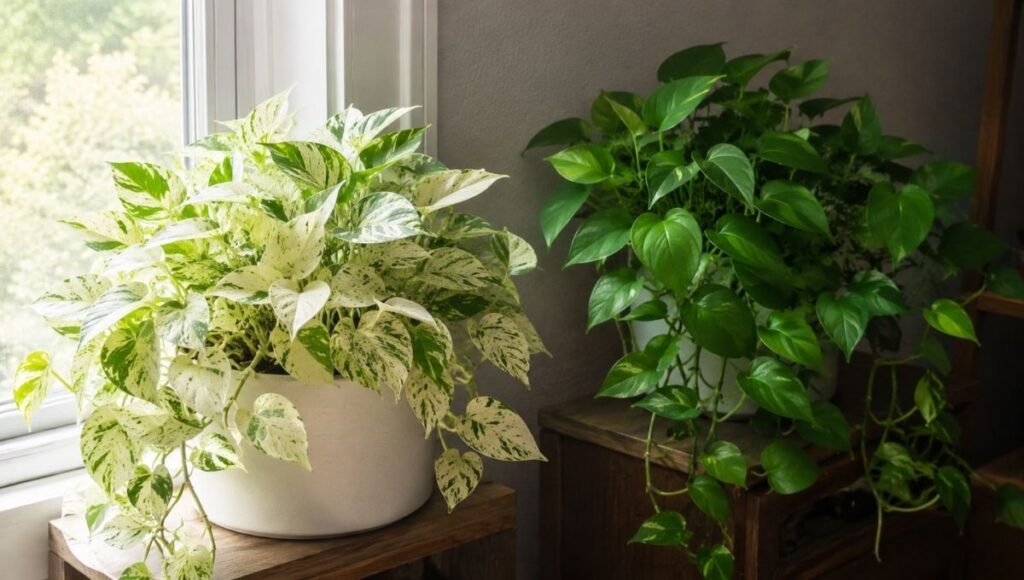
Here’s the thing most pothos variety guides don’t lead with, and should: the more white, cream, or pale yellow in a pothos leaf, the more light it needs.
This isn’t aesthetic preference — it’s plant biology. The pale sections of variegated leaves contain little or no chlorophyll, which means they can’t photosynthesize. A heavily variegated plant like Snow Queen (mostly white) is essentially surviving on what the small green sections can produce. To sustain that, it needs more light, not less.
The practical implication: if you have a north-facing apartment or a genuinely dim room, a mostly-white pothos variety will slowly decline — the colors fade, growth stalls, and the plant looks less impressive over time. In that same dim room, a Jade or Golden pothos will grow steadily and look healthy for years.
Match your variety to your actual light. Not the light you wish you had.
The Most Common Pothos Varieties (And Who Each One Is For)
Golden Pothos — The One to Start With
Leaves: Heart-shaped, mid-green with irregular golden-yellow streaks Light tolerance: The most forgiving of all varieties — tolerates low to bright indirect light Growth speed: Fast Best for: Complete beginners, low-light spaces, anyone who wants reliable and rewarding
The honest editorial take: Golden Pothos is not the most interesting or the most beautiful variety in the list that follows. It’s the one that consistently survives everything, grows confidently in almost any light, trails beautifully, and propagates reliably. If you’ve never owned a pothos and you’re choosing between varieties, the answer is this one.
Once you’ve grown it for a season, you’ll know exactly how you interact with this plant. Then you can graduate to something more specific.
Marble Queen — The Classic Variegated Choice
Leaves: Heart-shaped, highly variegated in cream-white and green — no two leaves the same Light tolerance: Medium to bright indirect light; loses variegation in low light Growth speed: Slower than Golden due to reduced chlorophyll in pale areas Best for: Bright rooms, people who love the look of high-contrast variegation
Marble Queen is where many plant collectors go after Golden. The white-and-green marbling is genuinely striking, and the unpredictable pattern means each new leaf is slightly different from the last. It grows more slowly than Golden — that’s not a flaw, it’s just the cost of so much beautiful pale variegation.
Position it in a bright window (east or west-facing is ideal) and it will be one of the most attractive trailing plants you can keep indoors. Put it in a dark corner and the new leaves will emerge with less contrast, more green — and eventually you’ll wonder what happened to the plant you bought.
Neon Pothos — The Statement Plant
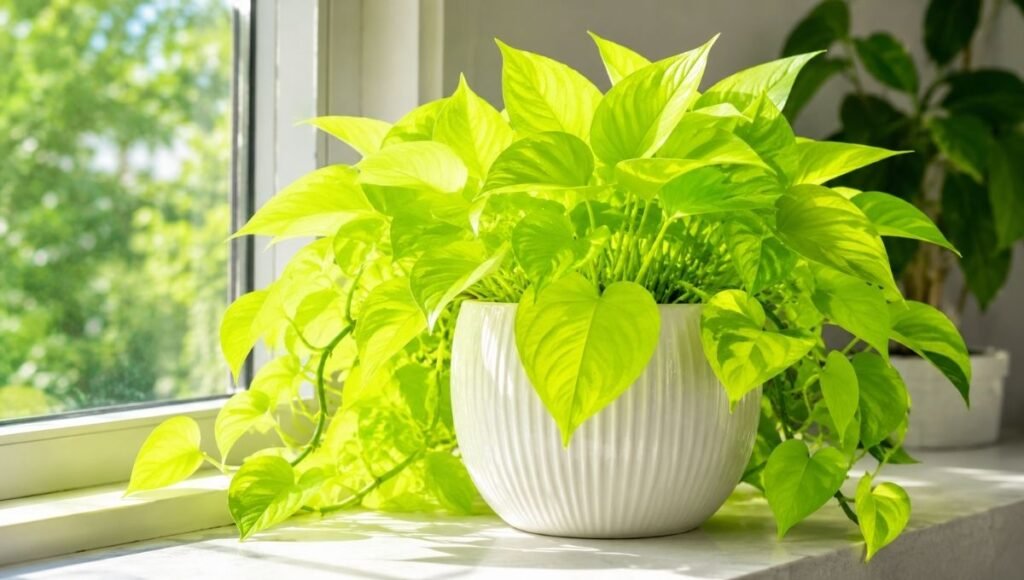
Leaves: Heart-shaped, solid chartreuse-lime, no variegation Light tolerance: Medium to bright indirect light for best color; goes duller in low light Growth speed: Fast Best for: Anyone who wants a bold color pop without complex variegation, modern interiors, shelves that need something visually interesting
Neon Pothos is a one-trick plant — and that trick is genuinely spectacular. That electric lime-green color catches the eye in a way that no green houseplant has any right to. It doesn’t look real next to other plants. In the right room, with the right light, it’s a statement.
The one nuance: in low light, the neon dims. The color becomes darker and flatter. It’s still a healthy plant — it doesn’t decline the way white-variegated varieties do in dim light — but the reason you bought it starts to disappear. Near a window, it glows. Far from one, it merely exists.
Snow Queen — The High-Maintenance Beauty
Leaves: Heart-shaped, mostly white with some green — significantly more pale than Marble Queen Light tolerance: Needs bright indirect light; grows very slowly even in good light Growth speed: Slow Best for: Bright south or west-facing windows, patient collectors, people who specifically want the whitest pothos
Snow Queen is what people are usually imagining when they say they want “a really white pothos.” The leaves are predominantly cream-white with only minimal green, which looks extraordinary and also means the plant is working hard to stay alive on very little chlorophyll.
In the right light, Snow Queen is one of the most beautiful pothos varieties you can own. In insufficient light, it grows so slowly it may seem like it’s not growing at all, and the white sections can develop browning over time. This is the variety to choose if you have a genuinely bright space and you want something that rewards careful attention. It is not the variety to choose as your first pothos.
Jade Pothos — The Low-Light Champion
Leaves: Heart-shaped, solid dark green — no variegation at all Light tolerance: The most shade-tolerant of all pothos varieties; genuinely thrives in very low light Growth speed: Fast (all that chlorophyll with no pale sections) Best for: North-facing rooms, dim hallways, bathrooms with poor light, anyone who needs reliable greenery in a challenging space
Jade is the plant world’s quiet overachiever. It doesn’t have the Instagram appeal of Snow Queen or the striking color of Neon. What it has is extraordinary adaptability — it will grow in light levels that most other houseplants find genuinely marginal. And because every bit of its leaf surface is green chlorophyll, it grows faster than any variegated variety in comparable conditions.
If your space is genuinely dim, Jade is the variety you want. Not as a consolation prize — as a deliberate choice for exactly the space you have.
N’Joy — The Compact Collector’s Choice
Leaves: Smaller than most varieties; distinct white and green blocks (the white tends to be cleaner and more separated from the green than in Marble Queen) Light tolerance: Medium to bright indirect light Growth speed: Slow Best for: Small spaces, shelves where a fast-growing plant would quickly become unmanageable, collectors who appreciate subtle differences between varieties
N’Joy often gets confused with Pearls and Jade (which has smaller leaves with green speckles within the pale areas) and Manjula (which has wider, wavy-edged leaves). Up close, the differences are clear — N’Joy’s blocks of white are relatively clean and defined, without the green-within-white speckles of Pearls and Jade.
It’s a compact, slower-growing variety — which makes it excellent for a windowsill or small shelf where you don’t want a plant that takes over. If you’re comparing N’Joy and Pearls and Jade in a shop, look at the pale sections: N’Joy is relatively clean white; Pearls and Jade has subtle green mottling within the white.
Pearls and Jade — The Detail-Oriented One
Leaves: Smaller than most varieties; white and silvery-gray variegation with distinctive green speckling within the pale areas Light tolerance: Medium to bright indirect light Growth speed: Slow Best for: People who appreciate subtle complexity in leaf patterns, collectors, small spaces
Pearls and Jade was developed at the University of Florida through mutation breeding of Marble Queen. The variegation is distinctly different from Marble Queen and N’Joy: the pale sections contain green and silver-gray mottling rather than being solid white. This gives the leaves a softer, more intricate appearance that rewards close attention.
It’s a genuinely beautiful variety — but slow-growing and small-leaved enough that it doesn’t make a dramatic visual statement from across the room. It’s a plant for people who look closely.
Manjula — The Unpredictable One
Leaves: Broader and slightly wavy-edged compared to other varieties; complex swirling patterns of white, cream, silver, and green — highly variable, no two leaves identical Light tolerance: Needs bright indirect light to maintain variegation Growth speed: Slow; also harder to propagate than most pothos Best for: Collectors, people who specifically want something unusual, bright indirect light situations
Manjula was patented by the University of Florida and is genuinely one of the more distinctive pothos varieties available. The broad, slightly wavy leaves with their unpredictable marbling look unlike any other variety when grown well. It’s also more finicky than most — it needs more light than Golden or Jade, propagates less readily, and can develop brown spots when stressed.
If you’re new to pothos, start with Golden. If you’ve successfully grown a few varieties and want something that requires more attention and rewards it with something truly unusual — Manjula is worth seeking out.
Cebu Blue — The One That Isn’t Quite a Pothos
Leaves: Elongated and lance-shaped (not heart-shaped), silvery blue-green with a metallic sheen; develops Monstera-like fenestrations when given a climbing support Light tolerance: Medium to bright indirect light; needs a support to show its best leaf form Growth speed: Fast when given a climbing support Best for: People who want something that looks dramatically different from standard pothos, people who enjoy watching plants develop fenestrations
Cebu Blue is technically a different species — Epipremnum pinnatum rather than Epipremnum aureum — though it’s sold alongside pothos in most shops and cared for identically. The leaf shape is completely different from other varieties: long and lance-shaped rather than heart-shaped, with a metallic silver-blue color that’s genuinely unlike anything else in the pothos family.
Given a moss pole or trellis to climb, mature Cebu Blue develops fenestrations — splits and holes along the leaf midrib that look like a Monstera. This makes it one of the most rewarding varieties to grow vertically. Without a support, it trails nicely but the leaves stay smaller.
Global Green — The Subtle One
Leaves: Heart-shaped; green-on-green variegation, darker on the outside, lighter lime toward the center Light tolerance: Medium indirect light; the subtle color contrast intensifies in better light Growth speed: Moderate Best for: People who want texture and interest without the contrast of white variegation, people who find the highly-contrasted varieties too busy
Global Green is a relatively recent introduction that hasn’t gotten as much attention as it deserves. The green-on-green variegation — darker emerald at the edges fading to lighter lime green toward the center — is subtle enough that it reads as “interesting green plant” rather than “look at my variegated pothos.” For some people, that’s exactly right.
It’s also more tolerant of medium light than most variegated varieties, since the pale sections are lime green rather than white, meaning more chlorophyll throughout the leaf.
The Quick Decision Guide: Which Pothos Is Right for You?
You have a dim room, limited natural light: → Jade Pothos. No contest.
You want the classic, reliable, can’t-go-wrong choice: → Golden Pothos. Start here.
You want dramatic white variegation and have a bright window: → Marble Queen (faster, more forgiving) or Snow Queen (slower, more white)
You want bold color instead of pattern: → Neon Pothos near a bright window
You have a small shelf and need something compact: → N’Joy or Pearls and Jade
You want something genuinely unusual that your friends won’t recognize: → Cebu Blue on a moss pole, or Manjula in bright light
You want subtle green interest without white variegation: → Global Green or Jade
A Note on Fake Pothos Names
Two “varieties” come up constantly in plant shops and online listings that deserve specific clarification:
Hawaiian Pothos is not a separate variety. It’s what happens when Golden Pothos is given a moss pole to climb — the mature leaves that develop can grow 12 inches across and look dramatically different from the small heart-shaped leaves of an unclimbed plant. If you see it sold as “Hawaiian Pothos,” you’re buying Golden Pothos with the promise that it will look impressive when it climbs. Same care, same genetics.
Satin Pothos is not a pothos at all. It’s Scindapsus pictus — a different genus with matte, velvety dark green leaves covered in silver spots. It’s sold in the pothos section of most shops, it’s cared for similarly to pothos, and it’s beautiful — but it’s a different plant. Worth buying, just not a true pothos.
All Pothos Varieties: The Care That Applies to Every One
Light requirements vary by variety as described above, but the core care is identical across the entire pothos family:
Water: When the top 1–2 inches of soil feel dry, water thoroughly. All varieties prefer to dry slightly between waterings. Overwatering causes root rot in every pothos variety equally.
Soil: Standard all-purpose potting mix with drainage holes. No special requirements.
Feeding: Balanced liquid fertilizer monthly during spring and summer; nothing in winter.
Toxicity: All pothos varieties contain calcium oxalate crystals and are toxic to cats and dogs. Keep out of reach.
For the full care guide for pothos, see: [How to Care for Pothos: The Complete Guide]
If You Only Have 5 Minutes to Decide
Check your light. Go to your brightest window and ask yourself honestly: how many hours of direct or very bright indirect light does that spot get? If the answer is 4+ hours — you can grow any variety on this list. If the answer is 2 hours or less — start with Jade or Golden. If you’re somewhere in the middle — Golden, Neon, or Global Green will serve you well.
Then pick the one that looks most beautiful to you. Because you’ll be looking at it every day, and that matters.
FAQ
What is the easiest pothos variety to grow? Golden Pothos, followed closely by Jade. Golden tolerates a very wide range of light conditions and grows vigorously even when care is inconsistent. Jade is the most shade-tolerant option and grows fastest in low light.
Which pothos variety has the most white? Snow Queen. It has significantly more white than Marble Queen and is the palest of the commonly available varieties. Because the pale sections can’t photosynthesize, it needs bright indirect light and grows more slowly than any other variety on this list.
What’s the difference between Marble Queen and Snow Queen? The ratio of white to green. Marble Queen has more green than white — the leaves look marbled. Snow Queen has more white than green — the leaves look predominantly white with green accents. Snow Queen also grows more slowly.
What’s the rarest pothos variety? Manjula is among the rarest varieties you’ll regularly find available. Harlequin Pothos (a highly variegated form of Manjula) is genuinely rare and commands high prices. Truly rare collector varieties exist but are outside the scope of most home gardeners.
Are all pothos varieties safe for cats and dogs? No — all pothos varieties contain calcium oxalate crystals and are toxic to cats and dogs if ingested. Contact your vet if your pet chews on any pothos variety.
What is the difference between N’Joy and Pearls and Jade? Both have white and green variegation with small leaves, but the details differ. N’Joy has cleaner, more defined white blocks. Pearls and Jade has green speckling and mottling within the pale sections, giving it a more intricate appearance. Pearls and Jade was developed from Marble Queen at the University of Florida.
The Collection Problem (And Why It’s Not Actually a Problem)
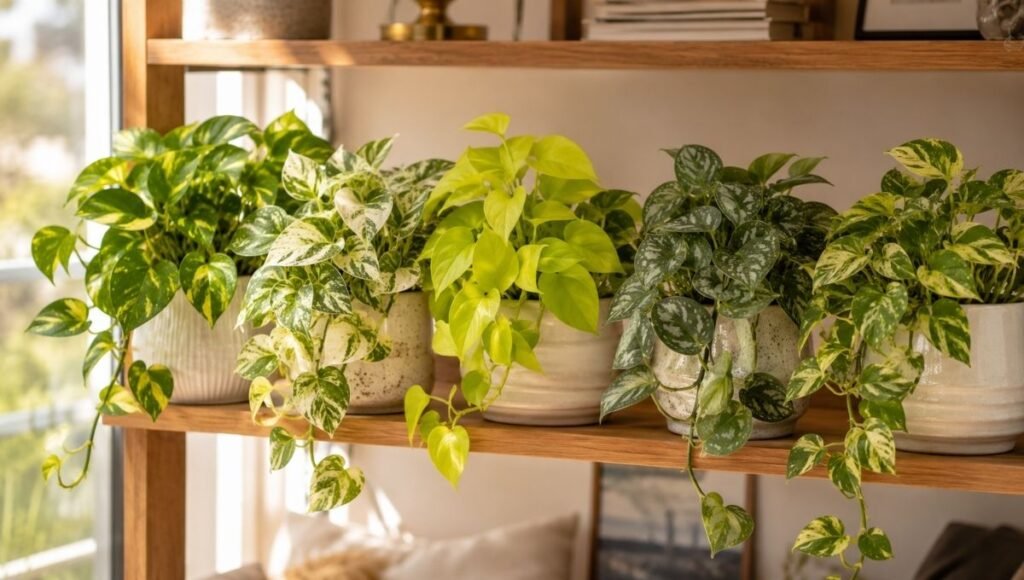
There’s something that happens to pothos owners eventually. You start with one. It’s golden. You love it. Then you see a Neon and think just one more. Then you see a Cebu Blue and think well, it’s technically different enough. Before long you have six pothos varieties and you’re reading Reddit master lists trying to identify a cutting someone gave you.
This is apparently universal. And it makes complete sense — the variety in this one genus is genuinely extraordinary. From the lime glow of Neon to the almost-tropical scale of Hawaiian Pothos on a pole to the intricate speckled elegance of Pearls and Jade, these are not the same plant repeated with minor differences. They’re genuinely different visual experiences.
Start with the one that’s right for your space. The collection will take care of itself.
Keep Growing
- 💧 [How to Care for Pothos: The Complete Beginner’s Guide] — the full care guide for every variety on this list
- 🌿 [Low Maintenance Indoor Plants: 12 Hard-to-Kill Picks] — more plants that thrive with minimal attention
- 💛 [Plant Leaves Turning Yellow? 7 Real Causes and Fixes] — diagnose any struggling pothos fast
- 🌱 [Indoor Plant Care: The Complete Beginner’s Guide] — the principles behind every plant you’ll ever own
References: Costa Farms (2024). A Plethora of Pothos Varieties. University of Florida IFAS Extension — Gainesville (2023). Pearls and Jade® Pothos (UFM12) — cultivar development and performance data. Penn State Extension (2023). Pothos as a Houseplant — care guidance and light requirements. Soga, M., Gaston, K.J., & Yamaura, Y. (2017). Gardening is beneficial for health: A meta-analysis. Preventive Medicine Reports, 5, 92–99. ASPCA Animal Poison Control Center. Toxic and Non-Toxic Plant List — Pothos (Epipremnum aureum).