
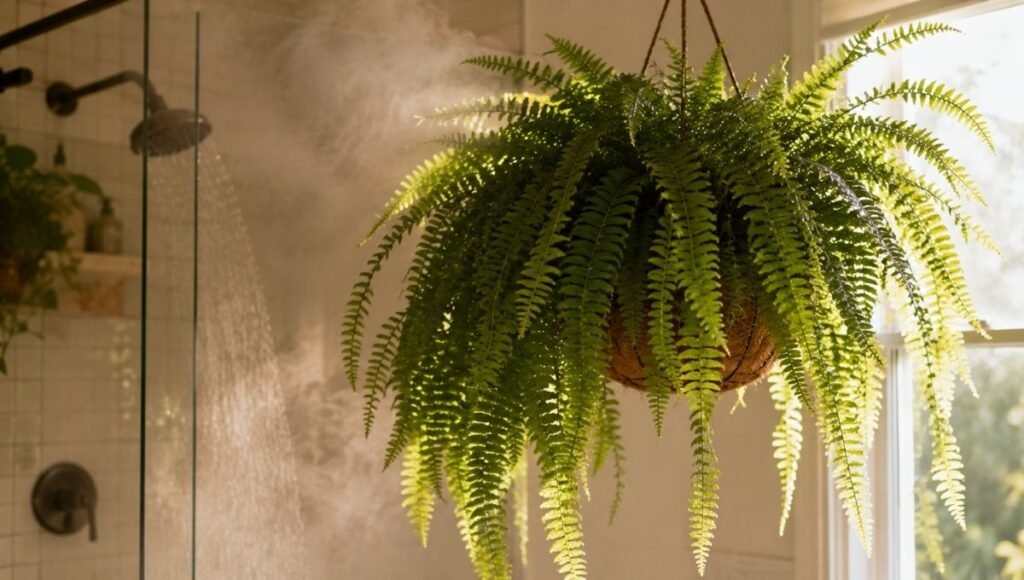
There’s something about a Boston fern that feels like a promise. Those long, arching fronds cascading from a hanging basket — lush, deep green, quietly wild — look like a piece of rainforest brought indoors. You bring one home, find it a bright spot in the bathroom, and feel immediately like someone who has their plant life together.
Then the fronds start turning yellow. Then brown. Then the little leaflets begin dropping — first a few, then constantly, until every surface around the pot is covered in tiny dead leaf bits and you’re starting to feel genuinely guilty about it.
Here’s the truth about Boston fern care that nobody leads with: these plants are not difficult because of complicated requirements. They’re difficult because of one specific requirement that most homes don’t naturally provide — humidity. Get the humidity right, and nearly everything else about a Boston fern becomes manageable. Get it wrong, and you’ll be replacing fronds indefinitely, no matter how carefully you water or where you position the pot.
This guide tells you exactly what that means in practice, and how to actually achieve it.
Key Takeaways
- Boston ferns need 60–80% relative humidity to thrive — this is their primary care requirement and the most commonly underestimated one
- They are completely pet-safe — confirmed non-toxic to cats and dogs by the ASPCA, making them one of the best lush, dramatic plants for pet households
- Water when the top inch of soil feels dry — keep the soil consistently moist but never soggy; the goal is “damp sponge,” not “wet clay”
- Bright indirect light (not direct sun) is essential — a north or east-facing bathroom with a window is genuinely one of the best placements in most homes
- A 2022 review in Environmental Research confirmed that lush, leafy indoor plants like ferns are consistently associated with lower stress and improved sense of wellbeing — your Boston fern is doing something real for your home environment
What a Boston Fern Actually Is
The Boston fern (Nephrolepis exaltata) is native to tropical forests in Central and South America, Florida, and the West Indies — growing on the moist, shaded forest floor where humidity is consistently high, temperatures are warm, and light is filtered through a dense canopy above.
That origin explains everything. It evolved in a world of perpetual moisture, dappled shade, and rich organic soil. Indoors, your central heating, your bright south-facing windows, and your standard potting mix are all working against its preferences. Understanding this isn’t discouraging — it’s actually clarifying. You’re not failing at Boston fern care because you’re doing something wrong. You’re just not replicating the conditions it came from. Once you do, the plant responds quickly and dramatically.
Indoors, Boston ferns typically reach 8–12 inches tall with fronds spreading to 2–3 feet wide — smaller than their wild counterparts but still impressively lush. They’re among the most effective natural humidifiers of any houseplant, transpiring moisture into the surrounding air as they grow. There’s a useful feedback loop there: a healthy Boston fern actually increases the humidity around itself, which helps it stay healthy.
Boston Fern Care: The Humidity Requirement (The Real Priority)
Let me be direct: if your Boston fern is struggling and you don’t know why, it’s almost certainly the humidity.
Standard indoor air humidity in most homes sits at 30–50%. In winter with heating running, it can drop below 30%. Boston ferns prefer 60–80%. That gap — between what your home naturally provides and what the fern wants — is the source of the vast majority of Boston fern problems: yellowing fronds, brown crispy tips, constant leaflet drop, and fronds that look dull and tired rather than lush and full.
The symptoms of insufficient humidity are specific: brown, crispy tips on otherwise healthy fronds; leaflets dropping at the slightest touch; new growth that comes in small and pale; fronds that curl inward slightly along their length.
Practical ways to raise humidity for a Boston fern:
The bathroom placement: a bathroom with a window — even a north-facing one — is genuinely one of the best places in most homes for a Boston fern. Steam from showers naturally raises humidity to the range the plant prefers. It doesn’t need south-facing sun; it needs consistent moisture in the air. This is not a marketing cliché — it’s an honest recommendation.
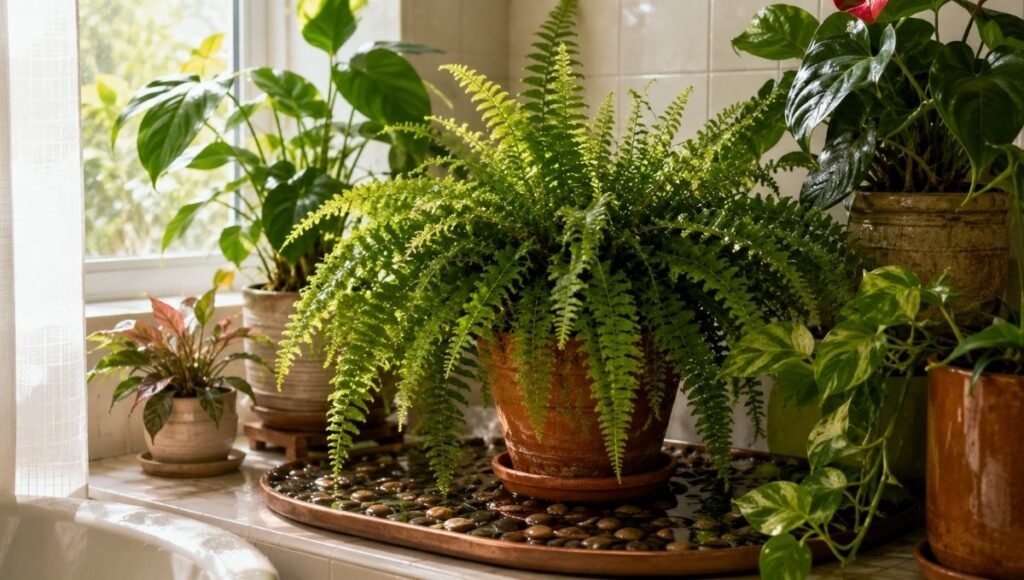
Pebble tray: fill a shallow tray with small stones, add water to just below the top of the stones, and place the fern pot on top. The pot sits above the water (not in it) and the evaporation creates a localized humid microclimate. Effective and completely low-effort once set up.
Grouping with other plants: plants release moisture through their leaves (transpiration). Clustering your Boston fern with other tropical plants creates a shared microclimate of elevated humidity — a small jungle corner effect that works surprisingly well.
Humidifier: the most effective solution, particularly in winter. Even a basic ultrasonic humidifier running nearby makes a measurable difference. If you have several humidity-loving plants, this investment pays for itself in dramatically better plant health.
Misting: the most commonly suggested approach — and the least effective. Misting provides humidity for roughly 20–30 minutes before the moisture evaporates. It won’t raise ambient humidity, and it can introduce fungal issues if water sits on fronds in low-air-circulation conditions. Do it if you enjoy the ritual, but don’t rely on it as your primary humidity strategy.
Boston Fern Care: Light Requirements
Boston ferns need bright indirect light — and the “indirect” part is not optional.
Direct sun scorches the delicate fronds almost immediately, producing bleached, brown patches that don’t recover. This eliminates south-facing windows as primary positions for most of the year, particularly in summer.
What works well: north or east-facing windows, where light is bright but never direct. A spot a few feet from a south-facing window, sheltered from direct beams by a sheer curtain. Bright ambient light from a skylight above.
The bathroom window: often east or north-facing, relatively small, with filtered light — which is actually closer to ideal Boston fern light than most people’s instinctive “best window” positions. This is another reason the bathroom placement works so well.
What happens with too little light: fronds grow leggy and sparse; new fronds come in smaller and paler; the plant loses its fullness and starts looking thin. If this describes yours, move it to a brighter position — but not direct sun.
The editing opinion: too many care guides say “avoid direct sun” without explaining that the fern also can’t handle genuinely dark rooms. It needs real, meaningful light — just not the harsh, direct variety. A shaded corner three rooms from a window is not adequate.
How to Water a Boston Fern
Boston ferns want consistently moist soil — not wet, not dry, but genuinely damp throughout. The goal is what gardeners sometimes describe as “a wrung-out sponge”: moisture everywhere, but no water pooling or sitting.
The watering rule: check the top inch of soil. If it feels moist, wait. If it’s beginning to dry out, water now — before it fully dries. Don’t wait until the soil is bone dry between waterings; Boston ferns don’t tolerate drought well and recover slowly from significant dry-out.
This is different from the “wait until fully dry” approach that works for succulents and snake plants. Boston ferns need consistency.
Frequency: every 7–10 days in spring and summer; slightly less frequent in autumn and winter when growth slows. But always check — actual frequency depends on your pot size, your home’s temperature, humidity, and light level.
Watering from above vs. below:
From above: water slowly at soil level, not over the fronds. Splashing water on the leaves promotes fungal issues, particularly in lower-humidity conditions where wet fronds don’t dry quickly.
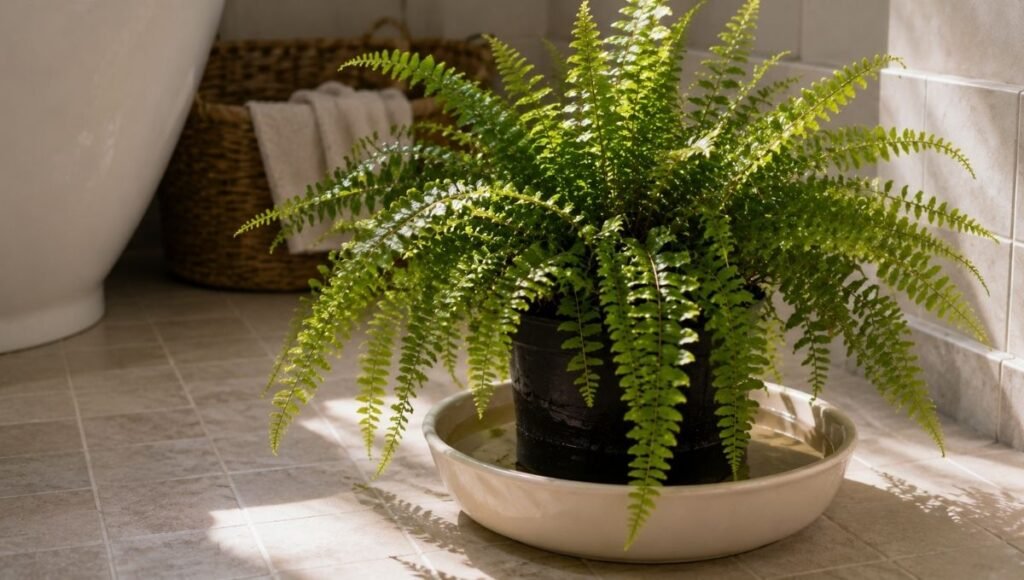
Bottom watering: set the pot in a few inches of water for 20–30 minutes, allowing moisture to absorb upward through the drainage holes. This ensures even moisture throughout the root ball without wetting the fronds at all. Particularly good for ferns that have dried out more than usual and need thorough rehydration.
Signs of overwatering: fronds turning yellow and soft; soil that smells musty; fronds drooping despite moist soil; roots that look brown and mushy if you check.
Signs of underwatering: crispy brown tips; leaflets dropping at the slightest touch; fronds curling inward; soil that’s dry well below the surface.
Soil, Pots, and Repotting
Boston ferns want rich, moisture-retentive but well-draining soil — a combination that sounds contradictory but isn’t. The goal is soil that holds moisture evenly without becoming waterlogged.
A standard all-purpose potting mix works reasonably well. For better results, mix in some peat moss or coconut coir (which improves moisture retention) and a small amount of perlite (which improves drainage). This combination holds the “damp sponge” moisture state more reliably than standard potting mix alone.
Avoid cactus mix or very gritty, fast-draining soils — these dry out too quickly for a moisture-loving plant.
Drainage holes are essential. A Boston fern in a pot without drainage will develop root rot quickly because the soil has nowhere to release excess water.
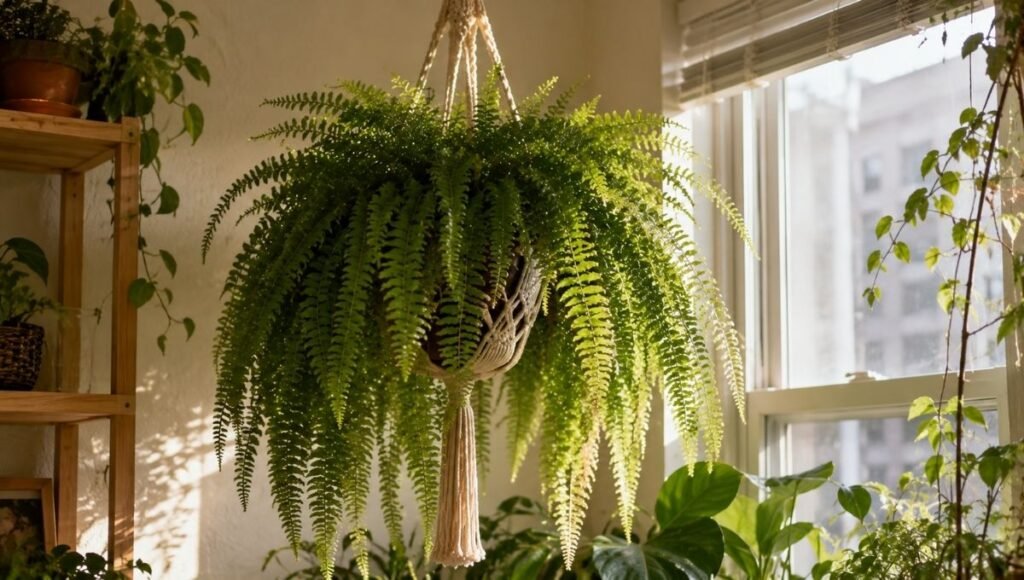
Hanging baskets: Boston ferns are among the most beautiful plants for hanging baskets — the arching fronds cascade naturally and look spectacular. The trade-off is that hanging baskets dry out faster than floor pots, particularly in warm conditions. Check moisture more frequently if you’re growing in a hanging basket.
Repotting: every 2 years, or when roots are growing from drainage holes or circling the pot bottom. Spring is ideal. Go up one pot size — 2 inches larger in diameter. Boston ferns don’t need to be particularly pot-bound; they appreciate room to grow.
Temperature: Keep It Stable and Warm
Boston ferns thrive between 65–75°F (18–24°C) — standard household temperature. They’re sensitive to cold in specific ways:
Cold drafts from open windows or exterior doors cause fronds to yellow and drop. Keep the fern away from drafty spots, particularly in winter.
Temperatures below 55°F (13°C) cause damage — leaf drop, frond yellowing, and slowed recovery. Don’t leave Boston ferns near uninsulated windows in winter or in unheated rooms.
Air conditioning vents: the dry, cold air from air conditioning is one of the worst things for a Boston fern — it simultaneously drops the temperature and reduces humidity. Keep the plant well away from any direct vent airflow.
Feeding Your Boston Fern
Boston ferns are moderate feeders during active growth. A balanced liquid fertilizer, diluted to half strength, applied every 4–6 weeks in spring and summer is sufficient.
Important: always water the plant first, then apply the diluted fertilizer. Feeding dry soil causes fertilizer burn on roots. Always apply at the base of the plant, not over the fronds.
Stop feeding in autumn. Don’t feed through winter. Accumulated fertilizer salts damage roots and cause the brown tips that are already the fern’s most common aesthetic complaint.
Pruning: The Bushing Secret
Regular pruning — removing dead, yellowed, or discolored fronds — keeps the plant looking full and healthy. Cut fronds at the base, as close to the soil as possible.
To make a Boston fern bushier: trim the outer fronds (the longer, arching ones at the perimeter) rather than the center growth. This encourages the plant to produce more fronds from the center, creating a denser, fuller shape.
In spring, you can cut the entire plant back quite dramatically — some growers cut to within 4–6 inches of the soil — and it will regenerate vigorously during the growing season. This sounds alarming but works extremely well for reinvigorating an overgrown or struggling plant.
Common Boston Fern Problems and Real Fixes
Fronds Turning Yellow
If fronds are yellowing from the base upward and the soil is consistently wet: overwatering. Reduce watering frequency and check drainage.
If fronds are yellowing with dry soil: underwatering or insufficient light. Water more consistently and assess the light level.
If fronds are yellowing in winter despite correct watering: low light and cold air from nearby windows or heating/cooling vents. Move to a warmer, brighter position away from direct airflow.
Constant Leaflet Drop
The small leaflets (pinnae) that make up each frond are the most sensitive humidity indicators. When they drop at the slightest touch — or fall constantly — the air is too dry. This is the humidity problem made visible.
Increase humidity immediately using a pebble tray, humidifier, or bathroom placement. The dropping will slow within 1–2 weeks of improved humidity.
Brown Crispy Frond Tips
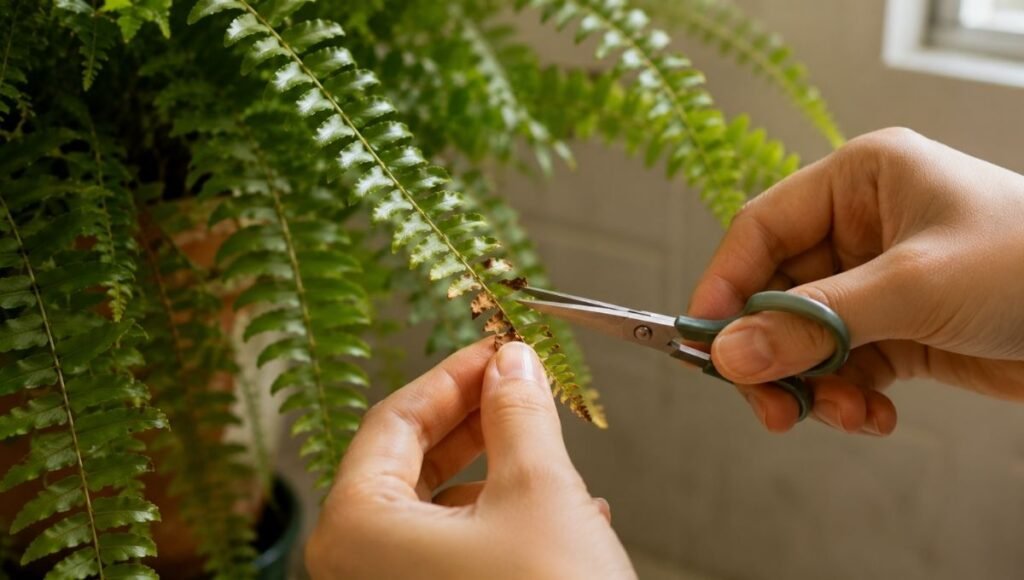
The most universal Boston fern complaint — and almost always humidity-related in combination with tap water minerals. Switch to filtered water or let tap water sit overnight before using. Increase humidity. Keep away from heating vents.
Existing brown tips won’t reverse — trim them with clean scissors, cutting at a slight angle. Address the cause to prevent new browning.
Pests
Boston ferns are susceptible to spider mites (fine webbing, dusty appearance on fronds), scale (brown bumps on stems), and mealybugs (white cottony patches). Check fronds regularly, particularly on the undersides.
Treatment: isolate the plant immediately. For spider mites, increase humidity (they hate it) and spray with insecticidal soap or neem oil every 5–7 days. For mealybugs and scale, treat with isopropyl alcohol on a cotton swab followed by neem oil spray.
If You Only Have 10 Minutes
Check the humidity situation first. If your home is dry — particularly in winter — that’s the problem, and no amount of watering adjustment will fix it. Put the fern in the bathroom, set up a pebble tray, or run a humidifier. Then check the soil: if it’s moist, don’t water. If it’s beginning to dry, water now at the base of the plant.
Those two things — humidity and consistent moisture — are the entire foundation of Boston fern care.
FAQ
Why does my Boston fern keep dropping leaves? Almost always a humidity problem. Low indoor humidity — particularly in winter with heating running — causes leaflets to drop at the slightest touch. Move the fern to a bathroom, set up a pebble tray, or use a humidifier. Improvement shows within 1–2 weeks of genuinely higher humidity.
How often should I water a Boston fern? Every 7–10 days in spring and summer — but always check the top inch of soil first. Keep it consistently moist (not wet, not dry). Boston ferns don’t tolerate fully drying out between waterings the way succulents do; they want reliably damp soil.
Can Boston ferns survive in low light? No — they need bright indirect light for several hours per day. They tolerate lower light than sun-loving plants, but genuinely dark rooms cause stunted, sparse growth and fronds that look dull and tired. A north-facing bathroom window is often ideal — enough light, naturally humid from showers.
Are Boston ferns safe for cats and dogs? Yes — Boston ferns are confirmed non-toxic to cats and dogs by the ASPCA. This makes them one of the best choices for pet households who want a lush, dramatic tropical plant without toxicity concerns.
Why are the tips of my Boston fern turning brown? Usually low humidity combined with tap water minerals. Increase humidity (pebble tray, humidifier, or bathroom placement), switch to filtered water or let tap water sit overnight, and keep the fern away from heating and air conditioning vents. Trim existing brown tips with scissors.
Can Boston ferns go outside in summer? Yes — Boston ferns love outdoor conditions in warm weather, particularly in a shaded or partially shaded spot (under a porch, tree canopy, or covered deck). Natural outdoor humidity is usually higher than indoors, and they grow noticeably more vigorously outside. Bring them back in before nighttime temperatures drop below 55°F.
The Thing About Ferns
There’s a reason ferns have been growing on earth for over 360 million years — long before most other plant families existed. They’re extraordinarily adaptable when given the conditions they actually need. The Boston fern specifically has become one of the most popular houseplants in the world not because it’s effortless, but because the effort it requires is specific and learnable.
Once you understand that humidity is the variable that unlocks everything else — that the crispy tips and the falling leaflets and the dull fronds are all asking for the same thing — the whole relationship shifts. The plant stops feeling like something you’re failing and starts feeling like something you’re genuinely in conversation with.
Research from the University of Exeter found that even routine plant care tasks — checking soil, misting, rearranging placement — produce measurable reductions in stress and improvements in mood. Your Boston fern isn’t just décor. It’s a daily practice of attention.
Give it the humidity. Everything else will follow.
Keep Growing
- 🌿 [Low Maintenance Indoor Plants: 12 Hard-to-Kill Picks] — for when you want something more forgiving
- 💧 [Indoor Plant Care: The Complete Beginner’s Guide] — the principles behind every plant you’ll ever own
- 🌑 [Peace Lily Care: Complete Guide] — another humidity-loving shade plant that communicates beautifully
- 💛 [Plant Leaves Turning Yellow? 7 Real Causes and Fixes] — diagnose any struggling plant fast
References: ASPCA Animal Poison Control Center. Toxic and Non-Toxic Plant List — Boston Fern (Nephrolepis exaltata). Largo-Wight, E., et al. (2022). When green enters a room: A scoping review of epidemiological studies on indoor plants and mental health. Environmental Research, 214. University of Exeter — Miles Richardson et al. (2022). Connection to nature and wellbeing through everyday activities. People and Nature, 4(2), 339–353. Missouri Botanical Garden Plant Finder (2024). Nephrolepis exaltata — Boston Fern. University of Florida IFAS Extension (2023). Boston Fern — Nephrolepis exaltata Care Guide.