
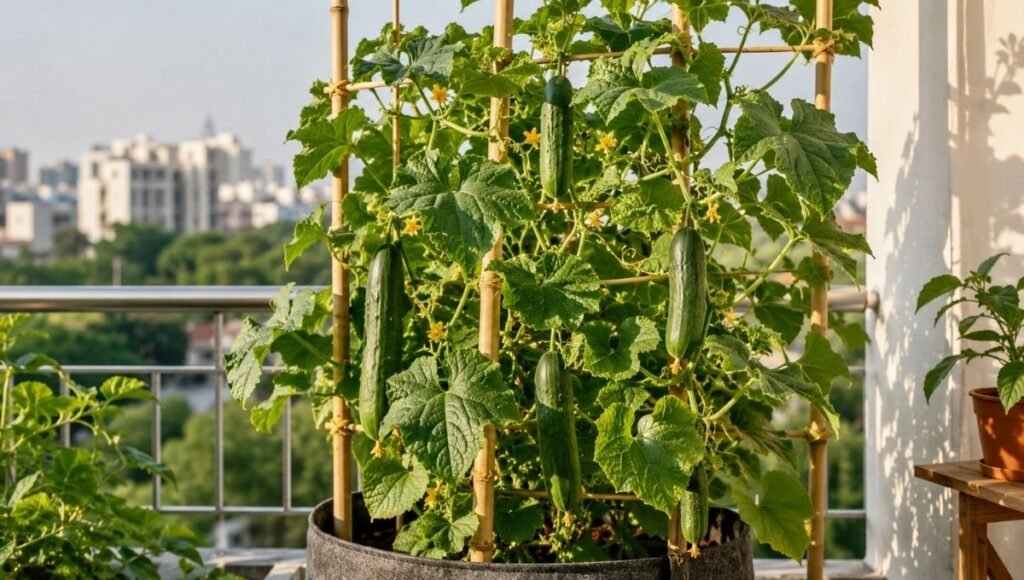
Cucumbers were the vegetable that almost broke my enthusiasm for container gardening entirely. The first summer I tried them, I got flowers — lots of flowers — but no actual cucumbers. The second summer I got tiny cucumbers that went bitter and soft before I could harvest them. By the third summer I was genuinely questioning whether “growing cucumbers in containers” was one of those things that sounds achievable in gardening articles but quietly isn’t.
It is achievable. I know that now. But it requires understanding a few specific things that most beginner guides either gloss over or explain in ways that don’t translate into actual practice. The wrong variety is the most common silent sabotage. Underwatering is the second — and not by a little. And the trellis question, which sounds optional, is more important than it appears.
This guide is the one I wish I’d had in that first summer. It’s honest about what cucumbers ask of you, specific about what actually works in containers and on balconies, and — unlike most guides — it starts with the single decision that makes more difference than everything else combined.
Key Takeaways
- Variety selection is the most important decision — parthenocarpic varieties that don’t require pollination to set fruit are the single biggest advantage for container and balcony growers
- Cucumbers need at least 6–8 hours of direct sun daily — there is no workaround for this; it’s the non-negotiable
- Container cucumbers are extremely thirsty — daily watering in summer is not an exaggeration; inconsistent moisture produces bitter fruit
- A trellis is not optional for most varieties — vertical growing keeps plants healthy, maximizes space, and dramatically increases yield
- According to the USDA, cucumbers are 95–96% water by weight — which tells you exactly why consistent, generous watering is so critical to both yield and flavor
The Decision That Changes Everything: Choosing the Right Variety
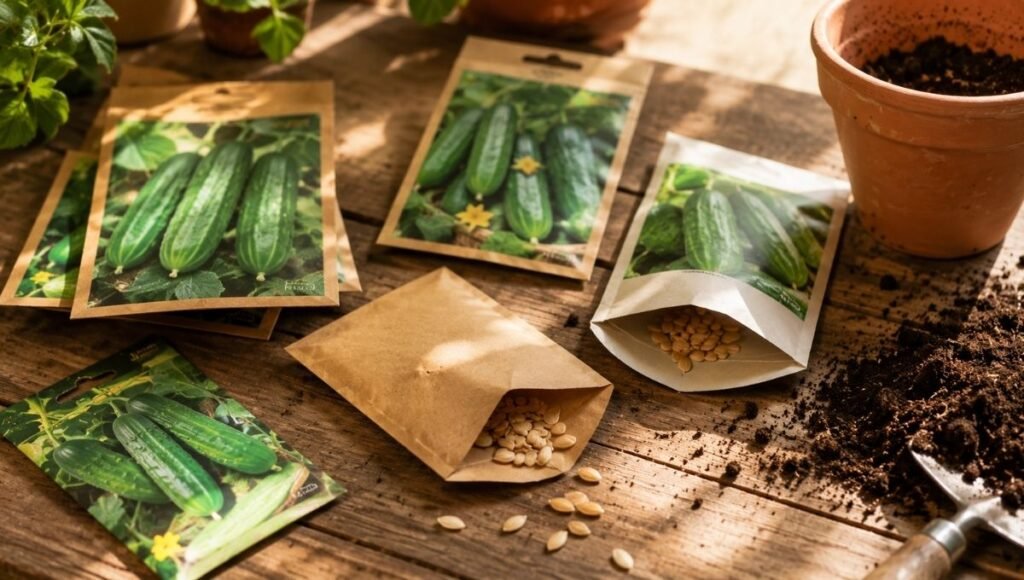
Most beginner guides bury this halfway down the page. I’m leading with it because it’s the reason so many people fail at container cucumbers before they’ve made a single care mistake.
Standard cucumber varieties — the ones with names like Straight 8, Marketmore, and the classic American slicers — are designed for garden beds with space, pollinators, and planting density. In a container on a balcony, they face three specific disadvantages: limited root volume to draw nutrients from, limited pollinators visiting a fifth-floor balcony, and minimal horizontal space for sprawling vines.
The solution is to grow parthenocarpic varieties — cucumbers that set fruit without requiring pollination. No bees needed. No hand-pollinating with a small paintbrush. No watching flowers open and close without producing anything. The plant just makes cucumbers, from those flowers, automatically.
For even better results, look for varieties that are also gynoecious — meaning the plant produces mostly or entirely female flowers. This roughly doubles the potential harvest compared to standard varieties that produce a mix of male and female flowers.
Specific varieties worth looking for:
- Spacemaster — compact, bred specifically for containers, reliable producer, manageable in 5-gallon pots
- Bush Pickle — compact and productive, excellent for smaller balconies
- Patio Snacker — bred for container growing, produces mini cucumbers continuously
- Corinto F1 — parthenocarpic, gynoecious, produces abundantly without pollinators
- Tasty Green — parthenocarpic, long slender cucumbers, good for smaller container setups
My honest recommendation: before anything else, find a parthenocarpic variety. If you’ve tried growing cucumbers before and got flowers but no fruit, this was almost certainly the problem.
Growing Cucumbers in Containers: Container Size and Setup
Cucumbers have extensive root systems and are heavy feeders. Container size genuinely matters more with cucumbers than with most other vegetables.
Minimum container size: 5 gallons for compact or bush varieties. This is the floor — don’t go smaller.
Better: 10–15 gallons for vining varieties, which allows the root system to develop fully and reduces how quickly the container dries out (more on watering below).
The material question: plastic containers retain moisture significantly better than terracotta — which matters a lot for a plant as thirsty as a cucumber. If you’re growing in a hot, sunny balcony position, plastic or fabric grow bags retain moisture more evenly than unglazed pots. Fabric grow bags specifically are excellent — they drain well, provide air pruning of roots (which produces healthier root systems), and stay cooler than dark plastic containers in direct summer sun.
Drainage: always non-negotiable. A cucumber in a pot without drainage holes will develop root rot before it ever produces fruit.
One practical note on weight: a 10-gallon pot of wet soil is heavy. If you’re on an upper-floor balcony with weight restrictions, this matters. Consider your balcony’s load limits before setting up multiple large containers. Fabric grow bags are lighter than ceramic or terra cotta alternatives at the same volume.
Sunlight: The Non-Negotiable
Cucumbers need a minimum of 6–8 hours of direct sun per day. Not filtered light, not reflected light from a white wall — actual direct sunlight hitting the leaves.
This is the requirement that disqualifies some spaces and honestly it’s better to know that upfront. A north-facing balcony, a space that gets morning sun for 3 hours and then falls into shade — these won’t produce meaningful cucumber harvests. A sunny south or west-facing balcony is where container cucumbers genuinely thrive.
What insufficient sun looks like: lots of vine growth, plenty of leaves, flowers that appear but drop without setting fruit, or fruit that develops very slowly and tastes bland or bitter.
If your space is borderline: track the sun on the sunniest day you can find before you plant. Count actual hours of direct sun, not just ambient light. 5–6 hours is the gray zone — possible with the right parthenocarpic variety, but manage expectations accordingly.
Watering: More Than You Think
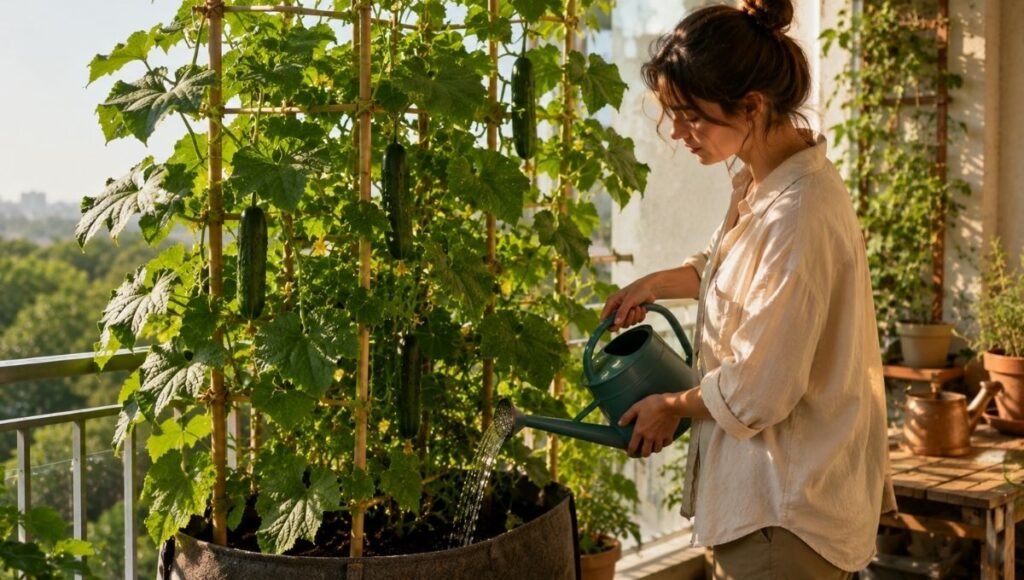
I want to be specific about this because “cucumbers need lots of water” is repeated in every guide and is not specific enough to actually help.
Cucumbers are one of the thirstiest vegetables you can grow in containers. The USDA notes that cucumbers are 95–96% water by weight — that water has to come from somewhere, and in a container it comes from you, consistently, every day.
In practice: during peak summer growing season, most container cucumbers need watering once daily, sometimes more if the container is small or the weather is very hot. This is not an exaggeration or an extreme scenario. It’s what thirsty plants in limited soil volume on a sunny balcony actually need.
The bitter cucumber problem: inconsistent moisture — dry for two days, then thoroughly watered, then dry again — is the primary cause of bitter cucumbers. Bitterness is a stress response. The plant produces cucurbitacin (the compound responsible for bitterness) when it’s water-stressed. Consistent moisture = sweet cucumbers. Inconsistent moisture = bitter cucumbers, every time.
How to water: water at soil level, not over the leaves. Wet leaves sitting in warm conditions attract fungal disease faster than almost anything else. In a sunny balcony setting, morning watering is ideal — foliage dries during the day and the plant is set up with moisture for the day’s growth.
Improving moisture retention in your mix: standard all-purpose potting mix is workable, but adding coconut coir or sphagnum peat moss (up to 30% of the total mix volume) significantly improves moisture retention. This means the container dries out more slowly between waterings — particularly helpful on hot, windy balconies.
The finger test: check the soil daily. If the top inch is dry, water now, not tomorrow. Cucumbers don’t wait.
Soil: Rich, Moisture-Retentive, and Well-Draining
Cucumbers are heavy feeders that also hate waterlogged roots. The soil needs to achieve both things simultaneously: hold moisture well enough that the plant doesn’t stress between waterings, but drain freely enough that roots aren’t sitting in standing water.
A good container cucumber mix: standard potting mix with 25–30% added coconut coir or peat moss (for moisture retention) and 15–20% perlite (for drainage). This combination holds water longer than standard mix alone while still draining freely after watering.
Never use garden soil in containers. It compacts with every watering, blocks drainage, and creates the soggy anaerobic conditions that rot cucumber roots.
Starting with a nutrient-rich base: mix in a slow-release granular fertilizer or a generous handful of worm castings when filling your container. Cucumbers are hungry plants that will consume nutrients quickly — starting with a rich base means the plant has resources from day one.
Feeding: More Often Than Most Vegetables
Container cucumbers deplete nutrients faster than in-ground plants because nutrients wash out with every watering. Regular feeding is not optional — it’s the difference between a plant that produces prolifically and one that stalls after the first flush of fruit.
A simple feeding schedule:
- Pre-planting: mix slow-release fertilizer into the soil
- Once plants are established and growing: liquid feed every 7–10 days
- Once flowering begins: switch to a fertilizer higher in phosphorus and potassium (lower nitrogen) — this supports fruit development rather than excessive leafy growth
- Continue through the entire fruiting period
The “higher potassium during fruiting” step is one the Nextdoor Homestead’s guide doesn’t explicitly state but makes a real difference: too much nitrogen during fruiting produces lots of vine and leaf and less fruit. Shift the formula once flowers appear.
The Trellis Question: Yes, You Need One
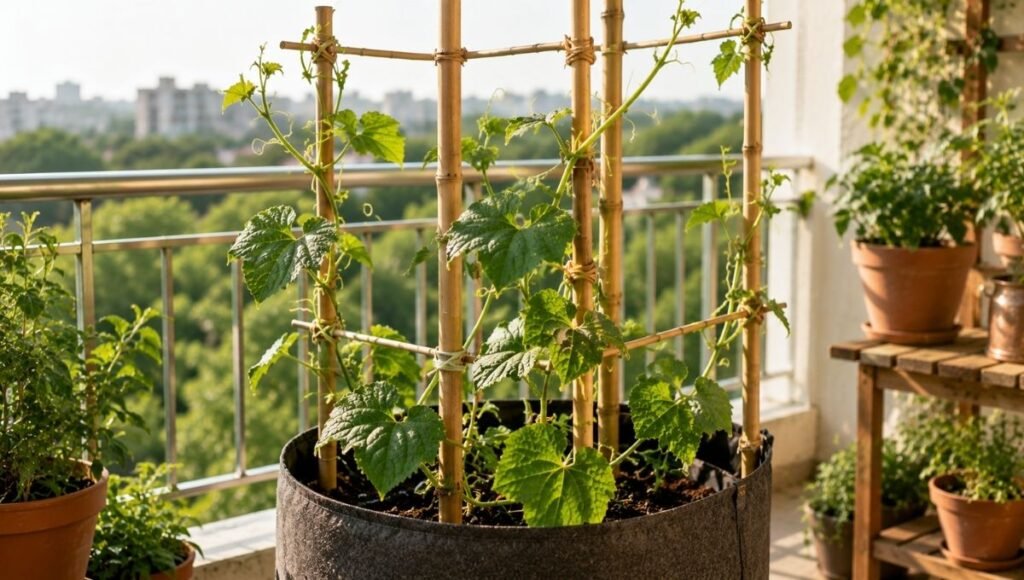
My instinct when I first grew container cucumbers was to let them trail and sprawl across the balcony floor. This works — technically — but it invites fungal disease, makes harvesting difficult, and dramatically reduces yield by limiting airflow around the plant.
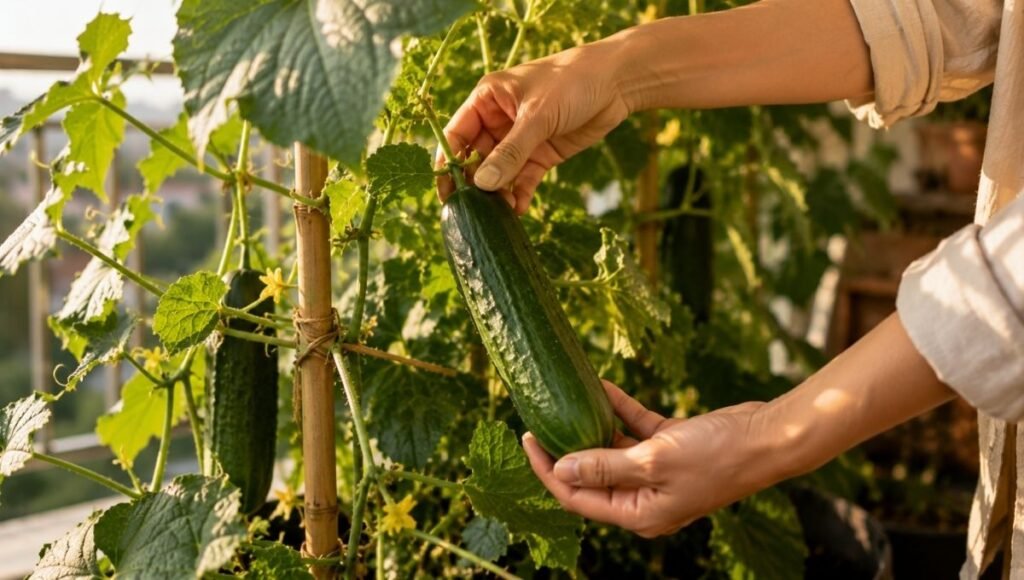
A trellis transforms container cucumber growing. Vertical growth keeps leaves and developing fruit off damp soil and surfaces, improves air circulation (which reduces mildew), makes it easy to spot and harvest cucumbers before they overgrow, and allows you to grow effectively in much less floor space.
Simple trellis options for a balcony:
- Bamboo stakes pushed into the pot with horizontal twine strung between them
- A simple A-frame trellis made from bamboo canes
- A wall-mounted lattice panel behind the container
- A tomato cage (works for compact varieties)
Training the plant: as vines grow, gently guide them toward the trellis and secure loosely with soft garden twine. Don’t tie tightly — you want the stem to have room as it thickens. Remove any very vigorous lateral shoots that are heading away from the trellis rather than up it.
Pollination: Why Parthenocarpic Varieties Matter on a Balcony
Standard cucumber varieties produce both male and female flowers and require a pollinator (usually a bee) to transfer pollen between them for fruit to develop. In a garden bed at ground level surrounded by flowering plants, this happens naturally. On a fifth-floor balcony, it may not happen at all.
If you’re growing a standard variety and getting flowers but no fruit, this is the problem. The solutions are to hand-pollinate (transfer pollen from male to female flowers using a small paintbrush or cotton swab), or to switch to a parthenocarpic variety that sets fruit without pollination.
I genuinely recommend just growing parthenocarpic varieties from the start — particularly for balcony gardeners. The hand-pollinating process is manageable but adds daily attention during flowering, and you need to correctly identify male vs. female flowers (females have a tiny proto-cucumber behind the flower; males don’t). Parthenocarpic varieties eliminate this entire variable.
Common Problems and Honest Fixes
Flowers but No Fruit
Most commonly: pollination failure in standard varieties. Switch to a parthenocarpic variety or hand-pollinate. Also possible: too much nitrogen (all vine, no fruit) — reduce nitrogen and increase phosphorus/potassium feeding.
Bitter Cucumbers
Almost always inconsistent watering. The plant produced cucurbitacin as a stress response to water deprivation. Water more consistently — check soil daily, water before it dries out rather than after. In very hot weather, twice-daily watering may be needed for smaller containers.
Yellowing Leaves
Lower leaves yellowing as the plant matures is somewhat normal — the plant redirects energy upward. Rapid yellowing across the plant: usually nutrient deficiency (particularly nitrogen) or overwatering. Check soil moisture and feed if not recently done.
Powdery Mildew (White Powdery Coating on Leaves)
Common in warm, humid weather with poor air circulation. Prevention: trellis for vertical growth, water at soil level not over leaves, maintain air circulation around the plant. Treatment: remove affected leaves, spray remaining foliage with diluted neem oil or baking soda solution every 5–7 days.
Cucumbers Turning Yellow on the Vine
Usually means they’ve been left on the plant too long past optimal harvest size — overripe cucumbers yellow and their seeds harden. Harvest more frequently and earlier. Also possible: nutrient deficiency, particularly potassium.
When to Harvest (Earlier Than You Think)
This is the mistake I made repeatedly in my early years: leaving cucumbers on the vine too long. It seems counterintuitive, but cucumbers are best harvested before they reach full size. A cucumber left on the vine too long becomes bitter, seedy, and tough — and it signals the plant to slow down fruit production.
Harvest when: cucumbers are firm, a rich green color (or whatever color is characteristic of your variety), and have reached roughly two-thirds of their expected mature size. They should detach with a slight twist and gentle pull.
Harvest frequency: check plants every 1–2 days during peak production. Frequent harvesting encourages the plant to continue producing rather than directing energy into maturing existing fruit.
Never leave cucumbers on the vine to go yellow — unless you specifically want seed. A yellowing cucumber tells the plant “job done,” and production slows or stops.
If You Only Have 10 Minutes to Start
Buy a packet of parthenocarpic cucumber seeds (Spacemaster or Patio Snacker are widely available), a 10-gallon fabric grow bag, and a bag of all-purpose potting mix. Mix in a slow-release fertilizer. Sow 2–3 seeds 1 inch deep, water well, and put the bag in the sunniest spot on your balcony. Thin to the strongest seedling once they emerge.
That’s it. Start there and adjust everything else as the plant grows.
FAQ
What is the best cucumber variety for containers? Parthenocarpic and compact varieties are the best choice. Spacemaster, Patio Snacker, and Bush Pickle are widely available and reliable. For better harvests without pollinator dependence, look specifically for varieties labeled “parthenocarpic” — these set fruit without bee pollination, which is a significant advantage on balconies and in apartments.
How often should I water cucumbers in containers? Daily in summer, and sometimes twice daily in very hot weather or for smaller containers. Check the soil before every watering — if the top inch is dry, water now. Cucumbers are one of the thirstiest vegetables and inconsistent moisture causes bitter fruit.
Why are my container cucumbers bitter? Almost always inconsistent watering. Water stress causes the plant to produce cucurbitacin, the compound responsible for bitterness. Water more consistently and frequently — check daily, water before the soil fully dries out.
Do cucumbers need a trellis in containers? Yes — for most vining varieties, a trellis significantly improves air circulation, reduces disease pressure, makes harvesting easier, and increases yield. Compact bush varieties manage without a trellis in smaller containers, but even they benefit from some support.
Can cucumbers grow in full shade? No. Cucumbers need 6–8 hours of direct sun daily. In partial shade, plants may grow but will flower erratically and produce little or no fruit. A south or west-facing balcony is ideal.
Why are my cucumber flowers falling off without producing fruit? If growing a standard (non-parthenocarpic) variety: pollination failure. Either hand-pollinate using a small paintbrush, or switch to a parthenocarpic variety. If growing a parthenocarpic variety: usually temperature extremes (above 90°F / 32°C or below 55°F / 13°C) or excessive nitrogen causing flower drop.
The Honest Assessment
Growing cucumbers in containers is genuinely possible and genuinely rewarding — but it’s not the most forgiving crop you can grow in a pot. It requires consistent daily attention in a way that cherry tomatoes don’t, and it’s less forgiving of watering inconsistency than almost any other vegetable.
That said, a cucumber you grew yourself — firm, cold from the fridge, sliced into a salad on a hot August evening — tastes completely different from anything you bought at a grocery store. Not because it’s chemically superior. Because you watered it every morning for two months and watched it happen.
Research from the University of Exeter found that people who grow their own food report significantly higher wellbeing and sense of connection to the natural world than those who don’t — even from small-scale balcony growing. The cucumber is not the point. The practice is.
Start with the right variety. Water it every day. Give it something to climb. You might be surprised.
Keep Growing
- 🍅 [Growing Tomatoes in Pots] — another rewarding balcony crop with similar sun requirements
- 🥬 [Easiest Vegetables to Grow for Beginners] — what to grow alongside your cucumbers
- 🪴 [Container Gardening: The Complete Beginner’s Guide] — the full framework for growing in pots
- 💧 [How Often to Water Potted Plants] — get container watering right for every season
References: USDA FoodData Central (2024). Cucumber, with peel, raw — Nutrient data. National Center for Home Food Preservation, University of Georgia (2023). Cucumbers — Selection and Preparation. University of Exeter — Miles Richardson et al. (2022). Connection to nature and wellbeing through everyday activities. People and Nature, 4(2), 339–353. Old Farmer’s Almanac (2026). Cucumber Growing Guide. University of Illinois Extension (2023). Growing Cucumbers.