
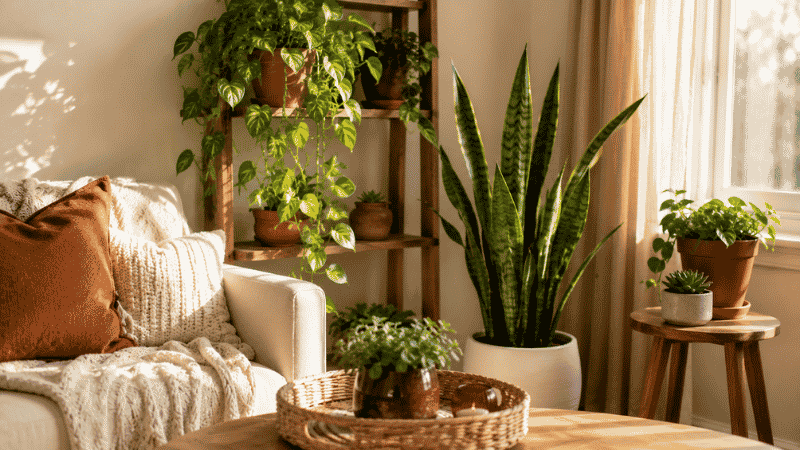
Seven plants. That’s the average number of houseplants a millennial has killed before figuring out what they were doing wrong. Not one or two — seven. According to a survey by OnePoll and Article, 67% of plant owners have called themselves “plant murderers” at some point, and nearly half felt genuinely disappointed every time a plant died on their watch.
If that sounds familiar, you’re in the right place — and you’re in excellent company.
Here’s the thing: plants don’t die because you’re bad at caring for them. They die because most beginner plant guides recommend beautiful plants that aren’t actually beginner-friendly, without telling you what those plants actually need to thrive. A fiddle leaf fig looks stunning in a Pinterest photo. It’s also one of the most temperamental houseplants in existence, prone to dropping every leaf if you look at it wrong. That’s not a beginner plant. That’s an advanced challenge dressed up as décor inspiration.
This guide is different. Every plant on this list has been chosen specifically because it forgives mistakes, adapts to imperfect conditions, and gives beginners a genuine chance to succeed. Some are for low-light apartments. Some are for bright, sunny windowsills. Some are safe for pets. All of them are genuinely, reliably easy to grow — even if you’ve never kept a plant alive before.
Key Takeaways
- 7 in 10 millennials identify as “plant parents,” yet 48% worry about their ability to keep plants alive — choosing the right plant from the start makes all the difference
- The best plants for beginners share four traits: tolerance for irregular watering, adaptability to varied light, recovery from mistakes, and no special humidity or fertilizer requirements
- Matching a plant to your actual light conditions is more important than any other care decision
- Most beginner plant failures come from choosing plants that aren’t actually beginner-friendly — not from lack of skill or care
- You can start a thriving indoor garden with as little as $10–$20 per plant from any garden center or grocery store
What Makes a Plant Truly Beginner-Friendly?
Before the list, it’s worth being clear about what “beginner-friendly” actually means — because a lot of popular plant content gets this wrong.
A genuinely beginner-friendly plant does at least three of these four things: it tolerates uneven watering without immediately dying, it adapts to less-than-ideal light conditions, it bounces back when you make a mistake, and it doesn’t require special fertilizers, high humidity, or frequent repotting to stay healthy.
What it doesn’t mean is “impossible to kill under any circumstances.” All plants have limits. The difference is that beginner plants have wide margins — they give you room to learn, adjust, and improve without punishing every small error.
The single most important factor in choosing any plant is matching it to your actual light. A low-light plant in a bright window and a sun-loving plant in a dark corner will both struggle — no matter how carefully you water them. Before you buy anything, spend a day noticing where light actually lands in your home at 9am, noon, and 3pm. That observation will guide every plant choice on this list.
Best Plants for Beginners in Low Light Rooms
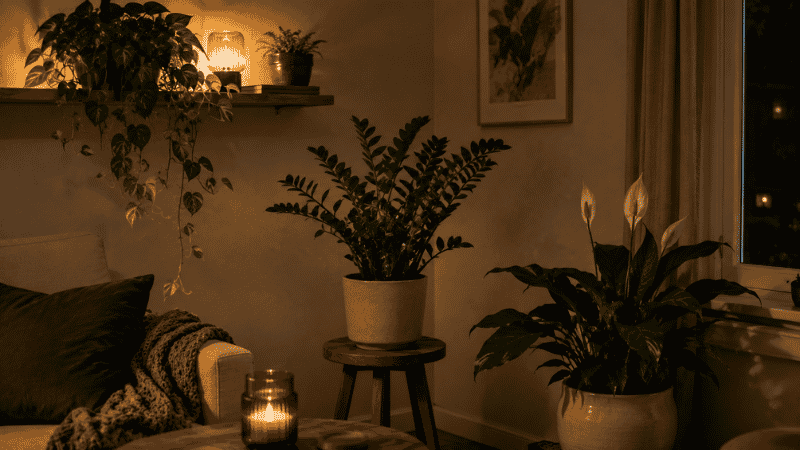
If your home has north-facing windows, small windows, or rooms that feel dim even on sunny days, these plants are built for you. They’ve evolved in the understory of tropical forests where very little direct sunlight penetrates — which means your darker apartment is closer to their natural habitat than you might think.
Pothos (Epipremnum aureum)
Light: Low to bright indirect | Water: Every 1–2 weeks | Pet safe: No
If there is one plant that every beginner should start with, it’s the pothos. It grows in low light or bright light. It grows in water or in soil. It forgives missed waterings, overwaterings, and almost every other mistake a new plant owner can make. Its trailing vines look beautiful draped from shelves or hanging baskets, and it grows fast enough to give you the satisfaction of visible progress.
Golden pothos is the most common and forgiving variety, but marble queen, neon, and pearl & jade varieties share the same easy-going character. Start with one pothos, learn its rhythms, and you’ll understand indoor plant care better than any article can teach you.
Most common mistake: Keeping it in a pot without drainage holes. Pothos needs to dry out slightly between waterings — soggy soil causes root rot quickly.
Snake Plant (Dracaena trifasciata)
Light: Low to bright indirect | Water: Every 2–6 weeks | Pet safe: No
The snake plant is one of the most recommended beginner plants in the world, and the reputation is completely deserved. It stores water in its thick, sword-like leaves, tolerates low light better than almost any other plant, and can go weeks without attention. It’s the plant for people who travel frequently, work long hours, or simply forget to water things.
Its upright architectural shape also makes it one of the most visually striking plants you can own — it looks like something a professional interior designer placed there, not something you bought from the grocery store clearance section.
Most common mistake: Overwatering. Snake plants rot in soggy soil faster than almost any other houseplant. Water only when the soil is completely dry, top to bottom.
ZZ Plant (Zamioculcas zamiifolia)
Light: Low to medium indirect | Water: Every 2–4 weeks | Pet safe: No
The ZZ plant stores water in underground rhizomes, which means it can survive weeks of complete neglect without visible distress. Its glossy, deep green leaves look so perfect that people regularly mistake it for a fake plant — which is arguably the highest compliment a low-maintenance houseplant can receive.
You’ll see ZZ plants in hotel lobbies, airport lounges, and office reception areas for exactly this reason: they look elegant and require almost nothing from the people around them.
Most common mistake: Root rot from overwatering. The ZZ plant genuinely prefers to be underwatered. When in doubt, wait another week.
Peace Lily (Spathiphyllum)
Light: Low to medium indirect | Water: Weekly | Pet safe: No ⚠️
The peace lily is remarkable for two reasons: it’s one of the few flowering plants that thrives in low light, and it communicates its needs with unusual clarity. When a peace lily is thirsty, it droops dramatically. When you water it, it perks back up within hours. For a beginner who isn’t sure when to water, this built-in signaling system is genuinely invaluable.
NASA’s Clean Air Study identified peace lily as one of the most effective air-purifying houseplants, capable of filtering benzene, formaldehyde, and other common indoor pollutants — a useful bonus for any living space.
Most common mistake: Placing it in direct sunlight. Bright direct sun scorches peace lily leaves quickly. Keep it in the shadier parts of your home.
Chinese Evergreen (Aglaonema)
Light: Low to medium indirect | Water: Every 1–2 weeks | Pet safe: No
Chinese evergreen is the most underrated plant on this list. It comes in an extraordinary range of colors — solid green, silver-streaked, pink-flushed, red-tipped — and it tolerates low light, dry air, and inconsistent watering better than most other houseplants. It’s exactly the kind of plant you can put in a corner you’re not sure what to do with and forget about for two weeks.
Most common mistake: Cold air exposure. Keep it away from air conditioning vents and drafty windows in winter — this plant dislikes sudden temperature drops.
Best Plants for Beginners in Bright, Sunny Spaces
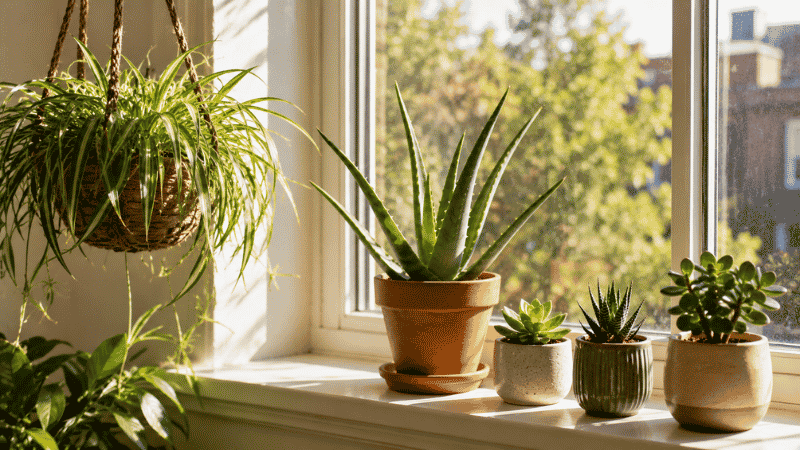
If you have south or west-facing windows, a sunlit balcony, or a bright sunroom, this section is for you. These plants love light and still ask very little in return.
Aloe Vera
Light: Bright direct or indirect | Water: Every 2–4 weeks | Pet safe: No
Aloe vera is both a plant and a household utility. Its gel soothes minor burns and skin irritation, which makes it a genuinely useful thing to keep in a kitchen or near a sunny window. As a succulent, it stores water in its fleshy leaves and thrives on neglect — water it infrequently, give it a sunny spot, and it will grow quietly and steadily for years.
Most common mistake: Overwatering, especially in winter. Aloe needs very little water from October through February — once a month is often enough.
Spider Plant (Chlorophytum comosum)
Light: Medium to bright indirect | Water: Every 1–2 weeks | Pet safe: ✅ Yes
Spider plant is one of the very few low-maintenance plants that’s completely non-toxic to cats and dogs — which makes it particularly valuable for pet-owning households. It’s also one of the most generous plants you can own: mature plants send out long stems tipped with miniature “spiderettes” that you can root in water and grow into entirely new plants, entirely for free.
Most common mistake: Root-bound neglect. Spider plants grow quickly and need repotting every year or two. If growth slows dramatically, check whether roots are circling the bottom of the pot.
Rubber Plant (Ficus elastica)
Light: Medium to bright indirect | Water: Every 1–2 weeks | Pet safe: No
The rubber plant is one of those plants that makes a room feel finished. Its large, glossy leaves — which come in deep green, burgundy, or variegated cream and pink — create an immediate visual impact, and it grows steadily into an impressive floor plant over time. Despite its dramatic appearance, it’s genuinely easy to care for.
Most common mistake: Moving it around too often. Rubber plants dislike being relocated — once they settle into a spot they like, leave them there.
Succulents (various species)
Light: Bright direct sun | Water: Every 2–4 weeks | Pet safe: Varies by species
Succulents are the most commonly recommended beginner plants — and they’re also the most commonly killed by beginners, because most people don’t give them nearly enough light. Succulents are desert plants. They need bright, direct sunlight for several hours a day. In a dim apartment, they will survive briefly and then slowly fade.
If you have a genuinely bright south or west-facing windowsill, succulents are wonderful. If your space is dimmer than that, choose pothos or a snake plant instead — they’ll make you far happier.
Most common mistake: Insufficient light and overwatering together — the deadliest combination for any succulent.
Best Plants for Beginners Who Want to Grow Something They Can Eat
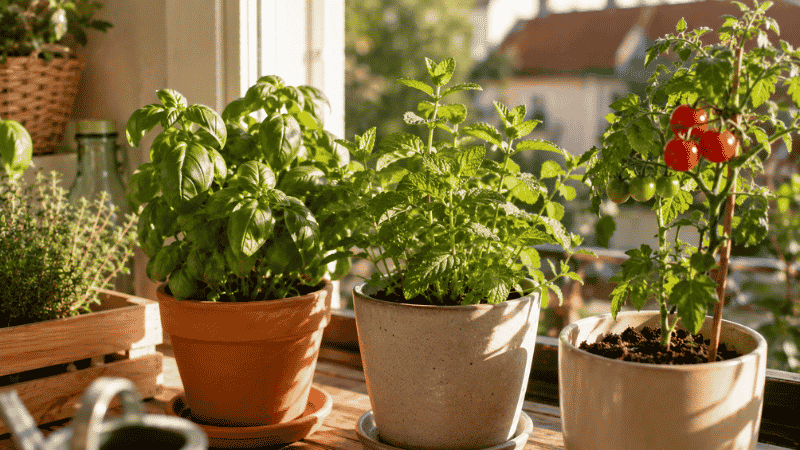
Growing edible plants is one of the most satisfying things a beginning gardener can do. The list of what you can grow in pots on a windowsill or balcony is longer than most people realize.
Basil
Light: Bright indirect to direct | Water: Regular — don’t let it dry out | Pet safe: ✅ Yes
Basil is the gateway herb. It grows fast, smells wonderful, and the act of pinching off leaves to use in cooking while the plant continues to produce more is one of the small joys that hooks people on gardening permanently. Keep it in a sunny window, water regularly, and pinch off any flower buds as they appear to extend the harvest season.
Most common mistake: Letting it flower. Once basil goes to seed, it stops producing flavorful leaves. Pinch flower buds off as soon as you spot them.
Mint
Light: Medium to bright | Water: Regular | Pet safe: ✅ Yes (cats may react to it)
Mint is famously vigorous — give it its own pot, because it will take over any shared container without hesitation. In its own space, it’s a joy to grow: fast-growing, fragrant, nearly impossible to kill, and endlessly useful in cooking and drinks. Spearmint, peppermint, and chocolate mint are all equally easy.
Most common mistake: Planting it with other herbs. Mint needs to live alone.
Lettuce and Mixed Greens
Light: Medium to bright indirect | Water: Regular | Pet safe: ✅ Yes
Lettuce is one of the fastest and most satisfying things a beginning gardener can grow. Seeds germinate within days, and loose-leaf varieties can be harvested in 30 days or less using the “cut and come again” method — snip outer leaves, and the plant keeps producing. A single balcony container can supply regular salad greens for weeks.
Most common mistake: Letting it bolt in summer heat. Lettuce prefers cooler conditions — it grows best in spring and fall, or indoors year-round.
Cherry Tomatoes
Light: Bright direct sun (6+ hours) | Water: Regular and consistent | Pet safe: No (leaves)
Cherry tomatoes are the most rewarding edible plant a beginner can grow, and the most demanding of the plants on this list. They need genuine sunlight — at least 6 hours of direct sun per day — and consistent watering, especially once fruiting begins. But when they work, they produce abundantly. Compact varieties like ‘Tiny Tim,’ ‘Tumbling Tom,’ and ‘Balcony’ are bred specifically for containers and smaller spaces.
Most common mistake: Inconsistent watering during fruiting. Irregular watering causes tomatoes to crack and can lead to blossom end rot. Once plants are flowering, try to water at the same time each day.
Best Plants for Beginners: Quick-Reference Guide
| Plant | Light Needed | Watering | Pet Safe | Best For |
|---|---|---|---|---|
| Pothos | Low–bright indirect | Every 1–2 wks | No | Everyone |
| Snake Plant | Low–bright indirect | Every 2–6 wks | No | Forgetful waterers |
| ZZ Plant | Low–medium | Every 2–4 wks | No | Dark apartments |
| Peace Lily | Low–medium | Weekly | No | Low-light flowers |
| Chinese Evergreen | Low–medium | Every 1–2 wks | No | Small spaces |
| Aloe Vera | Bright sun | Every 2–4 wks | No | Sunny windowsills |
| Spider Plant | Medium–bright | Every 1–2 wks | ✅ Yes | Pet households |
| Rubber Plant | Medium–bright | Every 1–2 wks | No | Statement pieces |
| Succulents | Bright sun | Every 2–4 wks | Varies | Desert-light spaces |
| Basil | Bright | Regularly | ✅ Yes | Kitchen gardeners |
| Mint | Medium–bright | Regularly | ✅ Yes | Herb lovers |
| Lettuce | Medium–bright | Regularly | ✅ Yes | Balcony growers |
| Cherry Tomatoes | Direct sun | Daily in summer | No | Balcony harvests |
The One Mistake That Kills Most Beginner Plants
Before anything else — before you worry about fertilizer, soil, pot size, or humidity — get this one thing right: check your soil before you water, every single time.
The majority of houseplant deaths, regardless of species, come from overwatering. Not from neglect. Not from bad light. From watering on a schedule — “every Sunday,” “every three days” — regardless of what the plant actually needs at that moment.
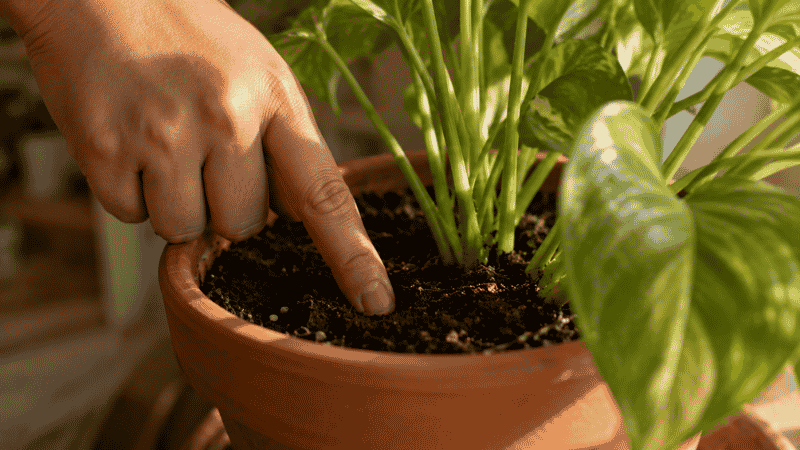
The fix is a single habit: before you pick up the watering can, push your finger an inch into the soil. If it’s moist, put the can down. If it’s dry, water thoroughly until it drains from the bottom. That’s it. That one change will do more for your plants than any product, any fertilizer, or any grow light you can buy.
If You Only Have 10 Minutes
If you’re new to plants and feeling overwhelmed, here’s the absolute minimum you need to start successfully:
Buy one pothos. Put it near a window — any window. Use a pot with drainage holes and a bag of standard potting mix. Water it when the top inch of soil feels dry. Do that for 30 days.
You’ll have learned more about plant care from watching that one pothos than from reading ten articles. Then add a second plant. Then a third. Build slowly, and your confidence builds with it.
FAQ
What is the absolute easiest plant for a complete beginner? Pothos (Epipremnum aureum) is the most consistently beginner-friendly plant available. It tolerates low light, survives uneven watering, grows in water or soil, and is available almost everywhere for under $10. Start here.
What plants are best for beginners with no natural light? ZZ plants and snake plants are the strongest performers in genuinely low-light conditions. Both can survive in rooms with only a north-facing window or ambient light from a hallway. They won’t grow quickly, but they’ll stay alive and healthy.
What is the best beginner plant for a balcony? Spider plants, aloe vera, and mint all thrive on balconies with moderate to good sun. For a sunny south or west-facing balcony, cherry tomatoes, basil, and succulents are excellent choices. For a shadier east or north-facing balcony, stick with pothos, lettuce, and peace lily.
What plants are best for beginners with pets? Spider plants, Boston ferns, areca palms, parlor palms, and calatheas are among the most popular pet-safe beginner options. Always verify toxicity at aspca.org before bringing any new plant home — “non-toxic” ratings can be species-specific.
How many plants should a beginner start with? One or two. Seriously. The most common beginner mistake is starting with too many plants at once, which leads to overwhelm and neglect. Start with one or two plants, learn their individual rhythms over a full season, then gradually add more. Quality of attention matters more than quantity of plants.
What’s the cheapest way to start a plant collection? Buy small plants rather than large statement specimens — they’re significantly cheaper and grow quickly with proper care. Propagate spider plants and pothos from cuttings (they root easily in a glass of water) for free new plants. Buy potting mix in larger bags rather than small ones for better value.
Why do my plants keep dying even when I follow the care instructions? Care instructions are generalized — they can’t account for your specific home’s light levels, humidity, temperature, or pot size. The most common cause of plant death is overwatering, often combined with a pot that lacks drainage. Check those two things before adjusting anything else.
A Thought Before You Start
Seventy percent of millennials call themselves plant parents — not just plant owners, but parents. There’s something in that word choice that says something real: plants connect us to cycles of growth and care that most modern life doesn’t offer. You water something, and it responds. You pay attention, and it rewards you. You make a mistake, and you learn.
The average plant parent has killed seven plants before finding their rhythm. That’s not failure — that’s the learning curve that every plant person goes through. The goal isn’t to never lose a plant. The goal is to get better, one plant at a time.
Start with one. Go from there.
Keep Growing
- 🌿 [Low Maintenance Indoor Plants: 12 Hard-to-Kill Picks] — the full guide to plants that thrive on minimal care
- 🪴 [Gardening for Beginners: Grow Your First Garden] — ready to take things outside? Start here
References: OnePoll & Article (2020). Millennials and Houseplants Survey. National Gardening Association (2021). Plant Trends Survey. Wolverton, B.C., Johnson, A., & Bounds, K. (1989). Interior Landscape Plants for Indoor Air Pollution Abatement. NASA/ALCA Final Report. Soga, M., Gaston, K.J., & Yamaura, Y. (2017). Gardening is beneficial for health: A meta-analysis. Preventive Medicine Reports, 5, 92–99. ASPCA Animal Poison Control Center. Toxic and Non-Toxic Plant List.