
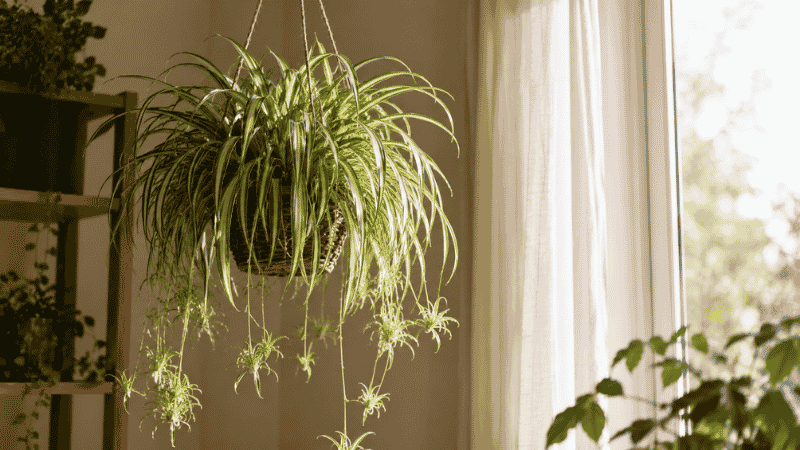
There’s a good chance you know a spider plant. The one that lived in your grandmother’s kitchen, trailing long ribbons of green from a hanging basket near the window. The one that kept producing little baby plants on long arching stems, even when nobody was particularly paying attention. The one that was, by any measure, absolutely thriving on a combination of occasional watering and cheerful neglect.
Spider plants have been household companions for generations — and for good reason. Spider plant care is genuinely one of the most forgiving relationships you can have with a living thing. They tolerate low light, irregular watering, and temperatures that range from “comfortably warm” to “I forgot to close the window last night.” They’re pet-safe, fast-growing, and one of the few houseplants that will actually give you free new plants as a thank-you for keeping them alive.
The main thing that trips people up — and the thing almost no one explains clearly — is the brown tips. Nearly every spider plant gets them eventually. This guide tells you exactly why they happen, how to prevent them, and everything else you need to know to keep your spider plant genuinely thriving.
Key Takeaways
- Spider plants are one of the few truly pet-safe houseplants — confirmed non-toxic to cats and dogs by the ASPCA
- Brown tips are almost always caused by tap water chemicals (fluoride and chlorine) or low humidity — not overwatering or underwatering as commonly believed
- Spider plants reproduce by sending out long stems (stolons) tipped with baby plants (spiderettes) — these can be rooted in water in 2–4 weeks for free new plants
- NASA’s 1989 Clean Air Study identified spider plants as effective at removing carbon monoxide and xylene from indoor air
- A slightly root-bound spider plant actually produces more babies — this plant rewards patience over frequent repotting
What Makes Spider Plants So Enduringly Popular
Spider plants (Chlorophytum comosum) are native to Central and Southern Africa, where they grow as ground-cover plants in shaded forest margins and rocky outcrops. This origin explains their indoor character: they evolved to handle variable light, survive dry periods using their thick fleshy roots as water reserves, and spread aggressively through runners — which, in your home, appear as the charming cascading stems topped with baby plants.
The thick, tuberous roots are the key to understanding spider plant care. These roots store water efficiently, which is why spider plants tolerate missed waterings so well. It also means they’re more likely to be damaged by too much water than too little — roots that are perpetually wet can’t breathe and will begin to rot.
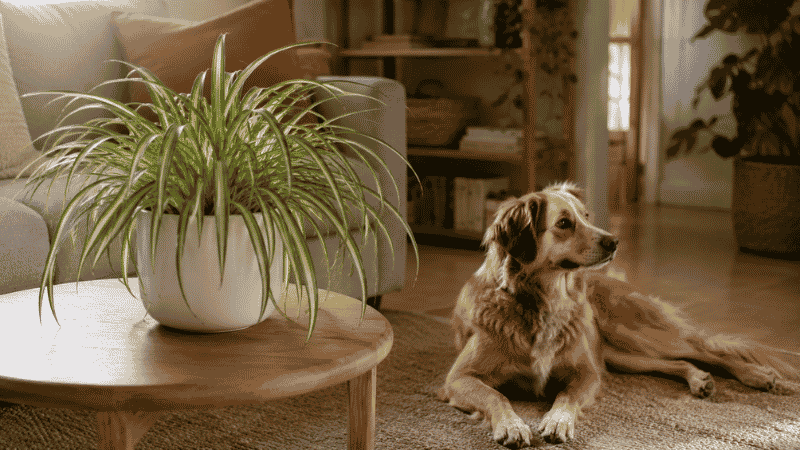
Beyond their toughness, spider plants are one of the genuinely pet-safe houseplants in a world where many popular species are toxic to animals. The ASPCA lists spider plants as non-toxic to both cats and dogs — which makes them a reliable choice for homes with curious animals. Worth noting: cats are sometimes drawn to chewing spider plant leaves (possibly due to mild compounds that have a mild euphoric effect on them), which won’t harm them but may harm the plant. If your cat is a committed chewer, hanging placement helps.
Spider Plant Care: Light Requirements
Spider plants are adaptable to a wide range of light conditions, which is a big part of their appeal. But adaptable doesn’t mean indifferent — light level has a real effect on how they look and grow.
In low light (north-facing rooms, dim corners): spider plants survive but grow slowly. The white or yellow stripes on variegated varieties fade and the leaves may become uniformly green. The plant stays alive but doesn’t thrive.
In medium indirect light (east-facing windows, a few feet from a south or west window): this is the sweet spot. Leaves are lush, stripes are sharp and bright, and the plant grows steadily and produces spiderettes.
In bright indirect light or dappled sun: excellent — spider plants respond well to more light as long as it’s not harsh direct sun, which scorches the leaf tips and edges.
In direct harsh sunlight: avoid this. Afternoon sun through a south or west-facing window will burn the leaves, producing bleached patches and crispy brown edges. Spider plants sit in dappled forest shade in the wild — replicate that, not a greenhouse bench.
One useful fact: the intensity of the white or yellow stripes on variegated spider plants increases with more light. If your plant’s stripes are looking dull or disappearing, try moving it to a brighter location.
How to Water a Spider Plant
Spider plants are more tolerant of underwatering than overwatering — their fleshy tuberous roots store water reserves that carry them through dry spells. This makes them excellent for forgetful waterers.
The rule: let the top inch or two of soil dry out before watering. When you do water, water thoroughly — until water drains from the drainage holes — then let the soil dry out again before the next watering.
Frequency: every 1–2 weeks in spring and summer; every 2–3 weeks in autumn and winter. As always, check the soil rather than following a fixed schedule.
Signs of overwatering: yellowing leaves, soft or mushy roots if you check the root ball, soil that stays wet for more than a week. Reduce watering frequency immediately and ensure the pot has drainage holes.
Signs of underwatering: crispy, dry leaf edges; leaves that look pale and slightly wilted; soil that’s bone dry and pulling away from the pot sides. Water thoroughly and the plant will recover quickly.
The Real Reason Spider Plants Get Brown Tips (It’s Not What You Think)
This is the most important thing in this entire guide, and it’s the thing most care articles get wrong or oversimplify.
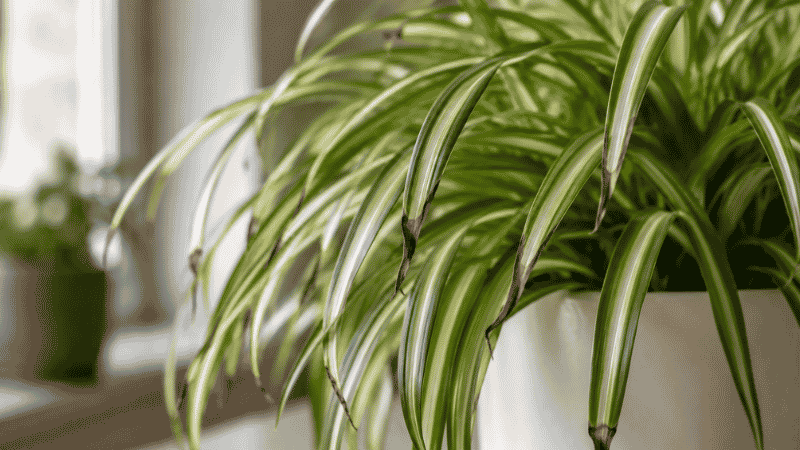
Brown tips on spider plant leaves are most commonly caused by fluoride and chlorine in tap water — not by overwatering, not by underwatering, and not necessarily by low humidity (though that can contribute).
Spider plants are sensitive to fluoride in particular. Most municipal tap water contains fluoride as a dental health additive, and when this accumulates in the soil over time, it causes characteristic brown tips — a condition sometimes called fluoride toxicity. The damage appears at the tips first and progresses along the leaf edges as accumulation worsens.
How to prevent brown tips from tap water:
- Switch to filtered water, rainwater, or distilled water
- If you use tap water, let it sit out overnight before watering — this allows some chlorine to dissipate (though it doesn’t remove fluoride)
- Flush the soil thoroughly every 3–4 months by watering very heavily several times in a row, allowing water to run through completely — this washes out accumulated mineral salts
Other causes of brown tips:
- Low humidity — spider plants prefer moderate humidity; in very dry homes (particularly in winter with heating running), leaf tips dry out. A pebble tray with water or grouping plants together helps.
- Over-fertilizing — too much fertilizer creates salt buildup in the soil, which also causes brown tips. Feed lightly (half-strength or less) and stop feeding in autumn and winter.
- Direct sunlight — hot sun scorches the tips first.
The reassuring truth: some brown tipping is almost inevitable for any spider plant. It’s cosmetic, not dangerous. Trim the affected tips with clean scissors, cutting at a slight angle to maintain the leaf’s natural pointed shape, and address the underlying cause.
Soil, Pots, and Repotting
Spider plants aren’t demanding about soil — a standard all-purpose potting mix works well. What they do need is good drainage; soggy soil is their main enemy. Adding a small amount of perlite (about 20% of the total volume) improves drainage if your mix tends to stay wet.
Always use a pot with drainage holes. This is non-negotiable for spider plants.
One interesting fact about repotting: spider plants actually produce more babies when they’re slightly root-bound. The mild stress of roots filling the pot appears to trigger the plant’s reproductive instinct — it starts sending out runners tipped with spiderettes as a survival response. This means you don’t need to rush to repot at the first sign of roots at the drainage holes. Wait until the roots are truly crowded (soil drying out very fast, roots circling densely at the bottom) before sizing up.
When you do repot, go up one size only — 1–2 inches larger in diameter. Repot in spring when the plant is entering its active growing season.
Warning: spider plant roots are fleshy and can crack or break ceramic pots if severely pot-bound. Check the pot each spring — if it’s starting to bulge or crack, that’s a clear sign it’s time.
How to Propagate Spider Plant Babies (Free New Plants)
This is one of the most joyful aspects of spider plant ownership. Once your plant is mature and healthy, it will send out long, arching stems (stolons) from the center. At the end of each stem, a small plantlet develops — often called a spiderette. These babies can be separated and grown into entirely new plants.
How to propagate spider plant babies:
Method 1 — Water rooting (easiest):
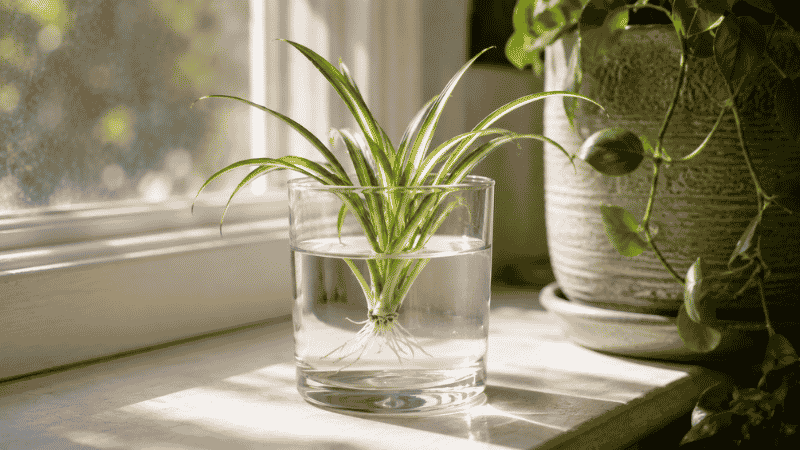
- Look under the baby plant’s base for small brown nodules — these are the pre-formed root nodes.
- Snip the stolon just below the baby plant, keeping those root nodes intact.
- Place the base of the baby in a small glass of water, ensuring the nodes are submerged.
- Set in bright indirect light and change the water every few days.
- Roots develop in 2–4 weeks. Once roots are 1–2 inches long, pot up in standard potting mix.
Method 2 — Soil rooting (faster establishment): Place the baby directly into a small pot of moistened potting mix without cutting the stolon first. Allow it to root in the soil while still attached to the parent plant (a few weeks), then cut the stolon once the baby has established itself.
One tip: don’t propagate too many babies at once. If your plant produces many runners simultaneously, removing all of them at once can stress the parent plant. Take a few at a time and let the parent recover between rounds.
Feeding Your Spider Plant
Spider plants don’t need heavy feeding — overfeeding is actually more likely to cause problems (brown tips from salt buildup) than underfeeding.
A balanced liquid fertilizer applied at half the recommended strength, once a month during spring and summer, is more than enough. Stop feeding entirely in autumn and don’t feed through winter — the plant’s growth slows significantly and accumulated fertilizer salts damage roots during this period.
One useful note: heavy fertilizing reduces spiderette production. If you want more babies, feed lightly or not at all.
Common Spider Plant Problems
Yellow Leaves
Yellow leaves on a spider plant are most commonly caused by overwatering — particularly if the yellowing is soft and affects multiple leaves across the plant. Let the soil dry out more thoroughly between waterings and check that the pot has drainage holes.
Less commonly, yellow leaves result from direct sunlight (which bleaches rather than burns the leaves) or severe underwatering (which produces yellowing alongside dry, crispy texture).
Leaves Looking Pale and Washed Out
Usually a light issue — the plant needs more light to maintain rich green color and bright stripe contrast. Move it to a brighter location (but keep it away from harsh direct sun).
No Baby Plants Appearing
Several possible causes: the plant may not be mature enough (young plants focus on leaf growth before reproducing); it may need more light (spiderettes are more common in good light); or it may be in too large a pot (slightly root-bound plants reproduce more readily). Also ensure you’re not over-fertilizing, which suppresses spiderette production.
Leaves Going Limp and Flat
Usually underwatering — the fleshy roots’ water reserves have run low. Water thoroughly and the plant typically recovers within a few hours. If the soil is wet and the plant is still limp, it may have root rot — check the roots for mushy or black sections and follow the root rot treatment (trim affected roots, repot in fresh dry soil, reduce watering).
If You Only Have 5 Minutes
Check whether the soil is dry. If it is, water thoroughly with filtered water if you have it. If the plant has brown tips, trim them with clean scissors. That’s genuinely the full maintenance routine for most weeks.
Spider plants are designed to thrive on low attention. The less you overthink it, the better they do.
FAQ
How often should I water a spider plant? Every 1–2 weeks in spring and summer; every 2–3 weeks in autumn and winter. Let the top inch of soil dry out before watering. Spider plants tolerate underwatering better than overwatering — their fleshy roots store water reserves that carry them through dry periods.
Why does my spider plant have brown tips? Most commonly, tap water chemicals (fluoride and chlorine) accumulating in the soil. Switch to filtered water or rainwater, or let tap water sit overnight before using. Flush the soil every few months by watering heavily to wash out mineral buildup. Low humidity and over-fertilizing can also cause brown tips.
Are spider plants safe for cats and dogs? Yes — spider plants are confirmed non-toxic to cats and dogs by the ASPCA. This makes them one of the best low-maintenance pet-safe houseplants available. Cats may be attracted to the leaves and chew them (possibly due to mild compounds), which won’t harm the cat but may damage the plant.
How do I get more spider plant babies? Ensure the plant has good indirect light and is slightly root-bound (don’t rush to repot). Reduce or stop fertilizing — heavy feeding suppresses spiderette production. Mature, established plants in good light naturally produce runners with babies once they’re comfortable.
Can spider plants grow in low light? Yes, they survive in low light, though growth slows and variegated stripes fade toward plain green. For the best-looking plant with bright leaf patterns and active growth, medium to bright indirect light is ideal.
How do I propagate spider plant babies? Snip a baby plant (spiderette) from the stolon, keeping the small brown root nodes at its base. Place the base in a glass of water in indirect light, changing the water every few days. Roots appear in 2–4 weeks. Once roots are 1–2 inches long, pot up in standard potting mix.
Do spider plants clean the air? NASA’s 1989 Clean Air Study found spider plants effective at removing carbon monoxide and xylene from sealed chambers. Real-world air purification is modest in ventilated homes — you’d need many plants for a measurable effect — but the research is legitimate. More consistently proven: the presence of plants like spider plants reduces psychological stress and improves mood in indoor environments.
The Plant That Keeps Giving
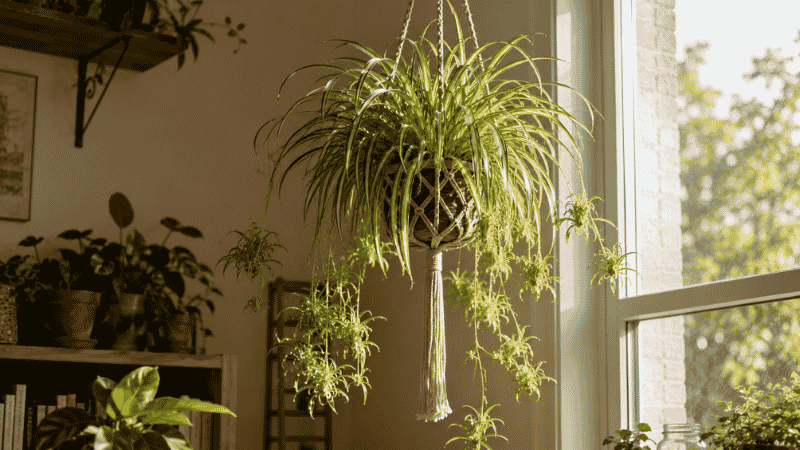
There’s something quietly generous about a spider plant. It asks very little — a bright window, some water when the soil dries, an occasional trim of the brown tips. And in return it gives you: lush trailing greenery, a steady supply of baby plants you can share with friends, and that particular satisfaction of a plant that’s clearly doing well under your care.
A 2015 study published in the Journal of Physiological Anthropology found that interacting with indoor plants — including routine care tasks — measurably reduces heart rate, blood pressure, and psychological stress compared to computer work. The spider plant, with its cheerful cascading form and easy-to-read care signals, is particularly well-suited to that daily moment of calm.
Keep one on a high shelf where the babies can trail. Keep one in a hanging basket by a window. Keep one on your desk. However you place it, it will reward you with more ease than almost any other plant you could choose.
Keep Growing
- 🌿 [Low Maintenance Indoor Plants: 12 Hard-to-Kill Picks] — more plants that thrive with minimal attention
- 🌑 [Snake Plant Care: The Complete Beginner’s Guide] — another forgiving companion for any corner
- 💛 [Plant Leaves Turning Yellow? 7 Real Causes and Fixes] — diagnose any struggling plant fast
- 🪴 [How to Repot a Plant: Step-by-Step for Beginners] — when your spider plant outgrows its pot
References: ASPCA Animal Poison Control Center. Toxic and Non-Toxic Plant List — Spider Plant (Chlorophytum comosum). Wolverton, B.C., Johnson, A., & Bounds, K. (1989). Interior Landscape Plants for Indoor Air Pollution Abatement. NASA/ALCA Final Report. Lee, M.S., Lee, J., Park, B.J., & Miyazaki, Y. (2015). Interaction with indoor plants may reduce psychological and physiological stress by suppressing autonomic nervous system activity. Journal of Physiological Anthropology, 34(1), 21. Old Farmer’s Almanac (2025). Spider Plant Care Guide. University of Florida IFAS Extension (2023). Chlorophytum comosum — Spider Plant.