
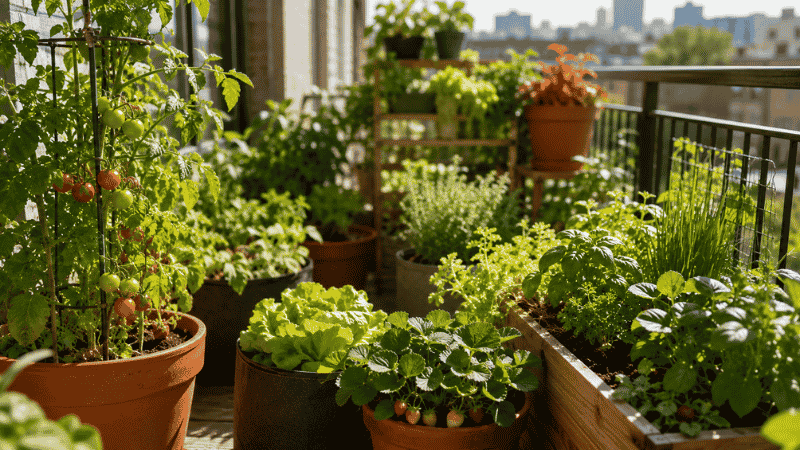
You don’t have a garden. Maybe you have a balcony, a front step, a single sunny windowsill, or a patio the size of a parking space. And somewhere in the back of your mind, there’s this persistent thought: I would love to grow something.
Here’s the thing most people don’t realize until they’ve actually tried it: some of the most productive, most beautiful, and most satisfying gardens in the world are container gardens. A few well-chosen pots on a balcony can produce more tomatoes than a mediocre in-ground bed. A window box of herbs can supply a kitchen for an entire summer. A grow bag of strawberries on a doorstep can be the most rewarding thing you’ve ever grown.
Container gardening is not a compromise for people who can’t have a “real” garden. It’s a legitimate, flexible, highly controllable way to grow plants — with distinct advantages over in-ground growing that experienced gardeners actively choose, not just settle for.
This is the complete guide. Whether you’re starting from absolute zero or have tried and failed before, everything you need to build a thriving container garden — from choosing the right pot to harvesting your first crop — is right here.
Key Takeaways
- The global container gardening market is projected to grow from $3.5 billion in 2023 to $5.8 billion by 2032 — container gardening is mainstream, not niche
- Container gardens give you complete control over soil quality, drainage, and sun exposure — often producing better results than in-ground gardens with poor native soil
- The single most important rule: always use potting mix, never garden soil — garden soil in a container compacts and blocks drainage, killing most plants within weeks
- Most vegetables, herbs, fruits, and ornamental plants grow successfully in containers with the right pot size and consistent care
- A beginner container garden can be started for under $50 and maintained on 10–15 minutes of attention per day at peak growing season
What Is Container Gardening?
Container gardening simply means growing plants in portable containers rather than directly in the ground. The container could be a terracotta pot, a plastic nursery pot, a fabric grow bag, a wooden planter box, a hanging basket, a window box, a repurposed colander, or a half-barrel — if it can hold soil and has drainage, it can be a container garden.
The practice is as old as gardening itself — ancient Romans grew plants in terracotta pots, and Versailles-style wooden planter boxes were used for centuries to grow citrus trees that needed to be moved indoors in winter. What’s changed is the range of materials, the quality of purpose-made potting mixes, and the breadth of what’s proven to grow successfully in containers.
Today, container gardening is booming particularly in urban environments. With over 56% of the world’s population now living in cities — a figure projected to reach 68% by 2050 — the demand for ways to grow food and plants in limited space has never been higher. The National Gardening Association reports that container vegetable growing specifically has increased significantly year over year, with balcony and patio gardens becoming one of the fastest-growing gardening categories.
Why Container Gardening Often Beats In-Ground Growing
This might surprise you, but container gardening has genuine advantages over traditional in-ground growing — not just for people without garden space, but for anyone who wants more control over their plants.
Complete soil control. You choose exactly what goes in your containers. No rocky ground, no clay, no compacted soil, no contamination. You start with the ideal growing medium every time and can adjust it for each plant’s specific needs.
Better pest and disease management. Containers keep roots off the ground, which is where many pests and soilborne diseases live. Slugs, underground pests, and soil pathogens are significantly less of a problem in containers than in garden beds.
Portability. You can move plants to follow the sun, bring tender plants inside before frost, rearrange your space for aesthetics, or take your garden with you when you move. No in-ground garden offers this.
Season extension. You can start plants earlier in the season indoors and move them outside when conditions are right. In autumn, you can extend the growing season by bringing containers inside or into a greenhouse.
Accessibility. Raised containers and planter boxes allow people with limited mobility to garden at a comfortable height without bending or kneeling.
Less weeding. Container gardens don’t produce the weed pressure of an in-ground garden. Your main maintenance task is watering and feeding, not weeding.
The trade-off is that containers require more frequent watering than in-ground plants (the limited soil volume dries out faster) and regular feeding (nutrients wash out with every watering). Once you understand these two differences and build habits around them, container gardening is genuinely simple.
Choosing the Right Container
The container is the foundation of everything else. Get this right and the rest becomes much easier.
Size Matters — Bigger Is Usually Better
The most common beginner mistake is choosing containers that are too small. A pot that’s too small restricts root development, dries out too quickly, and limits plant productivity. When in doubt, go larger.
General sizing guide:
| Plant Type | Minimum Container Size |
|---|---|
| Herbs (basil, chives, parsley) | 6–8 inches diameter |
| Lettuce and leafy greens | 6–8 inches deep, 12+ inches wide |
| Peppers, eggplant | 12–14 inches diameter |
| Bush tomatoes, cucumbers | 5-gallon / 12 inches diameter |
| Standard tomatoes, zucchini | 10–15 gallons |
| Strawberries | 8–10 inches deep, 12 inches wide |
| Dwarf fruit trees | 15–25 gallons |
| Perennial houseplants | Start small, repot as needed |
The rule: the larger the root system a plant develops, the more food it can produce and the more resilient it is to watering inconsistency. A tomato in a 5-gallon pot will produce. A tomato in a 15-gallon pot will thrive.
Drainage Holes Are Non-Negotiable
Every container must have drainage holes. This is the most important single feature of any container garden setup. Without drainage, excess water pools at the bottom, roots sit in it, oxygen is cut off, root rot develops, and the plant dies.
If you love a decorative container without drainage holes, use it as a sleeve: keep your plant in a plain nursery pot inside the decorative one, and remove the nursery pot to water it. This way you get the aesthetics without sacrificing drainage.
Container Materials: What to Choose
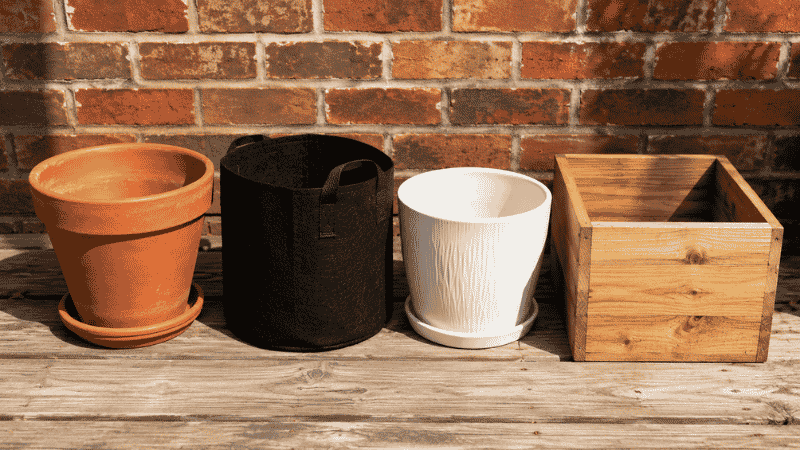
Terracotta / unglazed ceramic: Beautiful, breathable, helps regulate soil moisture. The downside: it’s heavy, breakable, and dries out faster than plastic because moisture evaporates through the walls. Excellent for plants that like to dry out between waterings (Mediterranean herbs, succulents). Requires more frequent watering for moisture-loving plants in summer.
Plastic: Lightweight, affordable, retains moisture well, comes in every size. Not as attractive as terracotta, but the plastic nursery pot inside a beautiful outer sleeve is a classic approach that gives you the best of both.
Fabric grow bags: Increasingly popular and highly effective. The porous fabric allows air pruning — when roots reach the bag wall, they’re naturally pruned rather than circling, producing a denser, healthier root system. Fabric bags also breathe better than plastic, keeping roots cooler in summer. Excellent for tomatoes, peppers, potatoes, and root vegetables.
Wood: Beautiful and insulating (wood keeps soil cooler in summer and warmer in cooler nights). Natural rot occurs over time, so look for cedar, redwood, or reclaimed wood with some weather resistance. Line the inside with plastic (not the bottom — leave drainage) to extend life.
Glazed ceramic: Heavy but retains moisture well and is beautiful. Good for plants that need consistent moisture. Fragile in freezing temperatures.
Self-watering containers: A reservoir in the base wicks water upward as the plant needs it. Excellent for busy people, frequent travelers, or anyone who tends to forget watering. Particularly good for moisture-loving plants like tomatoes and lettuce.
Soil: The Most Important Decision You’ll Make
Here is the rule that separates successful container gardeners from frustrated ones:
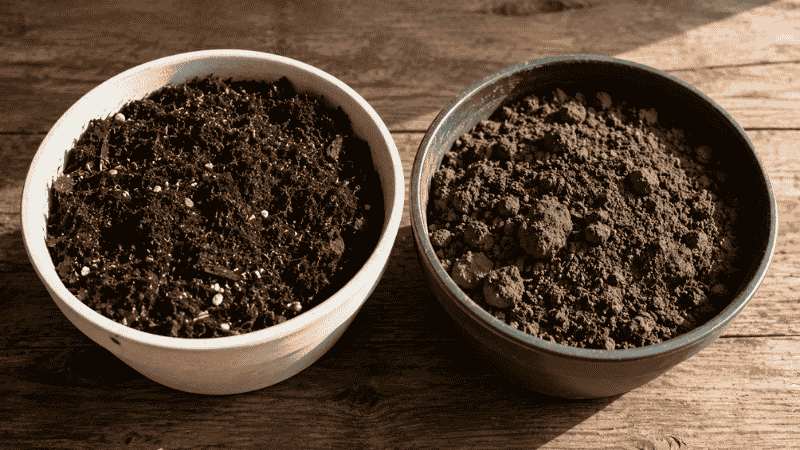
Never use garden soil in a container. Always use potting mix.
This is not a preference — it’s the difference between a plant that thrives and one that slowly suffocates. Garden soil, when placed in a container, compacts with every watering. The small pore spaces that allow water and air to move through the soil collapse under the weight, blocking drainage and starving roots of oxygen. Most plants placed in compacted garden soil in containers will decline within weeks.
Potting mix is specifically formulated for container growing. It stays loose, drains freely, provides air circulation to roots, and is lightweight enough for hanging baskets and balcony containers where weight matters.
Choosing a potting mix:
For most vegetables, herbs, and flowering plants: a standard all-purpose potting mix works well. Look for one that contains perlite (the small white particles that improve drainage and aeration) — or add perlite yourself at about 20–30% of the total volume.
For succulents and cacti: use a cactus and succulent mix, or mix standard potting mix 50/50 with coarse sand or perlite.
For moisture-loving plants (tomatoes, strawberries, basil): a potting mix with some moisture-retaining properties works well. Some mixes include coconut coir for this purpose.
Refresh soil regularly. Potting mix breaks down over time — after one full growing season, the structure begins to compact and nutrients deplete. Replace the potting mix in your containers each spring, or at least top-dress with fresh mix and compost.
Light: Match Your Plants to Your Space
Before buying any plants, spend a day watching your container garden space. Note exactly where direct sun lands at 9am, noon, and 3pm. This observation is the most valuable preparation you can do.
Full sun (6+ hours direct sun daily): Required for tomatoes, peppers, cucumbers, squash, basil, and most fruiting plants. South and west-facing balconies or patios typically provide full sun conditions.
Partial sun / partial shade (3–6 hours direct sun): Suitable for lettuce, spinach, herbs (parsley, chives, cilantro, mint), and many flowers. East-facing spaces typically fall in this category.
Shade (less than 3 hours direct sun): Very limited options for edibles — most vegetables won’t produce meaningfully. Leafy greens like lettuce may manage, but expect slow growth. Ferns, impatiens, and some ornamental foliage plants handle shade better.
The honest truth about north-facing spaces: A north-facing balcony in the Northern Hemisphere receives very little direct sun. Tomatoes, peppers, and most fruiting vegetables won’t work. Stick to leafy greens, mint, and shade-tolerant ornamentals. Fighting this reality is the most common source of container garden frustration.
Watering: The Skill That Makes Everything Work
Container plants need more frequent watering than in-ground plants. The limited soil volume in a pot dries out much faster, particularly in warm weather, in small containers, and in windy or sunny locations. In peak summer, some containers — especially hanging baskets and small pots — may need daily watering.
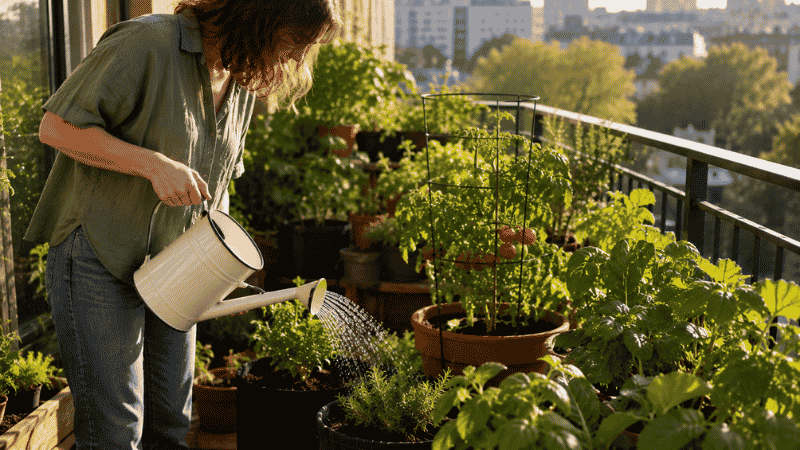
The fundamental rule: Check the soil before you water, every time. Press your finger an inch into the soil. If it’s moist, wait. If it’s dry, water thoroughly until water drains from the drainage holes.
Never water on a fixed schedule without checking the soil first. A “water every Tuesday” schedule ignores the reality that soil dries at different rates depending on temperature, wind, plant size, pot material, and season. The soil is the only reliable guide.
How to water properly: Water slowly and thoroughly — not a quick splash. You want moisture to reach the entire root zone. Stop when water flows freely from the drainage holes. Shallow watering that only wets the top inch trains roots to stay near the surface, making them more vulnerable to drying out.
Morning watering is best for most plants. It sets them up for the day’s heat without leaving wet foliage overnight (which can encourage fungal problems).
Signs you’re overwatering: yellowing leaves, mushy stems near soil level, a musty smell from the pot, soil that stays wet for more than a week.
Signs you’re underwatering: wilting that doesn’t recover after cooler evening temperatures, brown crispy leaf edges, soil that pulls away from the pot sides.
Feeding Your Container Garden
This is where many container gardeners underperform — and it’s entirely fixable.
Every time you water a container, nutrients wash out through the drainage holes. Over the course of a growing season, container plants lose nutrients at a rate that in-ground plants never experience. Without regular replenishment, a container that started strong will plateau and decline.
A simple feeding approach that works:
Before planting: mix a slow-release granular fertilizer into your potting mix. This provides a baseline of nutrients for the first 4–6 weeks.
During the growing season (spring through early autumn): apply a balanced liquid fertilizer every 2 weeks. For fruiting plants like tomatoes, peppers, and strawberries, switch to a high-potassium fertilizer once flowers appear — potassium supports fruit development and sweetness.
In autumn and winter: stop feeding. Most plants slow or stop growing in cool, shorter days. Fertilizer applied to a resting plant accumulates as mineral salts in the soil, which damages roots.
Reading the fertilizer label: The three numbers (N-P-K) represent nitrogen, phosphorus, and potassium. Balanced fertilizers (10-10-10 or 20-20-20) work well for leafy growth. Higher phosphorus and potassium (like 5-10-10) support flowering and fruiting.
What to Grow in Containers: Your Starter Plant List
Almost anything can be grown in a container with the right size pot. Here’s a practical guide to the most successful and satisfying container crops for beginners.
Herbs (The Best Starting Point)
Herbs are the ideal first container garden. They’re edible — every harvest feels useful and rewarding. They’re compact — most fit on a windowsill. They grow quickly enough to show progress within weeks.
Best beginner herbs: Basil, mint (give it its own pot — it spreads aggressively), chives, parsley, thyme, oregano, cilantro. See our full guide: [How to Grow Herbs Indoors].
Salad Greens (Fastest Results)
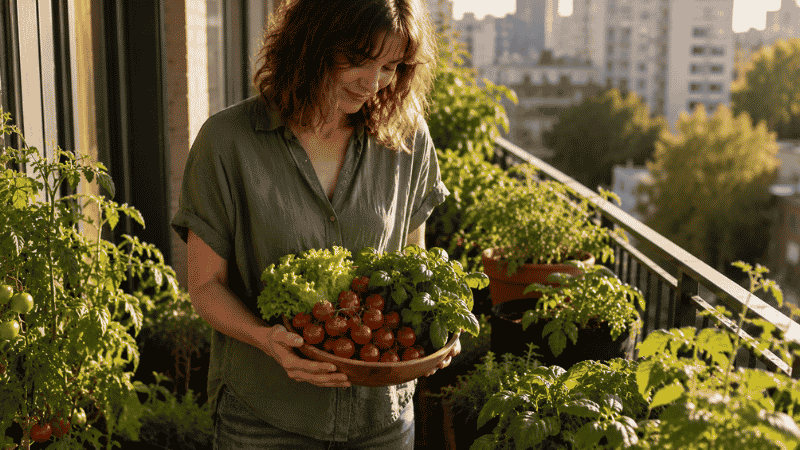
Lettuce, spinach, arugula, and mixed mesclun greens can be harvested within 30 days using the cut-and-come-again method — snipping outer leaves while the plant continues to produce from the center. A window box or balcony planter of mixed greens is one of the most productive and satisfying things you can grow. See our full guide: [Easiest Vegetables to Grow for Beginners].
Tomatoes (Most Rewarding)
Cherry tomatoes in a 5-gallon or larger container on a sunny balcony will produce abundantly from midsummer through the first frost. Choose compact varieties (Tiny Tim, Tumbling Tom, Patio) for smaller containers. See our full guide: [Growing Tomatoes in Pots].
Strawberries (Most Beautiful)
Strawberries trail beautifully from hanging baskets or planter pockets and produce fruit continuously through summer with the right variety. Everbearing and day-neutral varieties are best for containers. See our full guide: [How to Grow Strawberries in Pots].
Houseplants (Year-Round Indoor Container Garden)
Snake plants, pothos, peace lilies, and ZZ plants thrive in indoor containers with minimal care. These are the entry point for people who want greenery in their homes before moving to edible container gardens. See our guides: [Snake Plant Care] | [How to Care for Pothos].
Setting Up Your First Container Garden: Step by Step
Step 1 — Assess your light. Before buying anything, spend a day watching your space. Count the hours of direct sun at your growing location. This determines what you can grow.
Step 2 — Choose 2–3 containers. Start smaller than you think you should. Two well-maintained containers will teach you more and produce more than six neglected ones. Make sure each has drainage holes.
Step 3 — Buy quality potting mix. One bag of all-purpose potting mix is enough to get started. Don’t use garden soil.
Step 4 — Choose your plants. Match plants to your light level. If you have full sun, try herbs and cherry tomatoes. If you have partial sun, start with lettuce and herbs. If you have limited light, stick to shade-tolerant houseplants and leafy greens.
Step 5 — Plant correctly. Fill containers to within an inch of the top. Plant seedlings at the same depth they were growing in their nursery pots (or slightly deeper for tomatoes, which develop roots along buried stems). Water in thoroughly after planting.
Step 6 — Establish a check-in habit. Every morning, take 5 minutes to check your plants. Press the soil. Water if dry. Look for any signs of stress. This daily habit is worth more than any product or technique.
The 5 Most Common Container Gardening Mistakes
1. Using garden soil. Already covered — this is the single most reliable way to fail at container gardening. Always use potting mix.
2. Choosing pots that are too small. Undersized containers restrict roots, dry out too fast, and produce disappointing results. When in doubt, go larger.
3. No drainage holes. Without drainage, every watering creates standing water at the root zone. Root rot follows.
4. Watering on a schedule without checking the soil. Soil dries at different rates. Always check before you water.
5. Starting with too many containers at once. Overwhelm leads to neglect. Start with two or three containers, do them well, and expand from there.
Container Gardening Through the Seasons
Spring (March–May): The prime planting window. Start cool-season crops (lettuce, peas, spinach, herbs) outdoors. Plant warm-season crops (tomatoes, peppers, basil) indoors or in a sheltered spot after your last frost date.
Summer (June–August): Peak growing season. Water daily or every two days. Feed every two weeks. Harvest regularly to keep plants productive. Watch for heat stress in small containers — consider moving to partial shade during extreme heat.
Autumn (September–November): Cool-season crops return — lettuce, spinach, kale, and herbs all thrive in the gentler temperatures of early autumn. Clear out summer crops as they finish. Plant spring-flowering bulbs in containers for winter interest.
Winter (December–February): In cold climates, bring tender plants indoors or into a sheltered space. Hardy plants (kale, some herbs) can overwinter in protected containers. Focus on indoor container gardening: houseplants, indoor herb gardens, and planning next year’s container garden.
FAQ
What is the best container for vegetable gardening? For most vegetables, a plastic or fabric grow bag in the appropriate size is the most practical choice — lightweight, affordable, and excellent for root development. For aesthetics, terracotta inside a decorative outer pot gives you both beauty and function. Size is more important than material: choose the largest container your space allows.
How often should I water a container garden? Check the soil daily. Water when the top inch feels dry, watering thoroughly until it drains from the bottom. In summer, many containers need daily watering. In cooler months, every 2–3 days may be enough. There is no universal schedule — the soil is the only reliable guide.
Can I use the same potting mix year after year? Old potting mix compacts, loses nutrients, and can harbor disease. Replace it each spring, or at minimum top-dress with fresh mix and compost to refresh the structure and nutrients.
What can I grow in a small space or apartment balcony? Herbs, lettuce, radishes, cherry tomatoes, strawberries, peppers, and any compact variety of edible plant all do well on a balcony. Match your plant choice to your light levels — a south-facing balcony can grow almost anything; a north-facing one is better for leafy greens and shade-tolerant plants.
Do I need to fertilize container plants? Yes — more than you might expect. Every watering washes nutrients out of the soil. A slow-release fertilizer mixed into the potting mix at planting, plus liquid feeding every 2 weeks during the growing season, keeps container plants healthy and productive.
How do I know if my container garden is getting enough sun? Most vegetables need 6+ hours of direct sun. Spend a day watching your space and counting the hours of direct sunlight. If you’re consistently getting less than 4 hours, stick to shade-tolerant options like lettuce, spinach, mint, and ferns.
Can I overwinter container plants? Many container plants can overwinter successfully. Hardy herbs (thyme, rosemary, chives) often survive outdoors in protected spots. Tender plants (basil, tomatoes, peppers) need to come indoors. Perennial containers (strawberries, some shrubs) may need insulating or storing in a frost-free space. Check the hardiness rating of each plant.
A Different Way to Think About It
Container gardening changed the way I understood what a garden actually is. A garden isn’t a patch of ground — it’s a relationship between a person, a plant, and a contained piece of the world.
You can have that relationship on a fire escape. On a studio apartment windowsill. On a balcony so small you have to turn sideways to stand on it. The scale doesn’t determine the experience. The attention does.
A single pot of tomatoes, tended through a whole summer, checked every morning, watered, fed, watched through flowering and fruiting and finally harvested — that is a garden. And the food it produces will taste different from anything you’ve ever bought, not because it’s different in any measurable way, but because you made it.
Start with one pot. Go from there.
Explore the Full DirtZip Container Garden Library
Every guide below links back to this page — read the complete guides as you’re ready to go deeper:
- 🍅 [Growing Tomatoes in Pots] — the complete guide from seedling to harvest
- 🍓 [How to Grow Strawberries in Pots] — beautiful, productive, and perfect for balconies
- 🥬 [Easiest Vegetables to Grow for Beginners] — what to grow first and why
- 🌿 [How to Grow Herbs Indoors] — windowsill herb gardens that actually work
- 🪴 [How to Repot a Plant] — when your container plant outgrows its pot
- 💧 [Plant Leaves Turning Yellow?] — diagnose and fix the most common container plant problem
- 🌱 [Gardening for Beginners] — the complete beginner’s guide to everything
References: Custom Market Insights (2025). Home Gardening Market Size, Trends and Insights 2025–2034. DataIntelo (2025). Gardening Container Market Report. National Gardening Association (2023). Garden to Table: Food Gardening in America. University of Illinois Extension (2023). Container Vegetable Gardening. University of Maryland Extension (2023). Maintaining Container Grown Vegetables. Soga, M., Gaston, K.J., & Yamaura, Y. (2017). Gardening is beneficial for health: A meta-analysis. Preventive Medicine Reports, 5, 92–99.